
Spherical Roller Bearings Preventive Maintenance
Mike Sondalini, PWW EAM System Consultant
with permission of BIN95 Business Industrial Network
Posted 11/11/2025
Spherical roller bearings are popular across industries because they can take very heavy loads and are self-aligning. Their design allows them to take combined loads in both the radial and axial direction acting together.
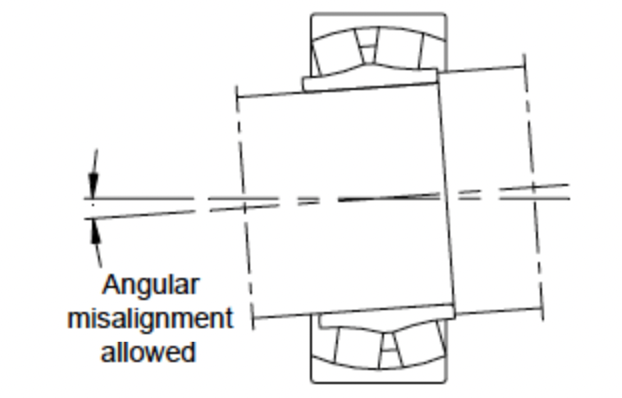
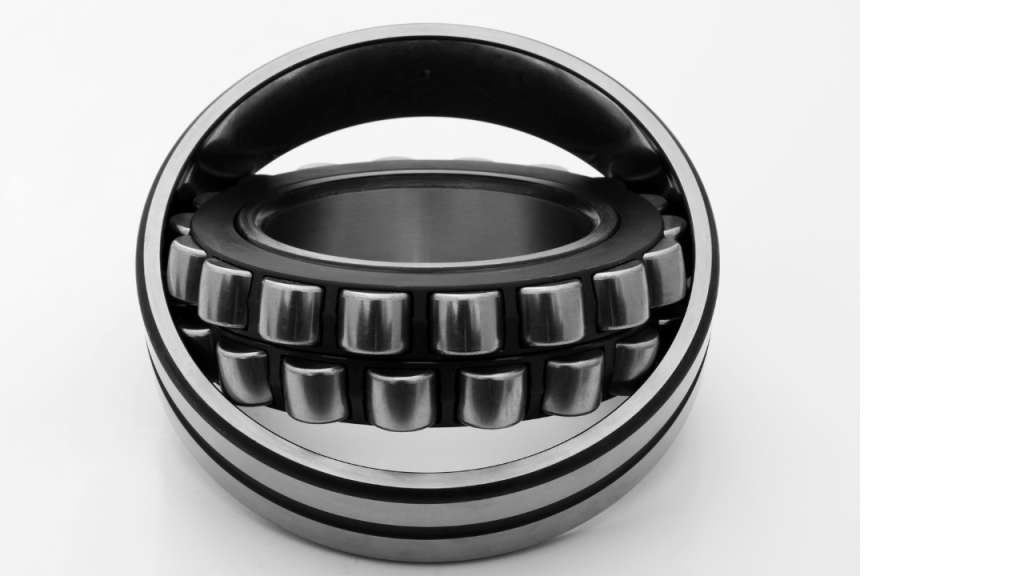
Each roller is loosely retained in place within a cage that goes full circle between the raceways. Figure 1 shows a simplified drawing of a spherical roller bearing (SRB) on a shaft under deflection.
The shape of the rolling elements gives the bearings their name. The contact surface is the curved portion of a sphere, and the curvature allows the carrying of axial loads. The axial load carrying capacity is less than that of an angular contact bearing but unlike angular contact bearings (unless paired back-to-back or face-to-face), spherical roller bearings can take axial loads in both directions.
Spherical roller bearings permit misalignment between the inner and outer races. The bearing takes up the misalignment by allowing the rollers to pivot in the raceways. Because the bearing races can rock independently, spherical roller bearings cannot resist a moment load (a load that is acting to tilt or snap the shaft). Double row angular contact or taper roller bearing can be used in such situations.
Misalignment can arise from the operating load causing bending, it can also arise when bearing housings are not machined at a single setting and from the self-load of a shaft and attached components if bearings are mounted far apart. The fact they are forgiving of slight alignment errors makes them a good selection for equipment expected to experience vibration.
For vibrating machinery (e.g. vibrating screens) the bearings are provided with an extra guide ring that runs between the rollers along their inside ends and keeps them square to the race. This center guide increases the bearings working life by reducing roller chattering on the raceways.
The bearings come with factory set internal clearances and no preload is required. Preload is the purposeful application of a force on the bearing to ensure the rollers a properly contacting the raceways. Because the clearances are factory set it is important to select the right bearing clearance for the application – especially where the bearing runs hot.
It is critical that bearings are well lubricated. SRBs can be lubricated by grease or by oil. In difficult service they will need extra attention to ensure that the lubrication is actually getting into the running area. To accommodate this, the larger sized bearings from the quality bearing manufacturers have a grease groove machined into the outside of the outer race with several grease holes through the race into the running area. Check that the bearing housing grease nipples are located directly over the grease groove.
If the bearing is oil lubricated in an oil bath, make sure the oil level always contacts the lowest roller as it comes around so the roller can splash lubricate its fellow rollers and the raceways. Do not over fill the oil bath because when the rollers come around, they will have to force their way through the oil which causes additional heat. The oil level should be no higher than midway up the most bottom roller as it comes around the raceways.
To ensure the rolling elements will actually rotate as they come into the loading zone of the bearing there must be a sufficient minimum load. Since spherical roller bearings cannot be preloaded, the load must come from the shaft and the attached components. The bearing supplier can perform calculations to confirm the in-service bearing load. If the self-load is insufficient, then an extra radial load will need to be applied. This can be by increasing belt or chain tension or purposely increasing the torque on the shaft.
Preventive maintenance of spherical roller bearings is essential to ensure equipment life and reliable performance. Regular inspection, lubrication, and maintaining the correct load and alignment conditions help prevent premature failure. By understanding the unique design and operating characteristics of these bearings, your maintenance team can improve equipment efficiency and reduce costly downtime.

Related Articles

The Cost of Producing Electricity
How Do Variable Speed Drives Impact Mechanical Seals?
How to Track Large Rotating Equipment

Suction Bell Upgrades for Vertical Turbine Pumps
Plant Numbering and Asset Identification