Engineering Precision: Sensor Technologies and Maintenance Strategies for Extreme Environments
Kristi Perkins, MBA, Sales Engineer, Emerson Measurement Solutions
Posted 2/19/2026
Introduction: Understanding Pressure and Temperature Transducers
A pressure and temperature transducer is an instrument that measures physical conditions within a system and converts it into standardized electrical signals that can be monitored, recorded, or used for control and measurement. Pressure transducers quantify the force exerted by a gas or liquid on a sensing element or sensing surface. While temperature transducers detect changes in thermal energy within a material or process. In both cases, the transducer serves as the interface between the physical world and electronic measurement systems. Often, pressure and temperature are measured in a single transducer device.
At a functional level, pressure and temperature transducers rely on sensing elements that respond predictably to pressure or temperature changes. Mechanical deformation, electrical resistance shifts, voltage generation, or capacitance changes are then translated into analog or digital outputs that allow control systems and data acquisition hardware to interpret real‑world conditions with speed and accuracy.
Different Technologies Used in Sensors and Their Suitable Applications
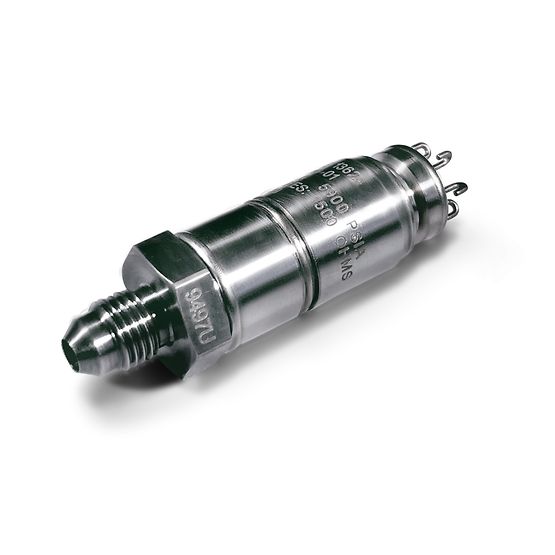
Modern pressure and temperature sensors rely on a range of underlying measurement technologies, each optimized for specific performance requirements, environmental conditions, and lifecycle expectations. Selecting the appropriate technology requires balancing pressure range, temperature limits, stability, size constraints, media compatibility, and long‑term reliability.
Tube-Type Sensing Technologies
Tube-type sensing technologies measure pressure by detecting the elastic deformation of a thin‑walled metal tube. As pressure is applied, the tube experiences a predictable strain that is converted into an electrical signal using strain gauges. The cylindrical geometry distributes stress evenly, allowing tube‑type sensors to withstand extremely high pressures.
Tube-type sensors are commonly manufactured from high‑strength alloys such as nickel‑based superalloys or stainless steels. Because the sensing element and pressure boundary are the same structure, these designs minimize leak paths and offer excellent long‑term stability. Tube-type can be analog or digital output, depending on the application.
Design Tradeoffs
Tube‑type sensors excel at very high pressures and harsh environments, but their mechanical stiffness limits sensitivity at low pressure ranges.
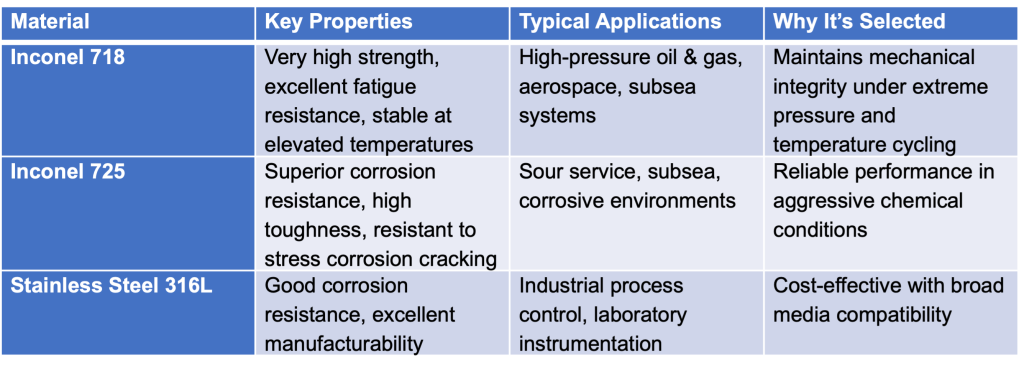
Material selection is just as critical as sensing technology, as it directly affects pressure containment, temperature tolerance, corrosion resistance, and long‑term stability.
Common Materials Used in Pressure and Temperature Transducers
Capacitive Pressure Sensors
Capacitive sensors measure pressure by detecting changes in capacitance between a flexible diaphragm and a fixed electrode. They provide excellent resolution at very low pressures.
Design Tradeoffs
Capacitive sensors are sensitive to contamination and typically require additional protection in harsh or high‑pressure environments.
Thin-Film and Strain-Gauge Technologies
Thin‑film and strain‑gauge sensors measure pressure by monitoring resistance changes in metallic films bonded to a pressure‑sensing diaphragm.
Design Tradeoffs
Accuracy can be influenced by installation stress and temperature gradients if not properly compensated.
RTDs (Resistance Temperature Detectors)
RTDs measure temperature through predictable resistance changes in metallic elements, typically platinum, and are valued for accuracy and long‑term stability.
Design Tradeoffs
RTDs have slower response times and limited maximum temperature capability compared to thermocouples.
Thermocouples
Thermocouples generate a voltage based on the Seebeck effect using two dissimilar metals and operate across extremely wide temperature ranges.
Design Tradeoffs
Thermocouples trade precision for durability and temperature range.
Maintenance of Sensors and the Associated Complexities
Even the most advanced sensors require ongoing maintenance to ensure long-term accuracy and reliability. Factors such as sensor drift, environmental exposure, and material aging all influence performance over time. To mitigate these effects, it is critical to operate sensors within the manufacturer’s specified pressure, temperature, and environmental limits, as operating beyond these boundaries can significantly reduce sensor lifespan and measurement integrity.
Best practices for maintaining sensor performance include condition-based calibration, historical data trending, and proactive lifecycle planning, particularly in applications where sensor access is limited or where failure presents high operational risk. In many industrial environments, annual recalibration is recommended; however, this is not always feasible. Sensors deployed in downhole and subsea wells, space and satellite systems, or critical industrial machinery may operate for extended periods without service access. In these cases, selecting a sensor with proven long-term stability and repeatability becomes essential.
A common mistake made in instrumentation applications is operating sensors beyond their rated pressure or temperature specifications. While this may provide short-term flexibility, it often leads to accelerated drift, permanent calibration shifts, or mechanical damage. Over time, these issues can introduce significant measurement error, ultimately resulting in reduced system performance, unplanned downtime, and potential revenue loss.
Conclusion – Pressure and Temperature Transducers
Selecting the right sensor technology and maintaining it effectively are inseparable challenges. By aligning sensing technology, material selection, specifications, and maintenance strategy with application demands, engineers can ensure reliable measurement in even the most extreme environments.
References:
Emerson. (2018). Material selection and compatibility considerations for Rosemount™ pressure transmitters (Tech. Note No. 00840-0100-3045, Rev. CB). https://www.emerson.com/documents/automation/technical-note-material-selection-considerations-for-pressure-transmitters-rosemount-en-77770.pdf
Gadepatil, S. (2025, November 27). 4 types of pressure transmitters | Working principles and key differences. Instrumentation Blog. https://www.instrumentationblog.in/types-of-pressure-transmitters/
Statler, M. (2026). Industrial pressure sensors [Blog post]. Advanced Technology Services. Industrial Pressure Sensor Types & Applications | ATS

Related Articles
What is a valve?
The 7 Secrets of Pump Reliability
A Guide to Matching Electric Motors with Hydraulic Power Units
Spherical Roller Bearings Preventive Maintenance

Gear Pump Operation and Maintenance
How do I Test Relays and Contactors?