
How do you Measure Reliability?
Tor Idhammar, CEO & President, IDCON INC
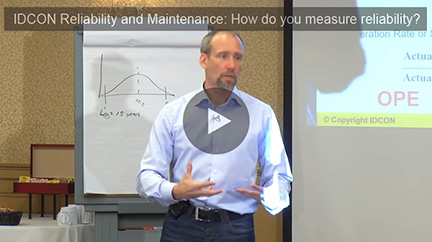
Reliability is often used by plants to define future improvement efforts and set expectations for employees and managers. Understanding how it’s defined and how to measure it can often be confusing to your organization.
This video will give you IDCON’s concept of Overall Production Efficiency.
Related Articles

Maintenance Management: The Perfect Role for Critical Thinkers
Critical thinking is essential for effective maintenance management. As a maintenance manager, you are responsible for overseeing the maintenance, repair, and replacement of equipment, machinery, and other assets. To be an effective maintenance manager, you must also be able to analyze problems, identify root causes, and develop solutions that address the underlying issues. This involves a range of critical thinking skills, such as deductive reasoning, problem-solving, and decision-making.

Happy Retirement Tim! But Don't Forget About the New Employees
Like most mature job functions, facilities management regularly face the scenario of senior employees retiring, more so than newer industries like artificial intelligence or electric vehicles. Everyone of us can related to throwing a surprise party for a fellow colleague, and then it hits us, when Tim walks out that door, along go 4 decades of knowledge. But Tim's job is done, he has earned a well-deserved retirement and it's time for new employees to take the reins.

Maintenance Crisis Song
The Maintenance Crisis Song written by Joel Leonard and Performed by Harley & the Hot Spots.
Leading Change: Why Transformation Efforts Fail
Over the past decade, I have watched more than 100 companies try to remake themselves into significantly better competitors. They have included large organizations and small ones, companies based in the United States and elsewhere, corporations that were on their knees, and companies that were earning good money. These efforts have gone under many banners: total quality management, reengineering, right sizing, restructuring, cultural change, and turnaround. But, in almost every case, the basic goal has been the same: to make fundamental changes in how business is conducted in order to help cope with a new, more challenging market environment.

Creating a Culture of Manufacturing Reliability
To create a reliable manufacturing culture, you must agree to work in a close partnership between operations and maintenance, including stores and engineering. This should start with a common manufacturing mission that clearly expresses this. Then you need to design and implement all work management processes with the agreed upon mission statement as a guideline.

Reducing Maintenance Costs in a Tough Economic Climate
The current economic climate dictates that cost management is a critical activity for many companies and their managers. Maintenance is very often seen as an area where cost cutting targets can be easily and quickly achieved. Many maintenance managers take the view that this type of philosophy always ends up with increased costs in the future. This is not true in many cases. 15 years of analysis and review of maintenance programs by the author shows that most maintenance departments are more reactive than they should be and because of this, they over spend and underperform.

How to Fix the 70/30 Phenomenon
When you ask front line supervisors or team leaders if all people in their teams are performing to the same standards or if some are doing more work and achieving more results than others, you will often get the same answer. All over the world, the most common answer, after some analysis, verifies that about 30% of the people do 70% of the work.