Metal stress causes failure. Too much metal stress will cause it to fail. Failure can occur by putting the metal under a once-only load greater than it can take or by metal fatigue from continually loading the metal cyclically with a high load less than the breaking load. Stress produces strain at the molecular level in the metal and discontinuities between atoms come together to form microscopic cracks. Under continued stress the cracks grow and eventually the metal parts.
Stress and Strain in Materials Under Loads
Stress occurs when forces pull (tension), push (compression) or act in combination on a material. When a force is applied the material reacts by distorting to counterbalance the force.
A greater force will cause a correspondingly greater distortion until the item breaks.
Stress is the force applied per unit of cross-sectional area square to the force.
Formula: Stress (σ) = Force / unit of area
Metric system units are Newton per square meter (N/m2) and imperial system units are pounds per square inch (psi). Strain is the amount the material deforms from the unloaded state when the force is applied.
Formula: Strain (ξ) = Change in length / original length
Strain has no units, as it is a ratio of length divided by a length. It represents a proportional change in size. When a force is applied to a metal deformation occurs and it is strained. The more the force – the more the deformation (strain). This relationship is recognized in Hooke’s Law and is shown in Figure 1 for two types of metals.
Figure 1: Graphs of Hooke’s Law
Figure 1 indicates that metals have an elastic region where load and strain are proportional (a straight line on a graph). In this region the metal acts like a spring and when the load is removed the deformation (strain) reduces and it returns to its original shape. If instead the load increases, the strain (deformation) rises until a point is reached where the metal can no longer sustain the load and it yields. The yielding can be gradual as in the left-hand plot of Figure 1 or it can be sudden as in the right-hand plot.
The aim of much of the work in metallurgy is to discover how to extend the yield point further because in doing so we can fabricate items using thinner metals for less cost.
At the Molecular Level
The behavior of metals under load is a result of their atomic arrangement. When a material is loaded it deforms minutely in reaction to the load. The atoms in the material move closer together in compression and further apart in tension.
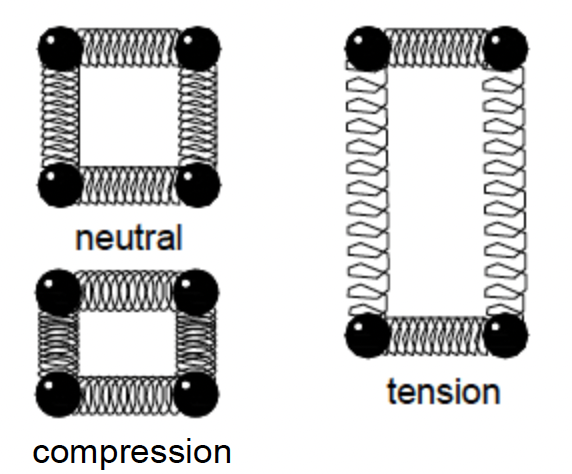
Consider the atomic bonds as being springs separating the atoms as shown in Figure 2. The springs are squeezed together in compression and pulled when in tension. The amount an atom moves from its neighbor is its strain as a force is applied the atoms change a proportionate distance.
Figure 2: Atomic movement under applied strain
This model however, does not explain why there is sudden yielding. With most modern metals yielding usually occurs at about 1% of the theoretic strength of the atomic bonds. Many materials yield at about 0.1% of the theoretic strength.
The reason metals have such low strengths is because of imperfect atomic structures in the crystal lattices which make them up. Often a row of atoms will stop mid-crystal and a gap is created in the atomic structure. These gaps act as huge stress raising points known as dislocations.
Effect of Applying Loads on a Material
A load applied to a metal is distributed along the atomic rows in the crystals. At the end of the rows forming dislocations the force is transferred to the bonds with neighboring atoms. Fewer bonds now carry greater loads and eventually fail as the force increases. As each atomic bond is broken and then remade with the next atom the dislocation moves an atom. Eventually the dislocation makes its way to the outside of the crystal. If sufficient dislocations accumulate at the crystal boundary the crystal separates from its neighbor.
Conclusion
Understanding how stress affects metals is essential to preventing premature equipment failure. While metals are designed to withstand significant loads, repeated or excessive stress can cause deformation, fatigue, and microscopic damage that eventually develops into a failure. By understanding how stress and strain behave at the material level, maintenance and engineering professionals can better recognize potential failure mechanisms and take steps to reduce them.
Managing metal stress is ultimately about protecting the integrity and service life of the equipment. Proper material selection, sound design, appropriate operating conditions, and maintenance practices that identify and address excessive loading can all help prevent small defects from becoming major failures.
Mike Sondalini
Mike Sondalini is a Senior Consultant at PWWEAM System-of-Reliability. BEng(Hons), MBA, CPEng. As a consultant and trainer, Mike was able to present his insights to his clients, suggesting innovative approaches to plant and equipment reliability. Their feedback was resoundingly positive. Efforts which earned him an international reputation for articulate, out-of-the-box articles on plant and equipment reliability, life-cycle EAM, maintenance management, work quality assurance, and team building. After decades of dedicated research, Mike authored “Industrial Manufacturing Wellness: The Complete Guide to Successful Enterprise Asset Management” a revolutionary approach on how maintenance and physical asset management systems should be run, the book detailed who, what, where, when, why, and how outstanding reliability could be achieved. Each step based in scientific and mathematical understanding to ensure repeatability of results and optimal outcomes.
The chart shows approximate pressure drops which may be expected at various flows rates through sharp edge orifices for petroleum type hydraulic oil. It may be used for designing limiting flow orifices in hydraulic systems. Chart values must be considered as approximate because a number of factors such as specific gravity, orifice efficiency, plumbing ahead of and behind the orifice may cause variations from the values shown.
The chart shows approximate pressure drops which may be expected at various flows rates through sharp edge orifices for petroleum type hydraulic oil. It may be used for designing limiting flow orifices in hydraulic systems. Chart values must be considered as approximate because a number of factors such as specific gravity, orifice efficiency, plumbing ahead of and behind the orifice may cause variations from the values shown.
Most of us who have spent time in the lubrication field have been told that it takes only a small amount of water (less than 500 ppm) to substantially shorten the service life of rolling element bearings. There is indeed a vast amount of research that supports these assertions. Being a career-long crusader of clean and dry oil, I will certainly not argue the contrary. In fact, water's destructive effects on bearings can easily reach or exceed that of particle contamination, depending on the conditions. Water can even cause bearing failure.
Most of us who have spent time in the lubrication field have been told that it takes only a small amount of water (less than 500 ppm) to substantially shorten the service life of rolling element bearings. There is indeed a vast amount of research that supports these assertions. Being a career-long crusader of clean and dry oil, I will certainly not argue the contrary. In fact, water's destructive effects on bearings can easily reach or exceed that of particle contamination, depending on the conditions. Water can even cause bearing failure.
Non-leak pumps have been the dream of pump designers ever since the first pump was invented back in the dark ages. We all want a non leaking pump for the obvious reasons. Because of this desire there are a number of companies willing to supply just about any kind of "Voodoo" you are looking for. Let's take a look at the non seal pump subject and see if this type of pump make sense in your application.
Non-leak pumps have been the dream of pump designers ever since the first pump was invented back in the dark ages. We all want a non leaking pump for the obvious reasons. Because of this desire there are a number of companies willing to supply just about any kind of "Voodoo" you are looking for. Let's take a look at the non seal pump subject and see if this type of pump make sense in your application.
Electric motor problems. This article presents a basic explanation of electric motor construction and operation along with twelve problems that can be encountered with their use. Most electric motors in industrial equipment are three phase alternating current induction motors. Induction is the creation of an electric current across a gap. Two types of induction motors are commonly used: squirrel-cage and wound- rotor. The names come from the way they are built.
Electric motor problems. This article presents a basic explanation of electric motor construction and operation along with twelve problems that can be encountered with their use. Most electric motors in industrial equipment are three phase alternating current induction motors. Induction is the creation of an electric current across a gap. Two types of induction motors are commonly used: squirrel-cage and wound- rotor. The names come from the way they are built.
On the design of a new machine which is to be run with a hydraulic motor, a determination of required speed and horsepower must be made so a model with suitable ratings can be selected. This article describes several methods of making such a determination. Designers who are experienced only in selecting electric motor drives need to be careful in designing hydraulic drives because of important differences between these two motors.
On the design of a new machine which is to be run with a hydraulic motor, a determination of required speed and horsepower must be made so a model with suitable ratings can be selected. This article describes several methods of making such a determination. Designers who are experienced only in selecting electric motor drives need to be careful in designing hydraulic drives because of important differences between these two motors.
Pneumatic directional control valves and cylinders are most commonly used in power circuits, with the valves controlling cylinders that, in turn, provide work. As we learn about a few of these circuits, other accessory valves will be introduced, along with some interesting ways of using them.
Pneumatic directional control valves and cylinders are most commonly used in power circuits, with the valves controlling cylinders that, in turn, provide work. As we learn about a few of these circuits, other accessory valves will be introduced, along with some interesting ways of using them.