

Prevent Corrosion During Boiler Downtime
A Review of Major Corrosion Issues in Industrial Boiler and Condensate Systems – Part 5
Brad Buecker, SAMCO Technologies
Posted 9/10/2026
Introduction
In previous installments, we examined several critical corrosion mechanisms that can occur during normal boiler operation and downtimes. This article focuses on the latter issue, corrosion during boiler downtime, and particularly where steam generators and auxiliary equipment are not protected from the effects of air in-leakage. Most of us are familiar with rusting outdoor objects that we see in everyday life, but allowing industrial equipment to remain full of water, or even with just some standing water, without proper protection, is a recipe for severe corrosion.
Part 1, Part 2, Part 3, Part 4
Air In-Leakage, the Primary Problem
Consider the following extract from an article that a power industry colleague and I prepared a number of years ago.
Both conventional and heat recovery steam generators are a complex maze of waterwall piping, superheater tubing, boiler drums [and headers], and other equipment. When a unit is taken offline due to reduced load requirements or other issues, the water inside the boiler circuits contracts in volume. This volume reduction induces a slight vacuum within the system, which in turn draws in outside air. Now, a stagnant condition with oxygen saturation, especially at air-water interfaces, has been established. 1
This is a prime example of localized corrosion, where the attack may cause through-wall penetration of metal in a short period of time.
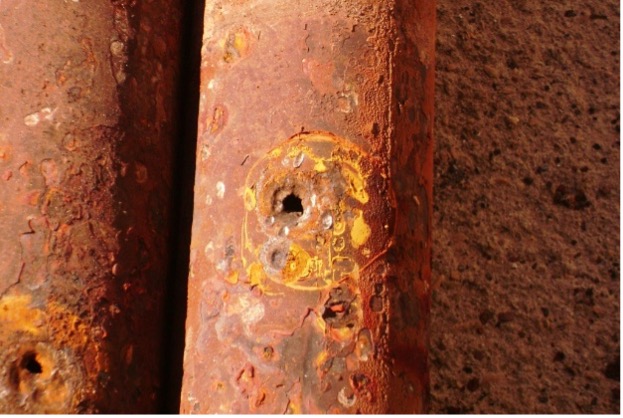
The key approach is to minimize or prevent oxygen-containing water from contacting metal, and especially carbon steel. This article provides a brief overview of long-standing corrosion control methods, and it discusses a relatively modern development that offers alternatives in many situations.
What Type of Layup Is It?
A critical factor in selecting the best layup procedure is the length of the planned shutdown. Reference 2 provides the following description.
- A short-term shutdown involves periods extending overnight or through a weekend. This shutdown period is typical of cycling operation and utilizes a wet layup or hot standby approach. Wet layup. . .. can be effective for months, if properly implemented and maintained.
- An intermediate shutdown is longer than a weekend and up to one week. This duration typifies a shutdown for minor equipment repairs. Either wet or dry approaches can apply.
- A long-term shutdown is one extending from a few weeks to six months. Such outages can involve major equipment repair, a planned outage, or a long-term layup due to system load requirements. It could also include “mothballing” a unit. Both wet and dry approaches can apply, but if return-to-service timing is not an issue, totally dry layup is preferred for extended outages.2
Two ideas from this list particularly stand out for the following discussion, “wet layup. . .. can be effective for months, if properly implemented and maintained” and “return-to-service timing.”
When I started in the power industry in the early 1980s, base load operation was common at most plants, with an (approximately) month-long, annual outage during the early spring for maintenance. Often, these planned outages would require boiler draining for tube repairs. If a boiler is drained “cold,” water can remain standing in some areas. Accordingly, procedures often called for draining when the boiler pressure had decayed to 25 psig.2 The water temperature at this pressure is 267o F, which induces flash drying in the circuits. Other equipment such as deaerators, feedwater heaters, the condenser hotwell, etc., could be drained at the same time to utilize their own residual heat for drying. As a further safeguard against corrosion, the procedures suggested applying a nitrogen blanket to the boiler and auxiliary equipment once draining began to place metal surfaces under an inert atmosphere. This latter procedure did not become exceptionally popular, at least in this author’s experience, due to the expense for equipment installation, couple with safety issues regarding a nitrogen atmosphere within confined spaces. (Nitrogen, of course, is not toxic – our atmosphere has a 78% concentration – but it is an asphyxiant.)
Shorter outages presented a different story, whose overall layup complexity has been magnified by current practice in which the many combined cycle plants with accompanying heat recovery steam generators (HRSGs) operate in a load-following mode to cover the variable output from renewable sources such as wind and solar. Reference 1 outlined a classic case where the two combined cycle units would be offline overnight or perhaps for a day or two, but whose HRSGs had to remain full to be available for startup on short notice. Plant personnel addressed three major corrosion issues, two oxygen related, with the following equipment modifications.
- Installation of an on-site nitrogen generating system (producing 99.5% pure nitrogen) such that a nitrogen “cap” could be placed on the HRSGs with the units still containing the normal level of water. The cap minimizes air ingress and does not impede immediate startup.
- Installation of a makeup water de-oxygenation unit that lowers the dissolved oxygen concentration to around 10 parts per billion (ppb) in fresh makeup water. This reduces corrosion when topping off or filling a cold unit.
- Installation of a dehumidified air (DHA) unit to circulate warm, dry air through the low-pressure stage of the steam turbines. (The topic is beyond the scope of this article, but perhaps I can discuss the issue in a future article for Maintenance World.)
Each of these systems has performed the required duties quite well.
Now, let’s turn our attention to a situation that often arises for steam generators and many other equipment items, the need for intermediate- to long-term wet layup, which allows a unit to be started quickly without having to fill vessels, pipes, boilers, etc. Long-time procedures called for adjusting pH and, in many cases, injecting an increased dosage of an oxygen scavenger/reducing agent just prior to shutdown to mitigate the effects of air in-leakage. Rather than review those details, we will focus on a more modern technology that is gaining broad acceptance.
Vapor Phase Corrosion Inhibitors
The late cooling water expert, Paul Puckorius, would stress in his training classes that the purpose of chemical treatment programs is to “protect metal surfaces.” This tenant applies to many applications besides cooling water. A class of compounds that has rapidly evolved in recent years is vapor phase corrosion inhibitors (VpCI or VCI). Reference 3 sums up the potential benefits quite succinctly.
Unlike desiccants or nitrogen blanketing, which only seek to remove elements (e.g., moisture or oxygen) that cause corrosion problems, VCIs actively protect the metal from reacting with corrosive elements by forming a protective molecular layer on the surface of the metal. This light, but not permanent, bond is called adsorption and takes place after the corrosion inhibiting molecules have diffused throughout the boiler enclosure by vapor action. Such a characteristic also means they are able to reach surfaces where it would be difficult to apply a coating or otherwise get access. . .. VCIs are also advantageous for wet layup, because they work in multiple phases, protecting metal surfaces below and above the water level.3

The reader will note that in the sample with a 98% nitrogen atmosphere, enough oxygen is present to cause noticeable corrosion. As this illustration suggests, in units that have nitrogen blanketing for protection, loss of nitrogen from a nitrogen generator malfunction or other difficulty could allow air infiltration that establishes corrosion cells. VpCIs release volatile products that migrate throughout systems and adsorb on metal surfaces, even in remote locations. From initial formulations that protected carbon steel, new compounds have been developed that protect a variety of other metals and, if need be, in atmospheres apart from air. Some of these other applications include:
- Equipment that has been hydrotested, but where the water must remain in the system for an extended period of time before unit startup.
- Cooling systems
- Specialty manufacturing such as the electronics industry
- Infrastructure, including protection of rebar in concrete
With VpCIs in place, water systems can usually be started up immediately, as the safe and non-hazardous compounds will wash out or escape as vapor during ramping up process.
Conclusion – Corrosion During Boiler Downtime
This installment briefly touches the surface (pardon the pun) of corrosion inhibition during steam generator shutdowns, but it hopefully emphasizes the importance of proper chemistry control at these times. Boiler tube or other equipment failures from offline corrosion can manifest itself many times over and cause huge problems. Beyond the issues listed above, the attack generates corrosion products that travel to boilers and precipitate on waterwall tubes and other internals. These deposits reduce heat transfer (which can cause tube overheating), and they serve as sites for under-deposit corrosion, yet another example of localized attack.
Disclaimer
The examples presented so far in this series illustrate that corrosion can manifest itself in many forms, and that plant personnel need to directly consult with technical experts regarding selection and operating parameters for programs at their facilities.
References
- Buecker, B., and Dixon, D., “Combined-Cycle HRSG Shutdown, Layup, and Startup Chemistry Control”; Power Engineering, August 2012.
- Mathews, J., “Layup Practices for Fossil Plants”; Power, February 2013.
- Holmquist, J., “Avoiding Long- and Short-Term Effects of Corrosion During Boiler Layup and Startup”; Contractor, May 4, 2026.
- Bryan, S., “Layup Protection with Vapor Phase Corrosion Inhibitors (VpCI), presented at the 43rd Annual Electric Utility & Cogeneration Chemistry Workshop (now co-located with Power-Gen International), POWERGEN 2026, January 18, 2026, San Antonio, Texas.

Related Articles


A Simple Fault Finding Technique

Best Practices for Preventive Maintenance on Unit Heaters

Pump Reliability: Mechanical Seals - Small Component, Big Impact
Proactive Maintenance for Hydraulic Cylinders