

Controlling White Rust Corrosion in Cooling Towers and Cooling Systems
Brad Buecker, SAMCO Technologies
Posted 10/6/2026
Introduction
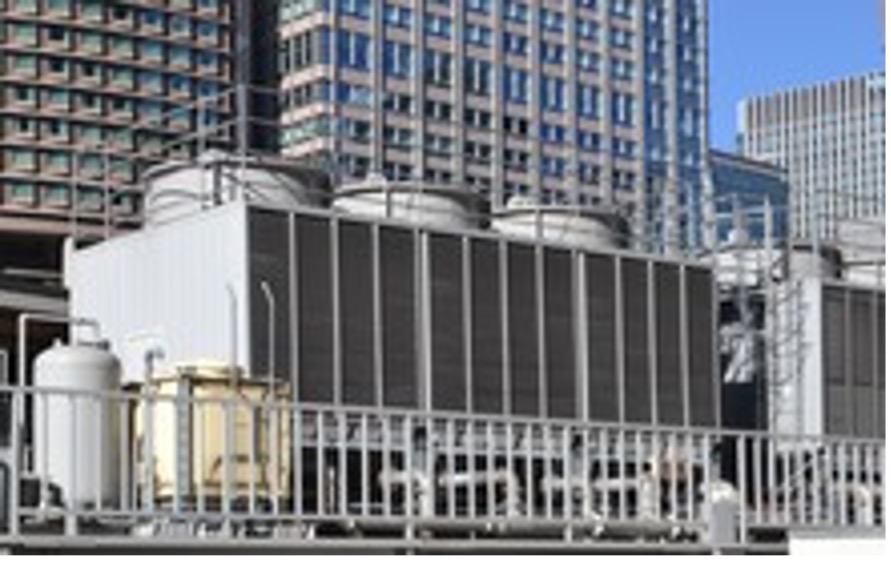
The benefits of coating steel with zinc (galvanizing) to protect the steel from corrosion were discovered as far back as 1732.1 Over time, of course, improved galvanizing methods evolved, and galvanized steel has become common for many applications. Included in these are small and moderately-sized cooling towers for commercial facilities, light industrial plants, and some unit operations at heavy industrial plants.
This Photo by Unknown Author is licensed under CC BY-SA-NC
Modern galvanizing methods impart a tight, uniform layer on steel surfaces. When placed in service, the outer surface will develop a passivated layer that protects the metal underneath. However, if the galvanized steel is not conditioned properly before startup, a different, non-protective oxide layer (white rust) may develop.
White Rust
A technical bulletin issued years ago by the Cooling Technology Institute (CTI) outlines details for conditioning new galvanized towers.2 The following discussion includes excerpts from this document.
It has been observed that under most normal cooling tower operating conditions, HMG [heavy mill galvanized] steel provides excellent corrosion resistance. When galvanized steel is exposed to a neutral pH, moderately hard water environment (example range: minimum 100 [parts-per-million] ppm calcium as CaCO3, bicarbonate alkalinity of 100-300 ppm as CaCO3, and pH 7.0 to 8.0), a surface barrier of non-porous zinc carbonate/zinc hydroxide believed to be 3Zn(OH)2∙ZnCO3∙H2O forms to prevent further rapid galvanic corrosion of the zinc coating.2
The document goes on to state that white rust, which is a different form of zinc carbonate, “refers to a type of corrosion product [that is] an accumulation of white, fluffy, or waxy non-protective zinc corrosion product, [which] will form rapidly in new galvanized steel cooling towers if operated with the cooling water in an unfavorable chemical condition.” 2
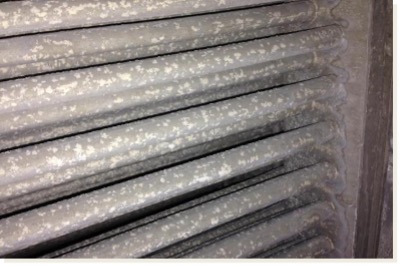
Once established, the corrosion can continue and eventually cause major problems.
White rust may be prevented by several methods including most prominently:
- Pretreatment with an inorganic phosphate passivation program (requires a minimum of 100 ppm calcium as CaCO3 and 400-450 ppm PO4.
- Operating with the cooling water initially for 45-60 days in the pH range of 7.0-8.0, moderate hardness levels of 100-300 ppm as CaCO3, and alkalinity levels of 100-300 ppm as CaCO3.2
The document includes the following table regarding recommended normal operating conditions.
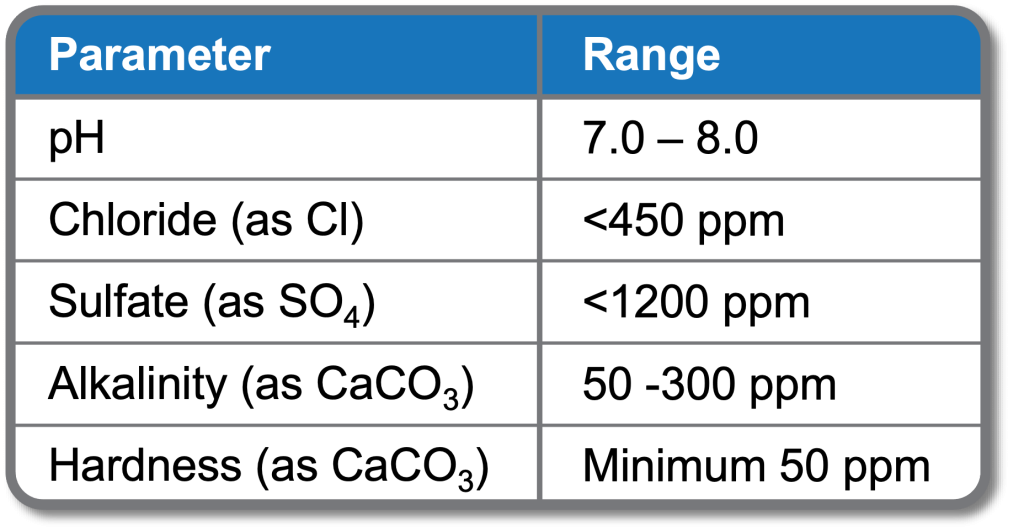
But the recommended pretreatment steps and normal operating conditions lists above can be complicated for a variety of reasons.
- Phosphate programs have been utilized extensively over the years to passivate carbon steel and other metals (including the lead in old municipal potable water lines). However, growing concern regarding the effects on the environment of phosphorus discharge in wastewater are increasingly limiting use of phosphates for industrial water treatment programs.
- Conditioning the galvanized metal for 45-60 days with water in the proper chemistry ranges requires careful planning. It could very well mean having cooling system pumps and chemical feed systems fully installed and operating long before actual plant operation.
- Regular operation per the guidelines shown in Table 1 could be problematic in some cases. The principal method of cooling in a tower comes from evaporation of a small amount of the circulating water. Evaporation increases the dissolved (and suspended solids) levels in the circulating water, known as the cycles of concentration (COC). COC is controlled by blowdown of some of the circulating water, and a common COC range in industrial towers is 4 to 6 but may be higher or lower depending on conditions.4 Rigorous monitoring and chemistry control may be particularly important in galvanized towers. Other examples of potential COC-induced corrosion effects, apart from galvanized issues, include; high chloride concentrations can cause pitting of some stainless steels such as those used in steam surface condensers; sulfate can attack mild grades of concrete, a typical industrial cooling tower basin material.
These examples highlight the importance of careful project planning and consultation with a reliable water treatment chemical company to develop effective pre-conditioning and operational chemistry programs. In some cases, supplemental raw water treatment may be needed to condition the makeup for use in the cooling tower (whether or not it has galvanized materials) to not only prevent corrosion but also scale formation and deposition of suspended solids.5 And, of course, reliable biocide feed systems should be in place to control microbiological fouling.
Conclusion
For readers wishing to study additional details on cooling towers and cooling water corrosion issues, excellent resources are the CTI (www.CTI.org) and the Association for Materials Protection and Performance (www.AMPP.org), formerly known as the National Association of Corrosion Engineers (NACE).
References
- History of Galvanizing And Galvanized Steel – SteelPRO Group
- Cooling Technology Institute, “Treatment of Galvanized Cooling Towers to Prevent White Rust”; CTI – Guideline ESG-142 (94).
- Post, R., Buecker, B., and Shulder, S., “Power Plant Cooling Water Fundamentals”; pre-conference seminar to the 37th Annual Electric Utility Chemistry Workshop, June 6, 2017, Champaign, Illinois.
- Buecker, B., and Aull, R., “Cooling Towers: A Critical but Often Neglected Plant Component – Part 1”; Chemical Processing, October 2024.
- “An Industrial Facility’s Guide to Cooling Tower Water Treatment”; Technical Publication – SAMCO Technologies (www.samcotech.com).

Related Articles


Root Cause Prevention Principles for Boiler Protection from Water-Side Corrosion and Scale Formation