

Guided Growth: Mentoring Humans and Humanoids in Complex Systems
Ahmed Rezika, SimpleWays OU
Posted 6/9/2026
In a brake repair shop, it begins with simple tasks. Removing parts. Cleaning components. Observing how experienced hands move. Over time, the newcomer starts to feel the work, not just follow steps. Awareness builds slowly. Judgment follows later.is t
In a multi-brand workshop, the path is wider but no less gradual. Different cars, different issues, yet the same principle applies. You start with what is manageable. You grow into what is complex.
Even in software, whether in a small company or a large organization like Meta, no one begins with full ownership. You fix small things. You learn the system piece by piece. The horizon expands with time.
This is normal because no one absorbs the full picture in a few weeks or even a few months.
But here is one problem, many newcomers stay small. They learn tasks but not connections. They execute but do not always understand. They become efficient in a narrow space yet disconnected from the wider system around them. This is considered a problem as that is how silos are formed. And it does not happen because people lack capability. It often happens because the system does not help them see beyond the task.
Even today, as we start speaking about robot colleagues and humanoids entering real work environments, the same principle applies. Any new system, human or machine, will begin with limited scope. It will learn through guided exposure. It will need boundaries, feedback, and structured growth.
The difference is that with machines, we are forced to be explicit. We define roles, constraints, expected outputs, and validation steps. We design their on-boarding carefully.
With humans, it often seems less consistent. Many workplaces assume they will “pick it up.” In reality: Some do, some do not.
While some newcomers arrive with visible curiosity, others take longer to engage. Not because they are less capable, but because something in the environment either activates that curiosity or leaves it dormant.
This is where mentoring becomes critical.
A mentor is not there only to transfer tasks. A mentor connects the dots. They help the newcomer see where the work fits, why it matters, and how it evolves. They guide those who are curious, and they create curiosity where it is missing.
In a world moving fast toward digitization and AI-supported work, this becomes even more important. The expectations are rising towards what tech offers and this is supported by the claims about the tools evolving and systems capabilities expanding.
But the starting point remains the same: Every newcomer starts small—even humanoids.
The real question is whether we design the journey that helps them grow beyond this small starting point.
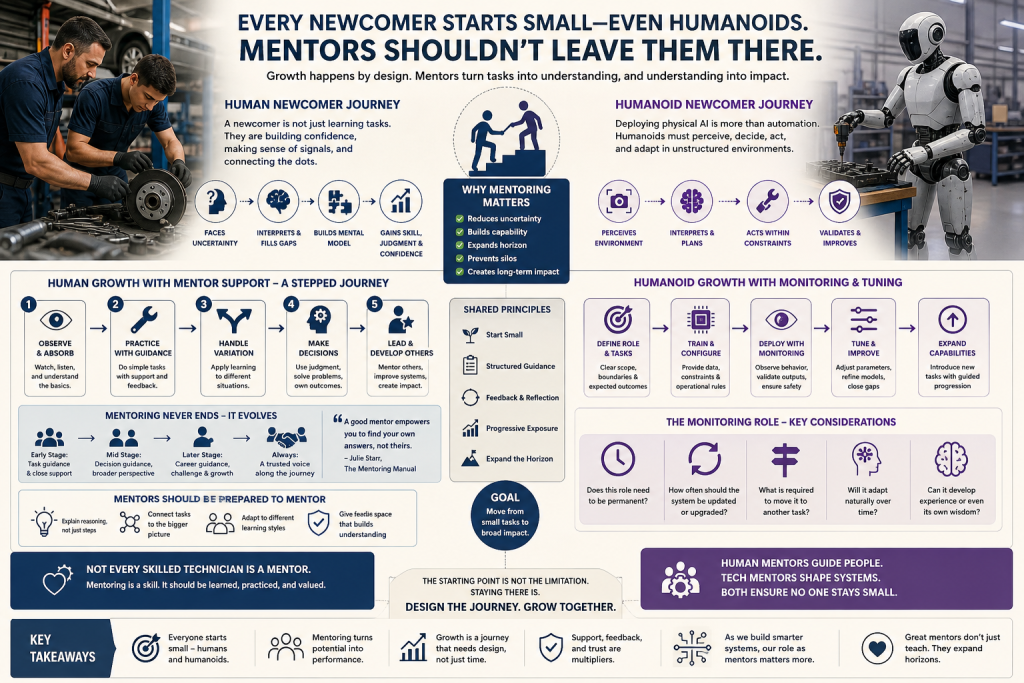
The Weight of Starting Small
Every newcomer carries an invisible load on day one.
When a newcomer enters a new environment, they are not only acquiring skills. They are building a mental model of how things work. The Zone of Proximal Development (ZPD) [1] is an educational concept introduced by Soviet psychologist Lev Vygotsky in the early 1930s. It refers to the difference between what learners can do independently and what they can achieve with guidance or collaboration from others, such as adults or more knowledgeable peers.
This “zone” represents a critical area for skill development, where tasks are challenging yet achievable with support, fostering growth and learning. Similarly, Etienne Wenger work on Communities of Practice [2] emphasized that learning happens through participation in a community, not in isolation. A newcomer learns by engaging with others, observing, asking, and gradually becoming part of the practice. This means onboarding is not a transfer of instructions. It is a structured process of guided participation, where meaning, confidence, and capability grow together. How do this look in a humanoid world?
This effort is often underestimated.
And it is not limited to humans. As industries move toward deploying interactive humanoids—not traditional fixed robots, but mobile systems expected to operate in human environments—the burden shifts but does not disappear. Leaders like Jensen Huang of NVIDIA have emphasized that bringing physical AI into real-world operations is far more complex than digital intelligence alone. Understanding environments, handling variability, and interacting safely with tools and people introduce a different level of challenge. In both cases, human or humanoid, the starting point is the same: limited understanding, high uncertainty, and the need for guided learning.
The Human Burden: Making Sense Under Uncertainty
A human newcomer steps into a system full of signals, most of them unspoken.
Instructions may be partial. Expectations may be implied. Standards may vary between individuals. The newcomer must interpret all of this while trying to perform correctly. This creates cognitive load. It also creates hesitation. As John Sweller [3] explains through cognitive load theory, learning becomes harder when too many unknowns compete for attention. Without structure, the brain spends energy just trying to understand the situation, leaving less capacity for actual skill development.
This is why some newcomers appear confident while others seem withdrawn. It is not always about capability. It is about how they manage uncertainty.
Research from Amy Edmondson on psychological safety [4] shows that people are more likely to ask questions and learn effectively when they feel safe to do so. Without that safety, newcomers often remain silent, even when confused. Silence then gets mistaken for understanding. Much of human learning happens through observation, imitation, and gradual confidence-building. This explains why shadowing alone is not enough. Without explanation and feedback, observation can lead to incomplete or incorrect mental models.
Over time, if clarity is not improved, people begin to rely on shortcuts. They develop habits based on what seems to work, not necessarily what is correct. This is where execution drift begins—not from negligence, but from accumulated assumptions.
Reducing this burden does not mean simplifying the work. It means structuring the learning environment so that understanding can grow with confidence.
The Humanoid Burden: Operating Without Assumptions
A humanoid system entering the same environment faces a different, but equally demanding challenge.
It cannot rely on assumptions.
Humans constantly use context, intuition, and past experience to fill gaps. A humanoid must instead interpret everything explicitly. It must perceive objects, understand spatial relationships, recognize tools, and execute tasks within constraints that may change from one moment to another. This is what makes physical AI fundamentally different from traditional automation. This idea was introduced through “Sony” in the movie “I, Robot” since 2004. It was speaking about the coexistence of human and robots in the everyday life by the year 2035. We are now closer to 2035 in time and probability.
As Jensen Huang has pointed out, moving AI from digital environments into the physical world introduces layers of complexity related to perception, reasoning, and action. Similarly, Elon Musk has emphasized that building humanoid robots is not just about intelligence, but about safely interacting with the unpredictable physical world.
Unlike industrial robots that operate in fixed, repeatable conditions, humanoids must deal with variability. Tools may not be in the same place. Components may differ slightly. Environments may change. Humans handle this variability naturally. Machines must be explicitly guided through it.
This is where structured learning/training/programming becomes essential.
Without: Clear roles, Defined tasks, Explicit constraints, Measurable outcomes, and Continuous validation the system cannot operate reliably.
In a way, the humanoid exposes a truth that has always existed.
What humans handle through experience and intuition must be defined explicitly for machines.
And that raises an important reflection. Either we invest this level of clarity and structure to teach machines to be reliable, or we expect similar or more complicated human-newcomers’ problems.

Mentors Shape the Journey, Not Just the Task
Onboarding does not succeed by structure alone.
It succeeds through people who guide that structure.
A mentor is more than just an experienced worker assigned to a newcomer. A mentor acts as the bridge between the individual and the organization, translating tasks into meaning and experience into learning. Without that translation, onboarding feels mechanical; with it, onboarding becomes genuinely developmental.
This role becomes even more critical as environments grow more complex. Whether guiding a human newcomer or shaping the behavior of a humanoid system, mentoring defines how learning unfolds, how mistakes are handled, and how capability expands over time.
Human’s Mentors: Reading, Guiding, and Activating Learning
A human mentor does more than explain steps. They read the person in front of them.
Some newcomers arrive asking questions. Others stay quiet. Some connect ideas quickly. Others need repetition and reassurance. Treating them the same way limits both. That’s why adaptation is a key skill for effective mentoring.
As David Kolb [6] showed in experiential learning theory, people learn through cycles of doing, reflecting, and adjusting. A mentor supports this cycle by not only showing what to do, but by helping the newcomer reflect on what happened and why. Without reflection, experience does not become learning.
At the same time, Carol Dweck [7] highlighted the importance of a growth mindset. When newcomers believe they can improve, they engage more deeply. Mentors play a key role here. They frame mistakes as part of learning, not as failure. This keeps curiosity alive, especially for those who may not show it immediately.
This is where our earlier point becomes important. Not all newcomers arrive with visible curiosity. Some need it to be activated.
A skilled mentor senses this and adjusts. They ask questions. They create safe moments for exploration. They connect small tasks to larger meaning. Over time, this builds confidence, and confidence often unlocks curiosity.
Without this, on-boarding may produce compliance but with it, on-boarding produces understanding.
Humanoid Mentors: Designing Learning Through Structure and Feedback
A humanoid system will not have a mentor in the human sense. But it will still be guided.
Its “mentor” becomes the system that defines how it learns. Unlike humans, a humanoid cannot infer intention or fill gaps through intuition. Its learning depends on structured input, controlled exposure, and continuous feedback. This is closer to engineered mentoring than natural mentoring.
As Yann LeCun [8] has argued, intelligent systems learn through interaction, prediction, and feedback loops, not through one-time instruction. Similarly, Demis Hassabis [9] has emphasized that building capable AI requires environments where systems can explore, test, and refine their behavior over time.
This aligns closely with how humans are mentored, but with one key difference. Everything must be explicit. Tasks must be clearly defined, boundaries must be enforced, feedback must be continuous, and success must be measurable.
Where a human mentor can adapt in real time based on observation, a humanoid system depends on how well this structure is designed in advance. In that sense, the humanoid reveals the discipline behind mentoring. It forces us to formalize what human mentors often do intuitively.
Both human and humanoid onboarding depend on guided learning. One adapts through human awareness while the other depends on structured design, but the goal is the same.
Move from small tasks to broader understanding and this brings you back naturally to our main argument: Every newcomer starts small—even humanoids. Mentors shouldn’t leave them there.
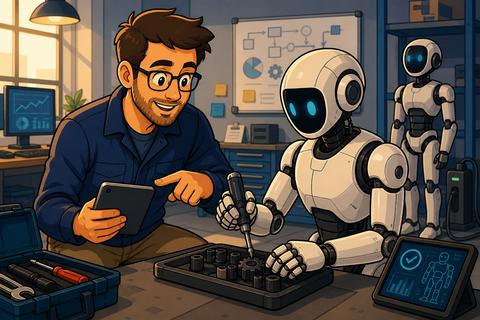
Mentors Shouldn’t Leave Them There
Growth does not happen by time alone. It happens by design.
A newcomer does not move from simple tasks to full understanding by accident. It requires a guided path, supported by someone who knows how to lead that journey. In practice, this growth often follows a natural progression. First, the newcomer observes and performs basic tasks under close supervision. Then, they begin to execute with guidance, understanding not only how but when and why. Later, they handle variation, make decisions, and connect tasks to outcomes. Finally, they reach a stage where they can adapt, troubleshoot, and even guide others.
This progression is not automatic, It depends heavily on the mentor. And this is where many systems fall short because not every skilled technician or 10x-coder is a mentor.
Experience in doing the work does not guarantee the ability to teach it. A mentor must know how to explain, how to observe, how to adjust, and how to build confidence without lowering standards. They must recognize when a newcomer is ready to move forward, and when they need more support. They must guide curiosity when it exists and activate it when it does not.
This requires preparation.
Mentors should be trained to:
- explain reasoning, not just steps
- connect tasks to the bigger system
- adapt to different learning styles
- give feedback that builds understanding
- create space for questions without judgment
Without this, onboarding remains uneven but with it, growth becomes intentional.
In the early stages, mentoring is close and task focused. Later, it becomes guidance on decisions, priorities, and trade-offs. With more experience, it may shift again—toward peer-level discussion, challenge, and even trusted advice beyond technical work.
Over a career, the mentor may no longer stand beside the person at the workbench. They may appear as a manager, a senior colleague, or even a trusted voice consulted when facing uncertainty. Mentor role in our life continues because growth does not stop. We face new roles, new systems, and new challenges that keep appearing by system design and its level is correlated to our growth. And at each stage, having someone to challenge thinking, offer perspective, or simply listen can make the difference between stagnation and development.
As The Mentoring Manual [5] emphasizes, effective mentoring is not about giving answers. It is about enabling others to think, decide, and grow independently over time. That shift—from instruction to empowerment—is what turns mentoring into a long-term force, not a short on-boarding phase.
Without this evolving support, people may remain capable. However, with it, they continue to grow.
From Mentoring Humans to Monitoring Humanoids
As we extend this thinking to humanoid systems, the role changes—but it does not disappear.
A humanoid will not need mentoring in the human sense.
It will require monitoring, tuning, and structured guidance. Which we shall explore in a coming lecture.
Someone—or a team—must define its role, adjust its parameters, validate its outputs, and expand its scope over time. This is not a one-time setup. It is an ongoing responsibility. As tasks evolve, environments change, and expectations grow, the system must be reviewed and refined.
In a way, this is engineering applied to learning.
The “mentor” becomes the designer of behavior.
The question then shifts.
Not how to guide a person.
But how to shape a system that can operate reliably across different situations.
And this opens a new set of considerations.

Open Questions Moving Forward
Does this monitoring role need to be permanent?
How often should the system be updated or upgraded?
What is required to move it from one task domain to another?
Will it adapt naturally over time, or will it always depend on structured tuning?
Can it develop something close to experience—or even its own form of “wisdom”?
Whether human or humanoid, every newcomer starts small.
The difference lies in how we design what comes next.
For humans, growth depends on mentors who guide, challenge, and expand understanding in addition to the natural talents of each individual.
For humanoids, growth depends on systems that monitor, tune, and refine behavior that is equal for all humanoids of that discipline or from this OEM.
In both cases, the starting point is not the limitation but staying there is. That is not a capability problem, it is a design choice.
Must-Know Jargon
Mentoring: Mentoring is a structured relationship where an experienced individual guides another’s growth through explanation, feedback, and perspective. It goes beyond task instruction to include judgment, decision-making, and confidence building. In this article, mentoring is presented as a continuous process, not a one-time onboarding step.
Cognitive Load: Cognitive load refers to the mental effort required to process information and learn new tasks. High cognitive load can overwhelm newcomers, slowing learning and increasing errors. In mentoring, managing cognitive load helps structure learning in manageable steps.
Zone of Proximal Development (ZPD): The Zone of Proximal Development describes the range where a learner can perform a task with guidance but not yet independently. It highlights the importance of timely support from a mentor. In this article, it explains why guided progression is essential for growth.
Experiential Learning: Experiential learning is the process of learning through doing, reflecting, and improving. It emphasizes that experience alone is not enough—reflection turns action into understanding. Mentors play a key role in enabling this cycle.
Psychological Safety: Psychological safety is the condition where individuals feel safe to ask questions, admit uncertainty, and make mistakes without fear of judgment. It directly affects how openly newcomers engage and learn. In mentoring, it is critical for activating curiosity and participation.
Human-in-the-Loop: Human-in-the-loop refers to systems where human oversight guides, validates, or adjusts automated or AI-driven processes. It ensures reliability and accountability in complex environments. In this article, it parallels how mentors guide both human newcomers and evolving humanoid systems.
On-boarding: On-boarding is the structured process of integrating a new person, or potentially a new autonomous system, into safe and effective work. It includes boundaries, capability testing, trust-building, and expectation setting. Good onboarding strengthens both safety and collaboration.
References
1- NIH, National Library of Medicine, Olga Vasileva, Natalia Balyasnikova, (Re)Introducing Vygotsky’s Thought: From Historical Overview to Contemporary Psychology, 7 Aug 2019, https://pmc.ncbi.nlm.nih.gov/articles/PMC6692430/
2- Tierney A. Communities of practice in life sciences and the need for brokering. F1000Res. 2016 Mar 4;5:280. doi: 10.12688/f1000research.7695.1. PMID: 26998239; PMCID: PMC4792202., https://pubmed.ncbi.nlm.nih.gov/26998239/
3- EdTechnica, Clark, C. & Kimmons, R. Cognitive Load Theory, https://edtechbooks.org/encyclopedia/cognitive_load_theory
4- Edmondson, A. C. (2022). Psychological safety (online resource). Harvard Business School / Amy C. Edmondson. Retrieved May 1, 2026, from https://amycedmondson.com/psychological-safety/
5- Starr, J. (n.d.). The Mentoring Manual: Free downloads (exercises and tools). LearnStarr. Retrieved May 1, 2026, from https://learnstarr.com/courses/the-mentoring-manual-free-downloads/
6- Kolb, D. A. (1984). Experiential learning : experience as the source of learning and development. Prentice-Hall. https://www.torontomu.ca/experiential-learning/faculty-staff/kolbs-el-cycle/
7- Dweck, C. S. (2006). Mindset: The new psychology of success. Random House. https://pmc.ncbi.nlm.nih.gov/articles/PMC8299535/
8- LeCun, Y., Dupoux, E., & Malik, J. (2026). Why AI systems don’t learn and what to do about it: Lessons on autonomous learning from cognitive science (arXiv preprint). Retrieved May 1, 2026, from https://arxiv.org/abs/2603.153819- Hassabis, D. (2022). Using AI to accelerate scientific discovery [Lecture]. University of Oxford. Retrieved May 1, 2026, from https://www.youtube.com/watch?v=AU6HuhrC65k
Related Articles

Machine Alignment: Alignment Pitfalls - How to Identify and Eliminate Them

How the Carbon/Graphite Seal Face is Manufactured and Where Carbon/Graphite Cannot be Used

Solving Hydraulic System Overheating Problems

Motor Brush Facts and Maintenance

The Importance of Equipment Fit, Tolerance, and Clearance
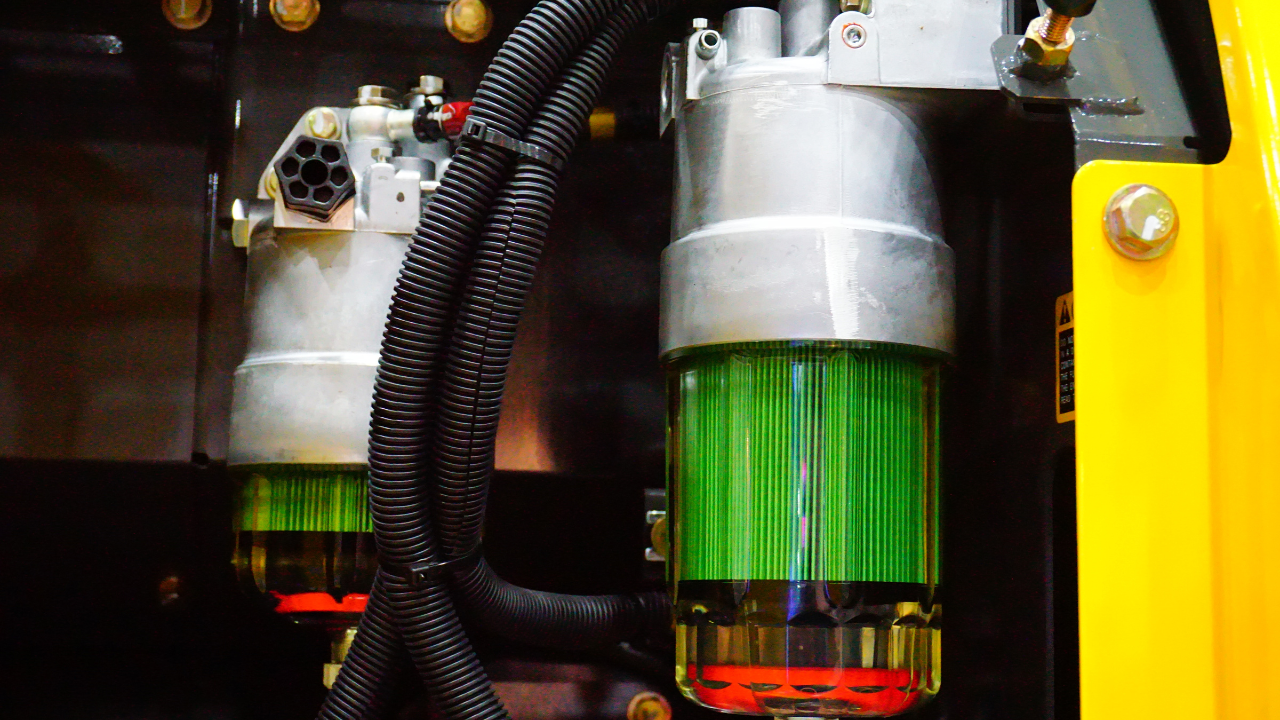
Hydraulic Filters that Do More Harm than Good