

Bearing Life: Condition Monitoring, Care, and Cleanliness
IDCON INC, a TRM Company
Posted 9/23/2025
Bearings: Even the smallest parts have a huge impact on equipment reliability. Their lifespan can seem unpredictable, but with the right condition monitoring tools, maintenance practices, and handling procedures, you can extend performance and prevent costly failures. Detailing condition-based monitoring methods like shock pulse monitoring (SPM), vibration analysis, essential care practices, and contamination control, this article walks you through practical steps to maximize bearing life and keep your equipment running smoothly.
What is condition-based monitoring?
Let’s start with the basics. A large part of improving reliability is to employ condition monitoring methods to detect failures before catastrophic breakdowns happen. However, condition monitoring only improves reliability if planning, scheduling, and repair is done before the breakdown happens. Find out how maintenance planning and condition-based maintenance work together.
If CBM is neglected, there are few corrective jobs in a plant that can be planned and scheduled. There are two important rules when you document a condition monitoring system:
- Find a method that allows on the run monitoring rather than shutdowns
- Use object methods rather than subjective
What are some objective condition monitoring methods?
- Wear particle analysis
- Infrared
- NDT
- Shock pulse meter (SPM)
- Vibration analysis
- Temperature readings
- Leak detection
Now let’s look at how these condition monitoring principles apply specifically to bearings — the most common failure point in rotating equipment.
Checking bearings, how should I do it?
If you want to detect early failures a regular vibration pen won’t detect it, we suggest using a SPM. The video above shows you the reading on our demo rig with a vibration pen versus a SPM meter. Thanks to SPM Instruments for providing us with the bearing checker pen.


A bearing has a random life due to a complex set of factors that determine the life of a bearing. SKF confirms that bearing life is random even when bearings are operating under same conditions.
“Under controlled laboratory conditions, seemingly identical bearings operating under identical conditions have different endurance lives”.
So, what to do now? Since we can’t predict exact bearing life, the best strategy is to control the factors we can: handling, mounting, lubrication, and operating conditions. We suggest focusing the on Essential Care of the bearing and equipment it’s part of.
Let’s imagine that you have a large centrifugal pump.
You can preserve the life of bearings by:
- Use of correct bearing specification according to OEM
- Store the bearing correctly
- Mount the bearing correctly
- Make sure that shaft and bearing housing have the correct tolerance
- Operate the equipment within its limits and avoid overload, and cavitation
- Align the shafts and couplings within
- Balance impeller to avoid vibration
- Select and use the correct lubricant/oil
- Make sure that the oil is clean and avoid moisture, chemicals, and contaminants
- Make sure that the oil is not breaking down and keeps properties and additives
- Prevent overheating of the pump
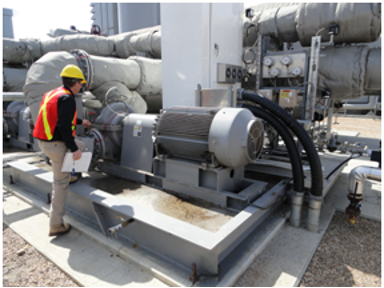
If we implement procedures to preserve the conditions of the bearings, we maximize the bearing life and reliability.
Now we need to figure out what procedures are needed when the bearing begins to fail and its condition deteriorates.
Predicting when the bearing is failing is not extending the life of the bearing but give us time plan and schedule downtime when it impacts the operations the least.
Based on the criticality and industry we could use the Condition Monitoring Standards (CMS by IDCON) or we could use FMEA and RCM to determine the condition monitoring procedure.
How often should you measure? Let’s save that for another time since the life of the bearing does not change when we do condition monitoring.
Checking bearings to detect early signs of failure is an excellent way extend the bearing life and the life of equipment, but don’t do it wrong! You need to use the right tools and methods.
To see how this works in practice, let’s look at a common scenario:
Scenario:
You are the Reliability Engineer responsible for developing an in-house condition-based PM program. One item you’re monitoring is an important process fan. This fan is located on a large cooling bed for spray-dried materials and is running 24/7.
You decided to have a monthly reading with a vibration data collector and analyze the spectrum. This will take a few months to get started and right now you don’t have the equipment, and no one is trained in-house, and it will be some time before you can get a contractor to set up your vibration routes. So, until that happens you decide to check the bearing every 2 weeks with a vibration pen. The overall vibration reading in inch/sec will not give much indication of a bearing condition.
The overall reading from a vibration pen is normally due to:
- Misalignment
- Unbalance
- Looseness
Another available tool is the bearing checker using the shock pulse method (SPM)- see picture below.
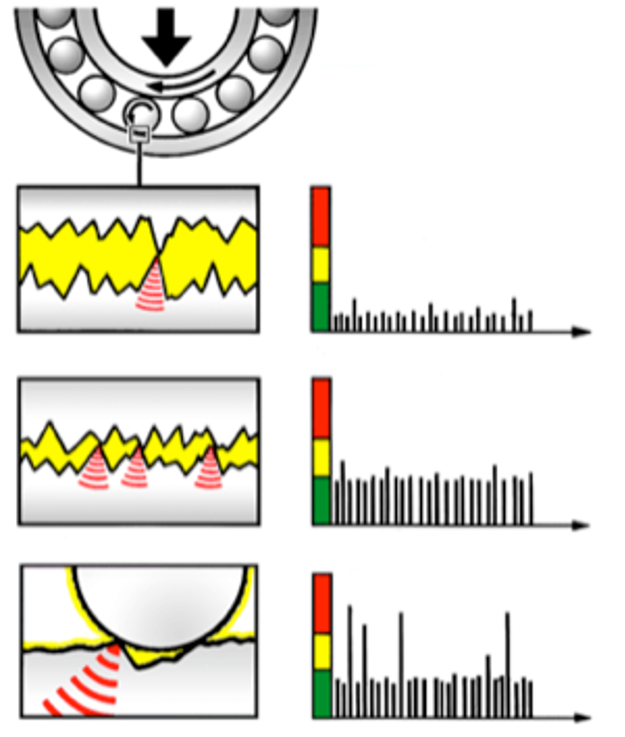

In this case you just enter the shaft diameter (inner diameter of the bearing) and the shaft RPM. The bearing checker will display a reading that is green, yellow and red. If the bearing is in the red, plan to replace it. It is a smart idea to have to have the frontline operator or maintenance tech to check the bearing condition in when doing their normal PM inspection routes. The SPM signal can also be trended.
Even with perfect monitoring, bearing life will decrease if they’re contaminated. That’s where cleanliness comes in.
Keep Bearings Clean
We are taught that dirt is bad for bearings. But why is it bad? If dirt enters between the ball/ roller and the bearing race, the oil film breaks, and dirt will grind between the roller elements and the bearing race. But isn’t it a bit much to ask craftspeople to wear gloves, work in clean rooms, and cover open bearing with plastic bags while working on the bearing installation?
To answer the question, we need to know two things. First, how big is the clearance between the roller element in the bearing and the bearing race?
We can call the clearance internal radial play and internal axial play. See Figure 1, illustrating bearing radial and axial play.
Second, how big are the dirt particles that may get inside the clearances?
Let’s start with the clearances inside bearings.
The internal clearances (play) in bearings before they are mounted can, for example, be found in a SKF catalogue, the clearances vary from 0 to 1,000 micrometers (micrometer = one millionth of a meter), depending on size and type of the bearing.
However, the clearance for mounted bearings is what is really interesting. The clearance number can’t be found in catalogues because the internal clearance will depend on temperature, mounting method, tolerances on shafts, etc.
But, by discussing the subject with Pall filtration, we found that most roller bearings used in industry have an internal radial clearance of 1-5 microns. It’s a wide range, but it gives us a ballpark number to work with.
Let’s compare clearance range (1-5 microns) with some of the common dirt size in industry. Figure 2 helps us visualize the size of common contamination factors together with some figures for size reference.
We can clearly see that common contamination such as dust, tobacco smoke and fingerprints can damage most bearings since the clearances in bearings are the same size or smaller than common contamination.
Therefore, we can conclude that clean rooms, gloves and usage of covers for bearings are very important for bearing reliability.
Conclusion – Bearing Life
Bearings may have a random lifespan, but their reliability is anything but random when you combine the right strategies. Condition-based monitoring helps you detect problems early, essential care practices preserve performance, and clean handling prevents avoidable failures. By aligning these three elements—monitoring, maintenance, and contamination control—you can maximize bearing life, reduce unplanned downtime, and keep your equipment running at its best.

Related Articles

Solving Electrical Problems with Thermal Imaging
Top Tips for Selecting Pressure Measurement Transmitters
Infrared Thermography

Data Analysis Tip 1 – Consider the Machine First and Then the Graphs
Harmonics and Sidebands

New Generation IR Cameras