There are several important silent assumptions of bearing reliability. However, before I address these assumptions, some even more basic assumptions and statements of fact must be established. While it might be a bit of a leap, I’m going to assume that the bearing is well-designed, well-manufactured, properly handled and stored, and finally, correctly selected for the intended application. With that said, we’re now ready to talk about those silent assumptions that are in the maintenance function’s domain.
These assumptions relate to the internal environment and duty cycle to which a bearing is exposed. Bearing manufacturers will frequently report that only a small percentage of bearings reach their fatigue limit (catalog life). According to one major supplier, typically only 10 percent of rolling element bearings reach their L10 life (it should instead be 90 percent by definition). The old saying that bearings don’t just die, they’re murdered, is rooted in fact. For a bearing to have a normal life expectancy, it is assumed that the following, often unspoken, root causes of failure (our silent assumptions) will not occur at any time after commissioning.
Mechanical Causes
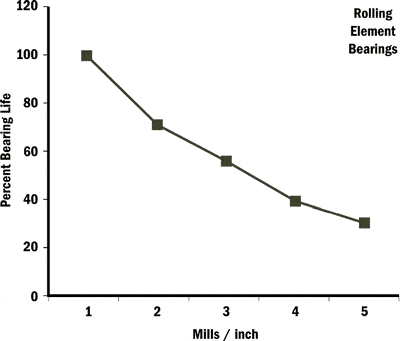
Exceeding a bearing’s dynamic load rating translates to a disproportionate reduction of fatigue life. For most bearings, doubling bearing load can reduce bearing life to roughly one-eighth of its normal life. Mechanical assaults on bearings by misalignment (Figure 1) and unbalance can produce similar consequences.
There are many vital lubricant properties that when altered or impaired can sharply diminish bearing life and reliability. These include such things as additives (AW, EP, etc.), acid number, lubricity, viscosity, pressure-viscosity coefficient and viscosity index. Using the wrong lubricants, degraded lubricants, mixed lubricants (including incompatibility) and/or contaminated lubricants can cause a loss of fluid properties.
Fluid Contamination
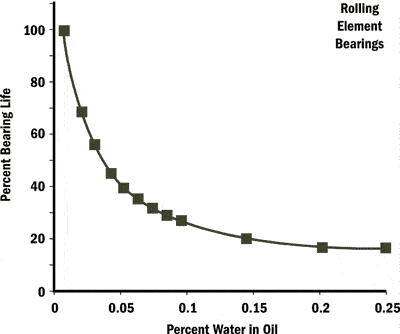
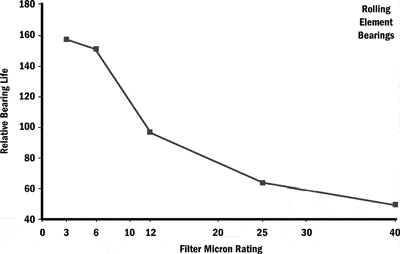
The “most wanted” fluid contamination assassins include dirt, water (Figures 2 and 3), fuel, glycol and soot. However, there are many others – too long to list here.
Heat too is a contaminant. Its aggressive tendencies can be dependably viewed as both a cause and effect of most types of fluid and mechanical problems – including many of those found elsewhere on this list. Overlubrication (too much grease) is a common cause of heat in grease-lubricated bearings.
Starvation
A surprising number of bearings are simply starved to death. Over time, they run dry of lubricating oil or grease unless properly and frequently relubricated. The wrong relubrication intervals are often the culprit, but such things as cold starts, dry starts and grease bleed problems can also contribute to starvation. …
… Other contributors of starvation relate to the failure of lubricating mechanisms such as flingers, slingers, rings, single-point devices, oil mist, oil pumps, centralized systems, etc.
While it is true that a bearing damaged from fatigue or wear won’t heal over by itself, it also won’t tell you where it hurts unless you ask. To be attentive to bearing reliability you must tune into these silent assumptions and their symptoms. This is where oil analysis can play an important life-extending role.
If you review each item in my list of silent assumptions, you will discover that, surprisingly, oil or grease analysis can in almost every instance call attention to these concerns, either directly or indirectly. When things go wrong, both the causes and symptoms of a problem are often revealed by the oil’s properties and contaminants. In fact, the alarms are silent only when you choose not to listen. To listen, you must:
sample correctly,
sample at the right frequency,
run the proper slate of tests,
set alarms and limits correctly,
possess suitable knowledge of data interpretation, and
timely and appropriately respond to nonconforming conditions.
Too often, oil is changed without real cause. Imbedded in the oil is a message about its health, the bearing’s health, contamination and other vital properties. We lose this message when the oil is changed without sampling. After all, problems such as misalignment or coolant leaks are never solved simply by an oil change alone. In such cases, changing the oil results not only in ultimately murdering the bearing but shooting the messenger as well.
Choosing an industrial heating system upgrade for any facility is a big undertaking—not only because it’s a major expense, but because it can have a long-tail effect on the facility’s energy efficiency as well as employee comfort. When looking for the best industrial heating system, several factors should be considered.
Choosing an industrial heating system upgrade for any facility is a big undertaking—not only because it’s a major expense, but because it can have a long-tail effect on the facility’s energy efficiency as well as employee comfort. When looking for the best industrial heating system, several factors should be considered.
Are you looking for ways to improve maintenance work execution? Are your planning and scheduling processes not generating the desired results? Does it seem like a struggle to find the information you need to define the what, how, how long, who, and when of a maintenance job? Take a three-part technical database survey on the technical database to uncover what a poor system is costing you. As a token of our appreciation for completing all three surveys, you’ll receive a customized report and a free 20-minute consultation with an expert from IDCON.
Are you looking for ways to improve maintenance work execution? Are your planning and scheduling processes not generating the desired results? Does it seem like a struggle to find the information you need to define the what, how, how long, who, and when of a maintenance job? Take a three-part technical database survey on the technical database to uncover what a poor system is costing you. As a token of our appreciation for completing all three surveys, you’ll receive a customized report and a free 20-minute consultation with an expert from IDCON.
Management today is never the same what was yesterday. And India, undoubtedly, has been one place that has witnessed radical changes in Management - be it Man Management, Money or Material Management. And it goes without saying that concept of "Lean" in all fields is the name of the game. Lean Organization, Reduced Vendor base, Shorter Production Cycle, Market Micro-segmentation and Skinned Distribution Points are all globally accepted jargons of the present day cost conscious world.
Management today is never the same what was yesterday. And India, undoubtedly, has been one place that has witnessed radical changes in Management - be it Man Management, Money or Material Management. And it goes without saying that concept of "Lean" in all fields is the name of the game. Lean Organization, Reduced Vendor base, Shorter Production Cycle, Market Micro-segmentation and Skinned Distribution Points are all globally accepted jargons of the present day cost conscious world.
Daily and weekly meetings between operations and maintenance are crucial in taking the efficiency of your daily maintenance to a higher level. Coordinating meetings where various departments prioritize work orders (WO) and maintenance is the foundation for a partnership between operations and maintenance. Such meetings create efficiency. Well-organized meetings with clear goals and agendas can completely change the culture for the better in an organization.
Daily and weekly meetings between operations and maintenance are crucial in taking the efficiency of your daily maintenance to a higher level. Coordinating meetings where various departments prioritize work orders (WO) and maintenance is the foundation for a partnership between operations and maintenance. Such meetings create efficiency. Well-organized meetings with clear goals and agendas can completely change the culture for the better in an organization.
As we look forward to 2024, it becomes clear that the demand for platform-driven models will continue to be a driving force in the industry. However, what will set successful entities apart are solutions that are purpose-built and have a tangible impact. In other words, the winners in this space will not only provide a broad range of services through integrated platforms but will also be distinguished by their ability to address specific challenges with precision and deliver outcomes that make a real difference.
As we look forward to 2024, it becomes clear that the demand for platform-driven models will continue to be a driving force in the industry. However, what will set successful entities apart are solutions that are purpose-built and have a tangible impact. In other words, the winners in this space will not only provide a broad range of services through integrated platforms but will also be distinguished by their ability to address specific challenges with precision and deliver outcomes that make a real difference.
Why are organizations leaving money on the table by not investigating failures that cost them money? One would venture to say that all manufacturing companies have failures each year that cut into their profit. The prevailing question is: What do you do when that failure occurs? Do you simply fix the equipment, get back up and running, and return to whatever you were working on at the time? Or, do you stop what you are doing and diligently try to understand why the failure occurred and put measures in place to prevent recurrence?
Why are organizations leaving money on the table by not investigating failures that cost them money? One would venture to say that all manufacturing companies have failures each year that cut into their profit. The prevailing question is: What do you do when that failure occurs? Do you simply fix the equipment, get back up and running, and return to whatever you were working on at the time? Or, do you stop what you are doing and diligently try to understand why the failure occurred and put measures in place to prevent recurrence?