
The New Toolkit: Why Maintenance Digital Skills Can’t Be Outsourced
Ahmed Rezika, SimpleWays OU
Posted 1/6/2026
In order to see what’s next in the maintenance realm, we demystified the parallels between the automobile’s dashboard and the maintenance dashboard and working environment in general in this article: “Not Your Old Dashboard Anymore: The Rise of AI-Driven Interactive Tools for Maintenance ” [1]
The connectivity revolution laid the foundation, but it’s AI that’s finally democratizing access to operational intelligence. In automotive, 76% of U.S. drivers now express interest in using voice generative AI capabilities in their vehicles, reflecting a 52% increase from the previous year, as systems powered by Large Language Models like GPT-4 and Gemini enable drivers to interact naturally rather than memorizing rigid commands. Mercedes-Benz’s MBUX system, active in over 3 million vehicles by late 2024, integrated ChatGPT and transitioned to Google’s Gemini AI [3], enabling the assistant to remember past conversations, adjust to driver habits automatically, and offer route suggestions without prompting.
The transformation is profound: instead of asking “What’s wrong with the engine?” and getting a cryptic P0420 diagnostic code, drivers now say “Hey, I’m low on battery, is there a fast charger nearby that’s still open?” and receive real-time availability, pricing, operating hours, and optimized routing. 85% of drivers surveyed said they’d be interested in using voice assistants to navigate car features and address maintenance issues —turning the owner’s manual from a forgotten glove box relic into an interactive conversation partner.
And that’s what we expect to land in the maintenance realm when we have business reports forecasting: “The maintenance industry is now witnessing a transformation as AI-powered systems analyze vast datasets to forecast equipment failures and enable proactive measures, with the predictive maintenance market projected to grow from $12.7 billion in 2024 to $80.6 billion by 2033 ” [5]
From Dumb Pipes to Smart Conversations: The AI Democratization of Dashboards
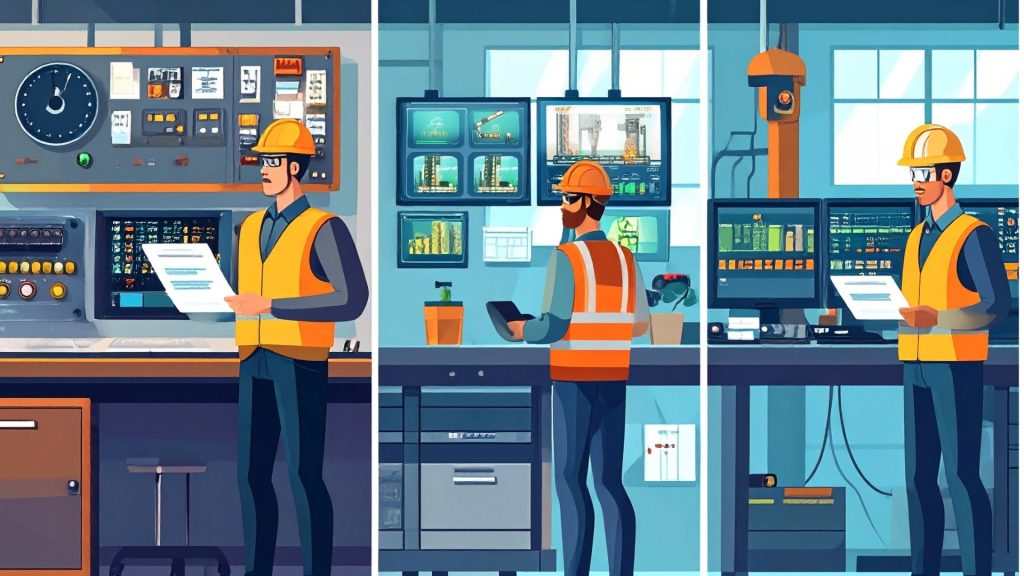
Manufacturing and maintenance systems are experiencing the same paradigm shift, but it’s moving beyond just automated work order generation—it’s about transforming institutional knowledge into an accessible, conversational interface. For Example: Industrility’s TwinGPT is described as an industry-first Generative AI solution transforming Operations and Maintenance (O&M) manuals into interactive, personalized digital twins of equipment. The democratization is striking: where once technicians thumbed through 400-page manuals searching for torque specifications or wiring diagrams, conversational AI now guides users through troubleshooting steps, answers FAQs in natural language, and escalates complex issues only when necessary.
Conversational AI assistants are expected to collect maintenance logs and expert knowledge, acting as virtual assistants to guide less experienced technicians through complex troubleshooting processes with step-by-step instructions. The real transformation isn’t that systems can create work orders automatically—that’s still a transactional, legacy mindset—it’s that AI centralizes scattered data from machine performance logs, maintenance records, production workflows, supplier data, and inventory levels, providing real-time, context-aware responses to help manufacturers make faster, smarter decisions. A technician facing an unfamiliar bearing replacement can now have a conversation with the system: “Walk me through replacing the inboard bearing on ……,” and receive step-by-step guidance pulled from OEM manuals, previous successful repairs on similar equipment, and current inventory status—all integrated seamlessly.
What will mark the launch of real AI-Assistant for Maintenance?
The fundamental difference between yesterday’s embedded intelligence and today’s AI-powered systems won’t be just sophistication or simplification —it’s conversational accessibility. Traditional dashboards required you to know which metric to check, which drill-down to follow, which threshold indicated trouble. Modern predictive maintenance systems don’t just display rising vibration trends—they send alerts with subjects like “High-Priority Alert: Impending Bearing Failure on Crusher Motor #1 (Predicted Failure in ~30 Days)” with dashboard views showing the specific fault signature, remaining useful life calculations, and automatically generated work orders pre-populated with required parts from inventory. However, this comes at an effort from the maintainers and the organization.
At this point, you won’t navigate to figures and interpret indications; you ask questions and receive answers. “What’s driving down my reliability index this week?” might trigger an AI response analyzing equipment health across your facility, identifying that three aging pumps are showing early cavitation signatures, and suggesting a phased replacement schedule that minimizes production impact.
State-of-the-art predictive maintenance now includes digital intelligent assistants using augmented reality, virtual reality, and mixed reality technologies alongside AI-based approaches. The dashboard evolved from a one-way broadcast medium into a two-way conversation—and that conversational intelligence is what’s finally making operational data accessible not just to data scientists and engineers, but to everyone who needs it, when they need it, in the language they speak [4] or, at least that’s what is promised.
The Technician’s New Toolkit: Why Digital Skills Can’t Be Outsourced
“Introducing new technologies into the core of a business can fundamentally change the skills that employees will need on a day-to-day basis. Organizations should direct resources to upskill those workers and make them feel comfortable with the new tech. McKinsey analysis has found that the top barrier to implementing growth strategies, especially those related to digitalization, is talent.” McKinsey [2]
The automotive technician in 2025 isn’t your grandfather’s mechanic—they’re diagnostic technicians who must master OBD-II scanners, oscilloscopes, multimeters, ECU reprogramming, and software updates while interpreting diagnostic trouble codes, freeze-frame data, live sensor readings, and performance charts. Bi-directional control is now standard for professional diagnostics, allowing technicians to actively command vehicle components for testing rather than passively reading codes, reducing diagnostic time from hours to minutes.
Modern auto technicians need comfort with wiring diagrams, CAN bus networks, telematics data, and ADAS -(Advanced Driver Assistance Systems) – calibrations for lane-keeping assist and adaptive cruise control, with the automotive over-the-air update market projected to grow at over 17% annually through 2032. The evolution is profound: what once required mechanical intuition now demands equal parts wrench work and software literacy. AI-driven diagnostic tools can quickly analyze sensor data and identify issues that might take human technicians hours to uncover, but rather than replacing technicians, these AI tools enhance their efficiency. The key insight? The technician closest to the problem owns the technology that solves it.
Will our maintenance team reach those horizons?
Industrial maintenance is experiencing a parallel but often delayed transformation, and the stakes for skill evolution are equally high. Maintenance roles are shifting from manual and hands-on to analytical and tech-driven, with increased use of digital technologies demanding a workforce skilled in operating and managing advanced systems. Computer and digital technological literacy is increasingly vital for maintenance technicians as machinery heavily incorporates computers in every sector, and AI and advanced technologies are infiltrating every industry.
The global industrial IoT market is estimated at $438.90 billion in 2024 and anticipated to reach $2,146.07 billion by 2034, with AI-enabled smart sensors continuously monitoring equipment to identify failures and leakages. Yet here’s where many organizations might stumble: they may treat IoT sensors, CMMS platforms, and predictive analytics as “IT problems” to be solved by IT departments, while keeping maintenance technicians focused solely on mechanical repairs. This creates a dangerous disconnect. When an IoT sensor triggers an alert about bearing temperature trending abnormally, the person who understands bearing failure modes isn’t the IT specialist—it’s the maintenance technician who’s replaced a thousand bearings and knows what “hot” really means in context.
The fundamental reason maintenance technicians can’t delegate digital skills to IT teams is the same reason automotive technicians can’t delegate diagnostic software to computer programmers: the domain expertise lives on the shop floor, not in the server room. AR and VR technologies may enable stepwise visualization and simulation of maintenance operations, with digital factory twins aiding virtual, interactive, and customized training for maintenance technicians to practice new skills in safe, simulated, real-world environments.
Condition monitoring and virtual technology in manufacturing provide maintenance with near “hands-on” experiences for offsite personnel, enabling accurate, real-time processes from anywhere. But these technologies only deliver value when wielded by people who understand what they’re looking at. An IT specialist can install sensors and configure dashboards, but they can’t interpret why a pump’s vibration signature changed after last week’s bearing replacement, whether that’s normal break-in or early failure, and how it relates to the production schedule.
The median annual salary for industrial maintenance technicians was $63,760 in May 2024, with employment projected to grow 13% from 2024 to 2034 as each day brings new challenges requiring technicians to use logic and creativity to diagnose system failures and implement safe, effective solutions. The technicians commanding premium wages in 2025 and beyond won’t be those who split their roles into “mechanical work for me, digital work for IT”—they’ll be the hybrid professionals who can pull data from a PLC, interpret sensor trends, adjust parameters in a CMMS, diagnose a mechanical failure, and execute the physical repair, all in the same shift. Just as automotive technicians had to evolve from wrench-turners to electronic diagnostic specialists, industrial maintenance technicians must become data-literate, IoT-savvy, and AI-conversant problem solvers. The tools have changed, but the principle remains: the best technician is the one who owns both the physical and digital sides of the problem.

Your Digital Skills Roadmap: A Practical Guide for Maintenance Professionals
Let’s be practical and direct to the point
For Frontline Maintenance Technicians
1. Master Your CMMS Platform (3-6 months)
- What: Learn beyond basic work order entry—explore reporting, asset hierarchies, PM scheduling, and mobile app features.
- How: Request formal training from your CMMS vendor. Spend 30 minutes daily exploring features you’ve never used. Volunteer to be the “power user” on your shift.
- Why: The CMMS is your mission control—if you can’t navigate it fluently, you’re operating blind.
2. Understand IoT Sensor Fundamentals (2-3 months)
- What: Learn how temperature, vibration, pressure, and flow sensors work. Understand sampling rates, thresholds, and alarm logic.
- How: Take free online courses (Coursera’s “Introduction to IoT” or LinkedIn Learning’s sensor fundamentals). Ask to shadow IT or instrumentation techs during sensor installations.
- Why: You can’t trust data you don’t understand. When a sensor says “high vibration,” you need to know if it’s real or a loose mounting bracket.
3. Build Basic Data Literacy (ongoing practice)
- What: Read trend charts, understand statistical concepts like mean/median/standard deviation, recognize patterns in time-series data.
- How: Use Excel or Google Sheets daily. Practice plotting your own equipment data. Take Khan Academy’s free statistics basics course (3-4 hours).
- Why: AI gives you insights, but you need to interpret whether they make physical sense in your context.
4. Learn Conversational AI Interfaces (1-2 months)
- What: Practice asking questions in natural language to any AI tools your organization provides. Learn to refine queries when answers aren’t helpful.
- How: If your CMMS has AI chat features, use them daily instead of menu navigation. Experiment with ChatGPT or similar tools to practice phrasing technical queries clearly.
- Why: The future isn’t clicking through dashboards—it’s asking the right questions conversationally.
5. Develop Basic Network Troubleshooting (3-4 months)
- What: Understand IP addresses, network connectivity, Wi-Fi vs. wired connections. Know how to check if a sensor is “online” vs. “failed.”
- How: Take CompTIA Network+ study materials (even without certification). Ask IT to explain your facility’s network architecture during downtime.
- Why: Half of “sensor failures” are connectivity issues. If you can diagnose network problems, you save hours waiting for IT.
6. Get Comfortable with Mobile/Tablet Interfaces (1 month)
- What: Use mobile CMMS apps, AR-enabled troubleshooting tools, and digital manuals on tablets instead of paper.
- How: Force yourself to leave the laptop behind for one week—do everything via mobile. Request ruggedized tablets if your facility doesn’t provide them.
- Why: The shop floor is your workplace, not the maintenance office. Mobile tools keep you where the action is.
For Maintenance Supervisors and Managers
1. Champion a “Digital-First” Culture (immediate start)
- What: Make digital tool usage non-negotiable. Recognize and reward technicians who master new systems.
- How: Set metrics: “90% of work orders closed via mobile app within 60 days.” Highlight digital successes in team meetings. Remove paper-based workarounds.
- Why: Cultural resistance kills digital transformation faster than any technical limitation.
2. Audit Your Data Infrastructure (1-2 months)
- What: Map what data sources exist (SCADA, CMMS, ERP, IoT), who owns them, and what integration gaps prevent maintenance access.
- How: Schedule meetings with IT, operations, and engineering. Create a simple diagram showing data flows and access barriers. Identify quick wins.
- Why: You can’t fix what you can’t see. Most organizations have rich data that maintenance teams can’t access.
3. Build IT-Maintenance Partnerships (ongoing)
- What: Establish regular collaboration with IT on sensor networks, API integrations, and system access rather than treating IT as a ticket-based service desk.
- How: Schedule monthly joint meetings. Invite IT to ride along during equipment troubleshooting. Include IT in maintenance planning discussions.
- Why: Digital maintenance requires both domains working together, not throwing problems over the wall.
4. Invest in Structured Training Programs (immediate planning)
- What: Budget for vendor training, online learning platforms (LinkedIn Learning, Coursera), and industry certifications (CMRP with digital focus).
- How: Allocate 2-4 hours per technician per month for structured learning during paid time. Track completion and competency growth.
- Why: “Learn on the job” doesn’t work for complex digital systems. Structured learning accelerates adoption dramatically.
5. Start Small with Pilot Projects (3-6 months)
- What: Choose one critical asset or production line for full digital integration—IoT sensors, predictive analytics, conversational AI access.
- How: Partner with a vendor willing to prove ROI. Document time savings, failure prevention, and cost avoidance. Use success to justify expansion.
- Why: Organization-wide rollouts fail. Successful pilots with measurable results build momentum and secure budgets.
6. Redefine Job Descriptions and Hiring (6-12 months)
- What: Update technician job postings to require basic digital literacy (CMMS proficiency, data interpretation, mobile tool usage).
- How: Work with HR to revise job descriptions. Add digital skills assessments to interview processes. Offer premium pay for hybrid digital-mechanical expertise.
- Why: If you keep hiring 1995 skill sets, you’ll have a 1995 maintenance operation competing in 2025.
Organizational Advocacy: What to Request from Leadership
For All Maintenance Professionals
- Dedicated training time: Request 2-4 hours monthly during paid work hours for digital skills development, not “figure it out on your own time.”
- Modern tools: Advocate for ruggedized tablets, reliable Wi-Fi coverage on the shop floor, and CMMS mobile app licenses for all technicians.
- Cross-functional access: Push for maintenance team read access to SCADA dashboards, production data, and IoT sensor platforms currently siloed in operations.
- Pilot program participation: Volunteer your team or equipment for new technology pilots—early adopters gain skills and influence vendor selection.
- Vendor training included: When purchasing new CMMS, IoT, or AI platforms, ensure comprehensive training is non-negotiable in the contract, not an expensive add-on.
The Bottom-Line Digital transformation in maintenance isn’t optional—it’s survival. The technicians who build these skills now will command premium wages and job security. The supervisors who champion this evolution will run world-class operations. The organizations that invest in their maintenance teams’ digital competency will outperform competitors still treating maintenance as wrench work. Start small, start today, and build momentum. The roadmap is clear; the only question is whether you’ll follow it before your competition does.

Conclusion: The Hybrid Technician Advantage
The maintenance profession stands at an inflection point. The choice isn’t between staying a “wrench-turner” or becoming a “data scientist”—it’s about becoming the hybrid professional who commands both domains. The technicians investing in digital literacy today won’t just survive the transformation; they’ll lead it, command premium compensation, and solve problems their peers can’t even see. The supervisors building these capabilities in their teams now will hopefully run the most reliable, efficient operations in their industries within 24 months.
This roadmap isn’t theoretical—it’s practical and, achievable. Start with what is in hand maybe your CMMS mastery this month. Add sensor fundamentals next quarter. Build data literacy continuously. The skills compound. The organizations that recognize maintenance professionals must own digital tools—not delegate them to IT—will win. Those treating this as optional will find themselves perpetually reactive, perpetually behind, and perpetually losing their best people to competitors who invested in their growth.
The dashboard revolution didn’t eliminate the need for hands-on expertise; it amplified its value exponentially. But only for those willing to evolve. Your move.
Must-Know Jargon
OBD-II (On-Board Diagnostics II) Standardized vehicle diagnostic protocol mandated in U.S. vehicles since 1996. Uses a 16-pin connector to retrieve diagnostic trouble codes and real-time performance data from electronic control units.
ECU (Electronic Control Unit) Programming Process of writing, updating, or modifying firmware and calibration parameters in vehicle electronic control modules. Controls engine management, transmission shifting, fuel injection timing, emissions systems, and other subsystems through embedded software algorithms.
CAN Bus (Controller Area Network) Multi-master serial bus protocol allowing electronic control units to communicate on two twisted wires. Supports data rates from 125 kbps to 1 Mbps, eliminating point-to-point wiring between components.
CMMS (Computerized Maintenance Management System) Software platform managing work orders, asset histories, preventive maintenance schedules, and spare parts inventory. Modern systems integrate with IoT sensors and ERP platforms via APIs.
SCADA (Supervisory Control and Data Acquisition) Industrial control system for real-time monitoring and control of processes across distributed facilities. Uses remote terminal units and programmable logic controllers to collect and transmit operational data.
IoT (Internet of Things) Network of embedded sensors and devices transmitting data over IP networks. In maintenance, monitors equipment parameters like temperature, vibration, pressure, and flow rates continuously.
API (Application Programming Interface) Standardized protocol allowing different software systems to communicate and exchange data. Enables CMMS platforms to pull sensor data from IoT devices, sync with ERP systems, or push alerts to mobile apps without manual data entry.
Predictive Analytics Statistical and machine learning techniques analyzing historical and real-time data to forecast future equipment failures or maintenance needs. Uses pattern recognition from sensor trends, operational history, and failure modes to predict issues before they occur.
ETL (Extract, Transform, Load) Data integration process extracting information from source systems, transforming it into consistent formats, and loading it into target databases or analytics platforms. Critical for consolidating maintenance data from CMMS, SCADA, IoT sensors, and ERP into unified dashboards.
AR (Augmented Reality) Technology overlaying digital information onto physical equipment through mobile devices or smart glasses. Displays step-by-step repair instructions, wiring diagrams, or sensor data directly on equipment being serviced in real-time.
OEE (Overall Equipment Effectiveness) Manufacturing metric measuring equipment productivity as percentage combining availability, performance, and quality rates. Calculated as (Availability × Performance × Quality) × 100, where world-class operations target 85% or higher.
References
1- MaintenanceWorld Magazine, Ahmed Rezika, December 2, 2025 | Article, It is not your old dashboard Anymore, https://maintenanceworld.com/2025/12/02/
2- McKinsey & Co, September 16, 2025 | Article, Remapping travel with agentic AI, https://www.mckinsey.com/industries/travel/our-insights/remapping-travel-with-agentic-ai
3- Google Partner on AI-powered Conversational Search within Navigation Systems, https://www.googlecloudpresscorner.com/2025-01-13-Mercedes-Benz-and-Google-Partner-on-AI-powered-Conversational-Search-within-Navigation-Systems
4- Connected Manufacturing, How Conversational AI Works, https://www.connectedmanufacturing.com/measure
5- WorkTrek, 10 Maintenance Industry Trends for 2025, https://worktrek.com/blog/maintenance-industry-trends/

Related Articles

Data Analysis Tip 1 – Consider the Machine First and Then the Graphs


Back to Basics: Understanding Decibels and Vibration Sensor Orientation

Breakthrough Technology for Maintenance Inspections

Examples of Root Cause Analysis
Smart Sensors in Maintenance: Hype or Game Changer?