How to Read Centrifugal Pump Curves
Mike Sondalini, PWW EAM System Consultant
with permission of BIN95 Business Industrial Network
Posted 9/18/2025
Don’t run centrifugal pumps on the end of the curve. Pumps are designed and selected to operate near their highest efficiency point. If they operate at the right-hand end of the centrifugal pump curve the likelihood of cavitation increases.
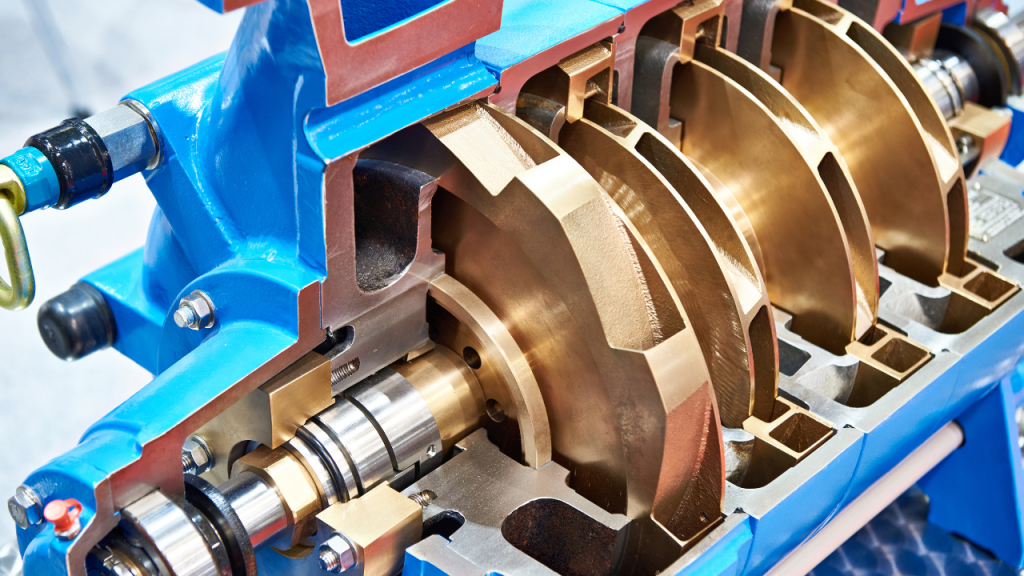
When the impellers in centrifugal pumps turn, they spin the liquid sitting in the cavities between the vanes outward. This liquid is forced up the discharge pipe and new liquid is sucked in to replace the liquid ejected by the spinning impeller. The amount of liquid pumped depends on:
i) the diameter of the impeller
ii) the size and shape of the cavity between the vanes
iii) the size of the pump and the size of its inlet and outlet openings
iv) the rotational speed (RPM) of the impeller
v) how much back pressure is at the pump discharge
vi) how much pressure is at the pump suction
vii) the density and viscosity (slipperiness) of the liquid
For a pump with a particular impeller running at a certain speed in a liquid, the only items on the list above that can change the amount flowing through the pump are the pressures at the pump inlet and outlet.
The effect on the flow through a pump by changing the outlet pressures is graphed on a pump curve. A typical set of pump curves for a centrifugal pump is shown below.

The lines running to the right and downward are the performance curves for the pump. They apply only to this pump running at 2900 RPM with the impeller diameters shown at the right end of each curve. At different speeds or with different impellers different centrifugal pump curves would result.
As an example of how to use the centrifugal pump curves, assume 120 cubic meters per hour of water had to be pumped up to a tank on a 50-meter-high building. The impeller size to use in the pump is found from the curves by running a line up the page at 120M3/H. Another line is run across the page at 55 meters (allowing about 10% extra back pressure due to friction loss in the piping and valves). The intersection point falls near the 211 mm size impeller.
The curves running up and down are the pump efficiency curves. They indicate the pump efficiency at different operating conditions. Pump efficiency is a measure of how much of the energy put into the pump actually goes into pumping the liquid. The duty point of 120M3/H and 55m back pressure for the 211 mm impeller determined above is well positioned at a high efficiency. This is a good pump selection for the duty.
The centrifugal pump curves tell what flow to expect from a particular size impeller for a given amount of back-pressure on the pump. When a pump is selected for a duty, the designer selects a pump that operates at high efficiencies on the pump curve for the impeller size. Changing the impeller width, the impeller diameter or the angle of the vanes in the impeller alters the impeller curve characteristics. A wider impeller scoops more liquid and produces more flow, a larger diameter impeller flings liquid out at higher speed and so produces more pressure and changing the angle of the vanes alters the shape and steepness of the pump curve.
The centrifugal pump curves suddenly stop at the right end of each curve. Beyond the end of the curve the pump manufacturer is advising that the pump cannot be safely operated. Trying to run a pump off the right end of the curve will result in pump cavitation and eventually destroy the pump.
Pump Cavitation
Pump cavitation occurs when pockets of vapor enter the pump because the liquid is boiling. As a pump tries to pull through more liquid, the pipe friction pressure loss on the suction line rises and the liquid entering the pump sees less pressure (because it was lost to friction). A vacuum starts to develop at the pump suction. If the vacuum gets deep enough the liquid will start to boil and vaporize and the liquid passing through the pump will contain bubbles of vapor. There is a roaring sound, as if the pump is pumping gravel. This noise is the vapor bubbles imploding when the pressure increases again after the low-pressure point.
Effects of “Running on the Right”
A pump operating off the right of the curve is cavitating. The suction and discharge pressures fluctuate wildly pulling and pushing the impeller about because of the out-of-balance forces. The shaft rattles; mechanical seals are damaged; packing is worn; bearings are destroyed by brinelling (hammering) and shafts are bent. Pumps will be noisy, vibrate and shake, get hot and the microjets of liquid ejected by imploding bubbles will hit and erode the impeller metal. Consequently, the pump will fail often and need a lot of maintenance.
The following are some possible reasons why a pump may be running off the right side of the curve:
Incorrect head pressure calculation.
The pump duty was incorrectly determined or unknown. Grabbing any pump available without doing calculations and checking the pump curve can result in this problem.
Additional tankage was added and the suction line extended.
A longer suction line has more pipe wall friction pressure loss so lowering the pressure available at the pump suction.
Blocked suction line.
Blocked strainers and closed valves are examples
Suction pipe line friction losses not allowed for.
Pressure loss occurs at every valve, every elbow and tee, every projection into the flow and along every millimeter of pipe.
Broken discharge pipeline or discharge bypass valve opened.
Once the back pressure is lowered a higher flow occurs which forces the duty point to the right of the original operating point.
Removing valves, tanks and pipes from the pump delivery line.
Reducing the back-pressure on a pump causes the flow through the pump to rise. The duty point moves to the right of the original point.
An old pump is moved to a new duty.
To keep capital costs down old pumps are often reused. If the pump is oversized it will operate on the right side of its original design duty point.
Change in the process conditions.
Often a new product will be put through an existing pump. This product may have different properties and so will behave differently.

Correcting the Situation
To solve the problems caused by pumps running off the right side of the centrifugal pump curve it is necessary to ensure the pump suction pressure is above the pressure at which the liquid vaporizes (boils). The list below indicates some of the ways to maintain suction pressure:
Use larger diameter suction pipelines
A larger diameter pipe has less pipe wall friction loss because the flow velocity is lower.
Pressurize the suction side.
The suction pressure can be increased by keeping a higher level in the tank, by moving the tank higher and by lowering the pump.
Put more back-pressure on the pump discharge.
Partially closing a valve on the pump discharge will increase the back-pressure and force the pump to operate further up on the left of the pump curve.
Install inducers to reduce suction loss.
These are long helical screws (like a feed screw on an auger) which fit up the suction pipe and spin with the impeller. They scavenge the liquid and draw it through by force.
Stop unnecessary pressure losses.
Maintain free flowing suction line conditions. Clear blockages, use smooth bore pipes and long radius elbows.
Change to a slower, larger pump impeller.
Change the pump size to one that delivers the same flow and pressure but at a slower speed. This usually also requires suction piping changes.
Keep the process liquid cool.
Keep the liquid as cool as possible to increase the temperature range to the boiling point temperature.
Slow the impeller speed.
Slowing the pump down reduces the flow rate of the liquid and lessens the pipe friction losses. Pumping takes longer and the head pressure falls.
Let the pump manufacturer know the range of duties required.
The manufacturer can make changes to the pump such as using harder impeller material, bigger bearings and changing the impeller shape to improve operation under cavitation conditions.

10 Quick Tips on Centrifugal Pump Curves
(courtesy Pumps and Systems)
- The curve shape for a given pump is mostly a function of the impeller specific speed (Ns). In general, the lower the specific speed of an impeller, the flatter the curve will be. In other words, high-head, low-flow pumps will have flatter curves than high-capacity, low-head pumps.
- Typically, the more vanes an impeller has, the flatter the curve will be.
- Adding an inducer (impeller suction side) has a similar effect to lengthening the impeller vane leading edges and can steepen the curve.
- Adding a discharge orifice to the pump can steepen the curve.
- Over- or under-filing (removing existing material on one side of the vane) on the impeller can change the shape of the curve. Over-filing rarely has predictable results, but under-filing is a commonly acceptable technique in the industry.
- Changing the cutwater location, usually removing material, will affect the curve shape. The BEP will move to the right, but efficiency will be compromised.
- Changing the impeller vane discharge angle or width will affect curve shape.
- Trimming the impeller outer diameter at a calculated angle will change the curve shape. For example, for a back pull-out or overhung pump, the impeller shroud that is on the suction side will be a larger diameter than the back shroud.
- A pump with a drooping curve will probably be more efficient than one of the same size with a constantly rising curve.
- Some centrifugal pump curves may show a droop as the pump approaches shutoff, but the phenomenon may actually be the result of non-compensated changes in the fluid density overlooked by the manufacturer, rather than a function of impeller geometry.
Conclusion – Centrifugal Pump Curve
Centrifugal pumps are most reliable and efficient when operated close to their best efficiency point. Running a pump on the far-right side of its curve introduces serious risks—cavitation, vibration, seal and bearing damage, and ultimately premature failure. Careful pump selection, accurate duty calculations, and attention to suction and discharge conditions are key to avoiding these problems. By understanding pump curves and respecting their limits, you not only protect your equipment but also ensure smoother operations, lower maintenance costs, and longer service life.

Related Articles
Pump and Driver Alignment 14-3
How to Get the Best from Expansion Joints
Eliminate Belt Drive Problems
Matching a Hydraulic Motor to the Load
PLC: Programming in List on a Mitsubishi FX PLC - Part 2

The State of the Semiconductor Industry and Its Growth