[webinar] Embracing Digital Transformation in Maintenance & Plant Operations | March 13 at 10AM EST – Register Now
The Basics of Lubrication PM Procedures
The Basics of Lubrication PM Procedures – Part 1
Mark Barnes, Noria Corporation
This is a 3 part series, click to view each part: 1 : 2 : 3
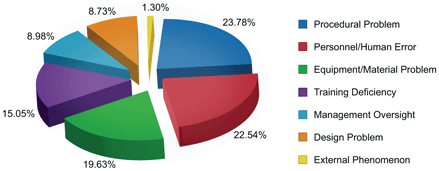
According to a recent poll of Reliable Plant magazine readers, as much as 60 percent of all plant problems can be attributed directly to “human factors” (Figure 1), specifically a lack of proper procedure (23.78 percent), a lack of training (15.05 percent) or personnel/human error (22.54 percent), which, though not always, is typically due to either a lack of proper documentation (procedure) or a lack of adequate training. What’s clear from this is that machines are failing because we either don’t know how to maintain them or haven’t adequately trained our staff to do so.
So, how does lubrication stack up? In this column, the first of a three-part series, I will look at the basics of lubrication preventive maintenance (PM) procedures. In Part 2, I’ll talk about what I call “hybrid PMs”, PMs that span multiple technologies. In Part 3, I’ll discuss how you should use the information in the PM to maximum effect in the field.
Knowledge Management
Many companies are starting to wake up to the reality that the way in which their assets are being maintained is simply not getting the job done. They are looking at ways to address either the lack of procedure or lack of training, and lubrication is no exception.
Figure 1. How Reliable Plant readers attributed plant problems to various factors.
While we’re talking about lubrication PMs, electrical PMs or mechanical inspections, the key is to develop a standard approach to capturing, organizing and delivering information, a field often referred to as knowledge management. Knowledge management is simply information about any business process in a form that can be easily disseminated and used by those who need it. The key here is “easily disseminated and used”. Take, for example, a library. Libraries contain tens of thousands of books. But unless each book is carefully catalogued in a system that is user friendly, and the book itself is carefully organized into relevant chapters and a subject index, the information is of little use. The same is true for lubrication knowledge.
As an example, consider the following real-life extracts from lubrication PMs I’ve reviewed in the past year or so:
Grease the motor bearing – Sure! How much? Which grease should I use? What should I watch for when applying grease?
Check oil level and top off as necessary – But, how do I check the level? Should the machine be running or down when I do my check? What oil should I use?
Sample gearbox – How? Should I crack the drain and insert a drop tube through the breather port, or is there a sample valve located somewhere?
I could go on, but you get the point. When it comes to lubrication, the amount of explicit knowledge or information available to the technician at the point of use is often so limited that, by inference, the technician has no option but to make certain assumptions on the fly. But wait, you say, “Our lube technician has 30 years of experience; he knows what he’s doing!”
Let’s examine this. So, Joe has been lubing for 30 years? Is it reasonable to expect that Joe has memorized every salient detail (how much, how often, which product or tool to use) for every task? And even if Joe is a true professional with a penchant for memorizing data, what will happen when Joe moves on to that long overdue retirement? Knowledge needs to be captured in a way that leverages Joe’s experience but insures that he or his successor is able to execute to a high level of precision and consistency each and every time.
Tacit vs. Explicit Knowledge
How do we capture knowledge? The first step is to recognize that knowledge comes in two distinct forms: tacit and explicit. Tacit knowledge is information that is stored in the minds of a few employees. My thoughts go back to a lubrication survey I did a few years ago where Joe (yes, that was really his name!) was unexpectedly sick on the day of the survey and nobody could tell me what lubricant was used in each machine because “Joe’s our lube guy”. I later learned that Joe had, in fact, suffered a mild heart attack, and while he fortunately recovered, things could have been much worse.
Explicit knowledge, on the other hand, is knowledge that has been captured as a procedure, document, training video, etc. In this form, it can be used by others to determine how a specific task should be done.
But wait, you say, “We have lubrication PMs. Our tasks are all documented in lube routes, so we’ve already captured our lubrication knowledge explicitly.” Unless you’ve documented each pertinent detail (how much, how often, which tool or product), don’t fool yourself – a PM cannot and should not be considered explicit unless all gray areas have been eliminated.
Why have few companies taken the time and effort to capture explicit knowledge? Hopefully you all agree that the devil is in the details, not the simple task description. The answer, in my opinion, is that the time and effort to build truly specific lubrication PMs is so daunting, and there always seems to be a bigger fire that needs attention.
The Difference is Accuracy
This need not be the case. The incremental effort required to make a lube PM truly explicit is really not that much harder than writing a general guide, particularly if you take an asset class approach to design the optimum maintenance process. But the difference in the accuracy by which tasks are executed is profound, depending on how specific the task description is in the PM.
Therefore, ask yourself if you have explicitly captured every detail necessary to lubricate your machines in your lube PMs, or if you are tacitly expecting that Joe will get it right every time. Stay tuned for Part 2, when I’ll go into more details of how a lube PM should (and should not) be laid out.
This is a 3 part series, click to view each part: 1 : 2 : 3
Mark Barnes
Mark Barnes is the Senior Vice President of Global Sales and Business Development at Des-Case Corporation. At the time this article was written he was the Vice President & Chief Technology Officer at Noria Corporation.
This project, like so many others, had a humble beginning. About five years ago, after returning from a routine sales call to the smelter where a representative was selling synthetic and specialty greases, he challenged the authors to develop a series of lubricants that he could sell to the aluminum industry. In a discussion with a group of maintenance people at the smelter, he was told that if his company could develop longer lasting lubricants and protect equipment better than the current product, they would buy from him.
This project, like so many others, had a humble beginning. About five years ago, after returning from a routine sales call to the smelter where a representative was selling synthetic and specialty greases, he challenged the authors to develop a series of lubricants that he could sell to the aluminum industry. In a discussion with a group of maintenance people at the smelter, he was told that if his company could develop longer lasting lubricants and protect equipment better than the current product, they would buy from him.
Air can also be temporarily entrained into oil through bearing agitation. This can occur in healthy oil, but is more common in oil containing high amounts of moisture, as well as oil having other forms of contaminants. Air entrained in oil sumps of rotating equipment tends to rise out and re-enter the headspace over time. Read to learn some of the potential effects of air entrainment.
Air can also be temporarily entrained into oil through bearing agitation. This can occur in healthy oil, but is more common in oil containing high amounts of moisture, as well as oil having other forms of contaminants. Air entrained in oil sumps of rotating equipment tends to rise out and re-enter the headspace over time. Read to learn some of the potential effects of air entrainment.
A number of common mistakes are made in selecting, scoping and carrying out lubrication PM tasks and intervals. I have outlined four common "wrongs" with respect to lube PM optimization, which can, with some effort and guidance, be turned into four "rights."
A number of common mistakes are made in selecting, scoping and carrying out lubrication PM tasks and intervals. I have outlined four common "wrongs" with respect to lube PM optimization, which can, with some effort and guidance, be turned into four "rights."
Overgreasing rolling element bearings in motors has been an industry problem for several years. More motors have bearing failures due to overgreasing than from undergreasing. For the nuclear power generation industry in particular, the Nuclear Regulatory Commission (NRC) provided guidance and direction. Their method delivered mixed performance results for the amount of resources that companies have had to devote to motor relubrication, motivating some organizations to develop additional improvements.
Overgreasing rolling element bearings in motors has been an industry problem for several years. More motors have bearing failures due to overgreasing than from undergreasing. For the nuclear power generation industry in particular, the Nuclear Regulatory Commission (NRC) provided guidance and direction. Their method delivered mixed performance results for the amount of resources that companies have had to devote to motor relubrication, motivating some organizations to develop additional improvements.
Like blood coursing through the veins of living beings, lubrication is what keeps a plant’s capital investments operating smoothly and efficiently. At the same time, when lubrication becomes contaminated or depleted of its sustaining properties, overheating or exhaustion are among the problems that can occur. That leads to downtime and loss of production, and the potential of some hefty maintenance expenses.
Like blood coursing through the veins of living beings, lubrication is what keeps a plant’s capital investments operating smoothly and efficiently. At the same time, when lubrication becomes contaminated or depleted of its sustaining properties, overheating or exhaustion are among the problems that can occur. That leads to downtime and loss of production, and the potential of some hefty maintenance expenses.
Ultrasonic technology (UT) has become widely accepted for the detection of leaks in both pressurized and nonpressurized systems. Most compressor service companies and several manufacturers own some type of ultrasonic sensor for pinpointing leaks. It is easy to cost-justify the purchase of an ultrasonic sensor based upon the high cost of energy loss due to leaks. However, there is another application for ultrasound that consumers, nondestructive testing (NDT) organizations, and even developers and manufacturers of ultrasonic sensors are often not aware of or overlook. UT can be used as a means to detect early wear of components such as bearings and gears due to lack of lubrication or overlubrication.
Ultrasonic technology (UT) has become widely accepted for the detection of leaks in both pressurized and nonpressurized systems. Most compressor service companies and several manufacturers own some type of ultrasonic sensor for pinpointing leaks. It is easy to cost-justify the purchase of an ultrasonic sensor based upon the high cost of energy loss due to leaks. However, there is another application for ultrasound that consumers, nondestructive testing (NDT) organizations, and even developers and manufacturers of ultrasonic sensors are often not aware of or overlook. UT can be used as a means to detect early wear of components such as bearings and gears due to lack of lubrication or overlubrication.
When we think of contamination in lubricated systems, we often focus on particle and water contamination. The fact of the matter is that there are many other contaminants we should consider and attempt to control. Most contaminants, which include any material not contained in the lubricant's formulation, can potentially damage the oil and the lubricated components. Although air is always present in lubricating oil, it is often justifiable to adopt measures to minimize its presence.
When we think of contamination in lubricated systems, we often focus on particle and water contamination. The fact of the matter is that there are many other contaminants we should consider and attempt to control. Most contaminants, which include any material not contained in the lubricant's formulation, can potentially damage the oil and the lubricated components. Although air is always present in lubricating oil, it is often justifiable to adopt measures to minimize its presence.