
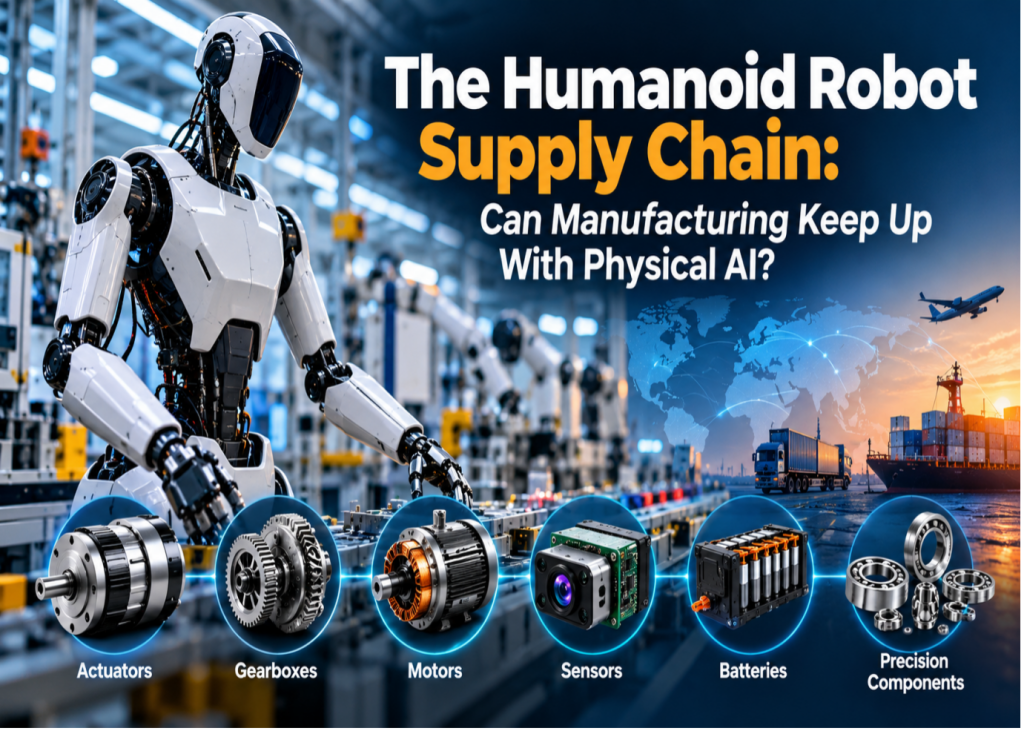
The Humanoid Robot Supply Chain: Can Manufacturing Keep Up With Physical AI?
Neeta Verma, Environmental Compliance Leader | Enterprise Quality Governance | Technical Author
Posted 11/5/2026
Humanoid robots are often presented as an artificial intelligence breakthrough. But the next phase of the industry may be decided less by AI models than by something far more physical: whether manufacturers can build enough reliable actuators, gearboxes, motors, sensors, batteries, precision components and serviceable systems at the right cost and quality.
That makes the humanoid robot race a manufacturing and supply-chain race.
The timing is significant. On October 6, 2026, Boston Dynamics appointed former Amazon AI leader Rohit Prasad as chief executive officer, effective October 7. The company said the appointment will accelerate its Physical AI strategy and the commercialization of intelligent machines at scale. [1]
The message is clear: the industry is moving from demonstrations and prototypes toward commercial deployment. But scaling a humanoid is fundamentally different from scaling software.
A humanoid has to move, sense, balance, manipulate objects, survive repeated operating cycles and interact safely with people. Every one of those capabilities creates a physical supply-chain requirement.
The real bottleneck is underneath the AI
McKinsey describes the robotics supply chain as the most underappreciated constraint on humanoid scale. Its analysis estimates that actuators represent approximately 40% to 60% of a humanoid’s bill of materials, while sensing and perception account for 10% to 20%, compute and control 10% to 15%, structural components 5% to 10%, and battery modules 5% to 10%. Together, these five domains represent approximately 85% to 90% of total unit costs. [2]
Many of the most important subsystems, including motors, harmonic drives, power electronics, battery systems and sensors, also overlap with established electric-vehicle supply chains. McKinsey estimates that China has approximately 90% of global permanent-magnet processing, 40% of precision bearings, 35% of motors and 30% of power electronics capacity relevant to these supply chains. [2][3]
This creates a difficult scaling problem.
The humanoid industry cannot simply order millions of standardized components from a mature supplier ecosystem in the way established automotive or consumer-electronics industries can. Many robotics components still require customization, qualification and relatively low-volume production.
The result is a classic industrial bottleneck:
Low volumes discourage suppliers from investing in dedicated capacity, while high component costs make it difficult for manufacturers to generate the demand needed to justify that investment.
Actuators are becoming the industry’s critical hardware bottleneck
The actuator is effectively the muscle of a humanoid robot.
It converts electrical energy into controlled mechanical movement and typically combines a motor, gearbox, sensors and associated electronics. The actuator determines how much force a robot can produce, how precisely it can move, how quickly it can respond and how reliably its joints can operate.
A humanoid requires numerous actuators across its body.
Recent reporting highlights an emerging actuator shortage in the United States. Apptronik, for example, has developed about 80 different actuators for its robots, illustrating how much design variation still exists across the industry. MarketWatch also reported that the types of actuators currently manufactured at scale in the United States are primarily designed for aerospace or automotive applications and are not necessarily suitable for humanoid robots. [4]
Tesla CEO Elon Musk has also said that the Optimus program did not initially have an established supply chain and that Tesla has had to build the supply chain or bring production in-house. [4]
This illustrates the industry’s current reality: manufacturers are not only designing robots. They are often having to help create the component supply chains required to build them.
Gearboxes, bearings and precision components create another choke point
Actuators depend on precision gear systems to convert motor speed into usable torque.
Strain-wave, or harmonic, gearboxes are particularly important because they can provide high reduction ratios and precision within compact spaces. But conventional precision manufacturing can be time-consuming and capital-intensive.
Schaeffler is attempting to address exactly this constraint.
In August 2026, the company introduced formed strain-wave gearboxes specifically for humanoid robots. Schaeffler says its forming technology can reduce manufacturing costs by more than 25% and material consumption by more than 75%. The company has completed validation and plans to begin mass manufacturing in 2027, initially in Germany and subsequently in other regions. [5]
Schaeffler says strain-wave gearboxes are key components within actuators that account for around half of humanoid manufacturing costs. It also says the new forming process can produce key components in seconds rather than minutes, addressing a potential manufacturing bottleneck as volumes increase. [5]
This is important because it demonstrates how traditional industrial suppliers can become strategic players in the humanoid ecosystem.
The same principle applies to precision bearings, motors, encoders, force sensors and other motion-control components.
The challenge is not simply making one technically capable part. It is making large volumes of parts with consistent tolerances, traceability, quality and reliability.
China has a major manufacturing advantage
China’s advantage in humanoid robotics is not limited to robot design.
It is the depth of the surrounding manufacturing ecosystem.
China already has major manufacturing capacity across permanent magnets, precision bearings, motors and power electronics, with these supply chains overlapping with its large electric-vehicle and electromechanical manufacturing base. [2][3]
This creates important economies of scale.
Motors, permanent magnets, power electronics, batteries and other components already have established manufacturing ecosystems because of China’s EV and industrial sectors. Humanoid manufacturers can therefore benefit from existing tooling, supplier networks, engineering expertise and production infrastructure.
The broader industrial-robot ecosystem reinforces that advantage. China installed approximately 354,000 industrial robots in 2025, up 20% year on year and representing approximately 59% of global industrial-robot deployments, according to the International Federation of Robotics. [19]
China’s humanoid market is also moving beyond demonstrations into commercial validation.
TrendForce estimated in August 2026 that China’s humanoid-robot market would reach CNY 15 billion in 2026 and grow by at least 60% in 2027 as mass production expands and applications increase across automotive, 3C electronics, aerospace, logistics and energy. TrendForce also noted that the market remained some distance from large-scale, standardized repeat purchases, making customer retention, maintenance cost and operating efficiency important tests of commercial viability. [6]
That distinction matters.
The question is no longer simply whether Chinese manufacturers can build humanoids quickly. It is whether those robots can be produced repeatedly, supported economically and deployed at scale.
Humanoid production is moving from prototypes toward repeatable manufacturing
XPENG provides an important example.
In September 2026, XPENG announced that it had commissioned humanoid robot production lines and completed production-line manufacturing of its IRON humanoid robot. The company said core-process automation exceeded 80% and that mass production was targeted by the end of 2026. [7]
This transition is significant because the manufacturing requirements change once a company moves beyond prototypes.
Production requires process capability, supplier qualification, incoming inspection, traceability, automated testing, calibration, yield management, corrective action and engineering-change control.
The same principles that determine quality in automotive and electronics manufacturing increasingly apply to humanoid robotics.
The scale-up target is becoming more concrete
Hyundai Motor Group has outlined one of the clearest industrial scaling strategies.
At CES 2026, Hyundai said it aims to establish a scalable production system capable of manufacturing 30,000 robot units annually by 2028. It also described a phased Atlas deployment strategy, beginning with parts sequencing at Hyundai Motor Group Metaplant America in 2028 and expanding to component assembly by 2030. [8]
This figure should be interpreted correctly.
It is a planned annual production capability, not evidence that 30,000 Atlas robots are already being produced or that 30,000 units will necessarily be sold in 2028.
Hyundai has subsequently continued to advance the industrial deployment plan. The Robotics Metaplant Application Center, or RMAC, opened at Hyundai Motor Group Metaplant America in Georgia in 2026. Boston Dynamics says Atlas robots are being trained there in real manufacturing environments, including logistics and sequencing of automotive parts. The company also said the RMAC operation will move next year to a building approximately ten times larger. [9]
Hyundai’s August 26, 2026 investor-day update confirmed the goal of deploying Atlas at HMGMA from 2028 and separately said RMAC would expand tenfold by the end of 2026. [10]
In September 2026, Hyundai also said it plans to deploy approximately 25,000 Atlas humanoid robots across its global plants over the next few years as part of its broader robotics strategy. This is a company plan, not a confirmed completed deployment. [17]
This creates a potentially important closed learning loop:
robot deployment → real-world data → training and validation → improved robot performance → broader deployment.
For manufacturers, it also means robot suppliers will increasingly need to provide not just hardware, but maintenance processes, spare parts, diagnostics, software support and lifecycle data.
More joints mean more maintenance exposure
A humanoid can contain dozens of actuators, with each joint combining motors, gearboxes, bearings, sensors and control electronics.
That dramatically increases the number of potential failure points.
For maintenance organizations, this changes the equation.
A production line equipped with humanoids may require:
- actuator condition monitoring
- gearbox inspection and replacement strategies
- bearing-life monitoring
- sensor calibration
- battery health management
- thermal monitoring
- joint-level vibration analysis
- spare actuator and gearbox inventories
- firmware and software change control
- documented repair procedures
- supplier traceability for critical components
The maintenance strategy therefore cannot be added after deployment.
It has to be designed into the robot architecture and the manufacturing supply chain from the beginning.

Atlas shows what industrial serviceability could look like
Boston Dynamics’ published Atlas specifications illustrate the direction.
Atlas is specified at 1.9 metres in height and 90 kg in weight, with 56 degrees of freedom, tactile sensing in its fingers and palm, and 360-degree camera coverage. Boston Dynamics specifies up to four hours of battery life, two hours under heavy lifting, a three-minute autonomous battery swap and IP67 protection. The published specifications also identify modular components, field-replaceable components and customer self-repair certification. [11]
These characteristics matter from a maintenance perspective.
If humanoids are expected to operate in factories, logistics facilities and other industrial environments, manufacturers cannot treat every failure as a laboratory engineering event requiring factory return.
The future maintenance model will increasingly depend on modular replacement, condition monitoring, standardized interfaces, diagnostic data and local service capability.
Batteries are becoming part of the humanoid supply-chain race
Battery technology is another important constraint.
McKinsey estimates battery modules represent approximately 5% to 10% of humanoid BOM cost. [2]
Battery performance affects operating time, robot weight, charging requirements, thermal management and productivity.
Samsung SDI is developing cylindrical and all-solid-state battery technologies for the robotics market. In September 2026, the company said its SolidStack all-solid-state technology uses proprietary solid electrolytes and an anode-free design, and that it was targeting mass production of its pouch-type all-solid-state battery in the second half of 2027. [12]
The important point is that this remains a development and planned mass-production timeline, not evidence that solid-state batteries are already being used at mass scale in humanoids.
For industrial users, battery sourcing will increasingly be part of the uptime equation.
Contract manufacturing is becoming part of the humanoid supply chain
The emerging supply chain is also beginning to involve established contract manufacturers.
McKinsey identifies Jabil as the worldwide production partner for Apptronik’s Apollo humanoid robots, illustrating how established manufacturing infrastructure can begin to support humanoid production as companies move from development toward scale. [2]
This is significant because contract manufacturing can provide access to production engineering, sourcing networks, quality systems and manufacturing capacity without requiring every robotics company to build the entire industrial infrastructure itself.
Physical AI is creating a new technology stack
The humanoid supply chain is also expanding beyond mechanical hardware.
In March 2026, NVIDIA announced a broad robotics ecosystem initiative focused on production-scale Physical AI. The company highlighted humanoid developers and robotics companies alongside its Cosmos world models, Isaac simulation technologies and Isaac GR00T robotics models. [13]
In June, NVIDIA announced Halos for Robotics, a full-stack safety system for robotics and Physical AI. NVIDIA said Agility Robotics was the first humanoid company to work with it on incorporating elements of Halos into a proprietary safety system. [14]
This matters because industrial deployment will require more than mechanical reliability.
Manufacturers will have to manage:
- AI model changes
- software versions
- sensor updates
- safety validation
- cybersecurity
- digital twins and simulation
- edge computing
- data governance
- human-robot interaction
- change control across hardware and software
The result is a new manufacturing-engineering problem in which mechanical, electrical, software, AI and safety changes can all affect the same production asset.
Geopolitics could reshape the robot supply chain
The global humanoid supply chain is developing at the same time as governments are tightening controls around strategic technologies.
The United States is already an example.
On July 28, 2026, the FCC added foreign-produced advanced robotic devices, except devices granted a Conditional Approval by the Department of War, to its Covered List. New models of covered devices cannot receive FCC equipment authorization unless exempted, while devices the FCC previously authorized can continue to be imported and sold. [21][22]
The FCC has since announced its first Conditional Approvals: Husqvarna robotic lawn-mower platforms on September 9 and ANSCER Robotics warehouse platforms on September 18. These approvals covered lawn-mower and warehouse-robot platforms rather than humanoid robots. [15][23]
This should not be described as a blanket ban on Chinese humanoid robots.
The regulatory structure is more specific and includes a conditional-approval mechanism.
Nevertheless, the policy direction is important for manufacturers because country of origin, component sourcing, national security, cybersecurity and market-access considerations can increasingly influence robotics supply chains.
The geopolitical exposure also extends upstream.
Permanent magnets are critical to high-performance motors, while precision components, power electronics and other actuator inputs are distributed across several regional supply chains. China’s manufacturing concentration in several of these categories therefore creates a strategic dependency for companies attempting to build regional humanoid ecosystems. [2][3]
China’s manufacturing advantage is attracting greater scrutiny
The supply-chain issue is now attracting attention beyond robotics companies themselves.
Recent reporting in October 2026 described growing interest among U.S. venture investors in visiting Chinese robotics factories to understand China’s manufacturing capabilities, component ecosystem and deployment advantage. The reporting also highlighted continuing dependence on Chinese components among some U.S. robotics companies. [16]
This is an important strategic signal.
The competition is no longer simply about who has the best robot.
It is about who has the deepest manufacturing ecosystem behind the robot.
Humanoid hands are becoming another manufacturing bottleneck
The supply-chain challenge is not limited to the robot’s major joints.
Humanoid hands are emerging as another difficult manufacturing problem because they combine compact actuators, tactile sensing, complex mechanical structures and the need for precise manipulation.
Boston Dynamics officially unveiled its new Atlas hand in October 2026. The new hand has four fingers and 13 degrees of freedom, compared with seven degrees of freedom in the earlier design, while being designed around the requirements of real-world manipulation and scalable production. [20]
TrendForce’s October 8, 2026 analysis also highlighted the growing competitive focus on robot-hand architecture and dexterity. It noted that Boston Dynamics is moving toward a leaner, task-driven hand designed with mass production in mind, while Tesla’s pursuit of near-human dexterity is creating additional manufacturing challenges. [18]
For manufacturers, this adds another layer to the supply-chain question.
A humanoid may be able to walk reliably with standardized lower-body components, but industrial tasks often depend on the hand’s ability to grip, orient, sense and manipulate different objects repeatedly.
That means manufacturers will increasingly need to evaluate hand actuators, tactile sensors, precision mechanisms and replacement parts alongside the rest of the robot BOM.
What manufacturers should do now
Companies planning to deploy humanoids should begin treating them as production assets, not experimental gadgets.
1. Map the complete robot BOM
Identify which components are single-source, geographically concentrated, difficult to qualify or exposed to rare-earth, battery or semiconductor constraints.
2. Qualify critical alternatives early
For actuators, gearboxes, motors, bearings, sensors and batteries, dual sourcing should begin before commercial deployment creates a shortage.
3. Build maintenance into procurement
Supplier selection should evaluate not only unit price, but also:
- expected service life
- replacement time
- spare-parts availability
- field-replaceable modules
- diagnostic capability
- calibration requirements
- firmware support
- repair documentation
- end-of-life support
4. Treat engineering changes as supply-chain events
A change to a gearbox, sensor, motor, battery or software model can affect safety, reliability, performance and potentially regulatory status.
Manufacturers need formal change-control processes that connect engineering, procurement, quality, maintenance and compliance teams.
5. Monitor geopolitical exposure
Companies should know where critical magnets, semiconductors, batteries, sensors and motion-control components are produced and processed.
A nominally diversified supplier list does not provide true resilience if multiple suppliers depend on the same upstream source.
6. Measure robots like production equipment
The most important metrics will eventually move beyond demonstrations and unit shipments.
Manufacturers should monitor:
- uptime
- mean time between failures
- mean time to repair
- actuator replacement frequency
- battery degradation
- unplanned downtime
- task success rate
- maintenance cost per operating hour
- spare-parts consumption
- energy consumption per task
These metrics will determine whether humanoids actually deliver manufacturing value.

The next competitive advantage may be reliability
The humanoid industry has already demonstrated impressive mobility, manipulation and AI capabilities.
The harder challenge is repeatability.
A factory does not need a robot that can perform an impressive demonstration once.
It needs a machine that can perform the same task thousands of times, recover safely from unexpected conditions, communicate its maintenance needs, receive controlled software updates and return to production quickly after a component failure.
That is why the next stage of humanoid robotics will be determined by supply-chain engineering as much as by artificial intelligence.
China’s manufacturing depth gives it a significant advantage in several component categories. European suppliers have opportunities in precision motion, gearboxes, motors, sensors and robotic hands. U.S. companies are investing heavily in AI, robotics platforms and domestic supply chains. Companies such as Hyundai, Boston Dynamics, XPENG, NVIDIA, Samsung SDI and Schaeffler are already building pieces of the emerging ecosystem.
The competitive question is therefore changing.
It is no longer simply:
Who can build the smartest humanoid?
It is:
Who can build, supply, maintain and scale the most reliable humanoid at an economically viable cost?
That is the supply-chain race behind Physical AI.
And for manufacturers, the companies that solve the less visible problems of actuators, precision components, batteries, maintenance, quality, traceability and serviceability may ultimately determine how quickly humanoid robots move from demonstrations into everyday industrial production.
References
[3] McKinsey & Company, “China’s humanoid robot edge,” June 10, 2026.
[11] Boston Dynamics, “Atlas Specifications,” December 23, 2025.
[12] Samsung SDI, “Robot Batteries Power the Era of Humanoids,” September 8, 2026.
[13] NVIDIA, “NVIDIA and Global Robotics Leaders Take Physical AI to the Real World,” March 16, 2026.
[17] Hyundai Motor Group, “Inside the Robotics Race: Atlas Learns the Real World,” September 30, 2026.
[18] TrendForce, “Humanoid Robot Market Bulletin – Oct. 8, 2026,” October 8, 2026.
[20] Boston Dynamics, “Robot Hands for Modern AI and Real Work,” October 1, 2026.
[22] Mondaq, “FCC Adds Advanced Robotic Devices To The Covered List.”

Related Articles

Maximo Application Suite – Trick or Treat?

An Engineer's Guide to Robots

An Inspector Seeking Work: Closing the Gaps Nobody Has Time to Cover
The New Semiconductor Shortage: How AI Is Reshaping Chip Supply, Prices and Manufacturing