

Training Robots for Maintenance: From Digital Practice to Real-World Reliability
Ahmed Rezika, SimpleWays OU
Posted 10/8/2026
How do we turn a robot that can dance, run, and manipulate objects into a maintenance colleague capable of working safely around industrial equipment?
Watching humanoid robots dance, sprint across a stadium, or recover from a fall is fascinating. These demonstrations are more than entertainment. They show how rapidly robotics is advancing in movement, coordination, balance, and physical interaction.
Yet, as maintenance engineers, we should look beyond the spectacle. Running 100 meters is one challenge. Recognizing a loose connection, positioning a vibration sensor, or opening an unfamiliar equipment enclosure without damaging anything is another.
Industrial maintenance introduces a different set of expectations. We need more than impressive movement. We need repeatable actions, reliable measurements, appropriate responses to unexpected conditions, and strict respect for equipment and personnel safety.
The interesting question is not whether a humanoid can perform a task once. It is whether it can perform that task repeatedly, recognize when something is going wrong, and know when to stop and request assistance.
In the previous article, Training the Next Maintenance Technician: Can Humanoids Learn Real Industrial Tasks?[6], we explored how humanoids could learn by watching human demonstrations, through tele-operation, and by practicing in simulated environments. We ended at the sim-to-real challenge: transferring what a robot learns in a digital world into the unpredictable conditions of a real industrial facility.
This second part picks up precisely there. We will examine how simulation, reinforcement learning, and controlled real-world practice could prepare humanoids for actual maintenance tasks, and where the lessons from robotic athletics may be more relevant to industrial reliability than the records themselves.
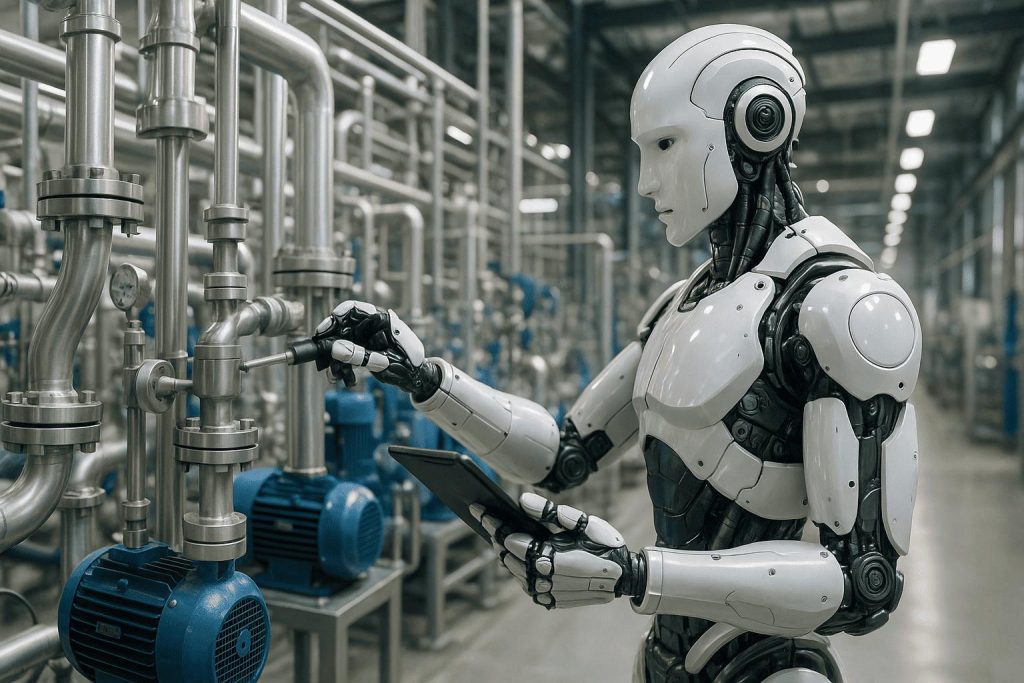
The Sim-to-Real Gap: When the Digital World Meets the Shop Floor
Learning in Simulation—and Facing Reality Later leads to one of the central challenges in robotics: the sim-to-real gap.
Researchers are working directly on this gap. In 2025, researchers demonstrated sim-to-real reinforcement learning for vision-based dexterous manipulation on humanoids. They trained humanoid systems in simulation on tasks including grasp-and-reach, box lifting, and bi-manual handover, then transferred the learned policies to real hardware. Importantly, the work included automated real-to-simulation tuning and visual variation to reduce the differences between the simulated and physical environments. [1]
The progress has continued. In 2026, researchers presented VIRAL, a framework that trained humanoid loco-manipulation entirely in simulation before deploying it directly to a real Unitree G1 humanoid. The system used extensive randomization of lighting, materials, cameras, image quality, and sensor delays to make the simulated training environment less predictable. The resulting robot could perform continuous loco-manipulation in real environments without additional real-world fine-tuning. [2]
Another 2026 project pushed this idea further by training a humanoid entirely from simulated visual data to interact with different articulated objects, including doors, and then transferring the learned policy to a real robot. [3]
This is where simulation becomes particularly interesting for maintenance. We do not necessarily need to create one perfect digital copy of a machine. Instead, the training environment can expose it to variation as different lighting, different access positions, different component appearances, different obstacle locations, or slight changes in dimensions,
The objective is not to teach: This is exactly how you open this exact door.
It is to teach something closer to: This is how you recognize, approach, manipulate, and verify this type of task under different conditions.
Although that distinction could be critical for maintenance applications, simulation is not the final answer. Why? Because No matter how many digital attempts the humanoid completes, there will eventually be a first encounter with the real machine. And that is where reality may still win in many ways and distract the humanoid e.g. a loose cable may block its path, a component may have been modified years earlier, oil may make a surface slippery, or a door may resist because of wear.
This is why the most realistic future is probably not: Train in simulation → release the robot alone.
It is more likely to be: Demonstrate → simulate → practice → test on the real asset → supervise → gradually increase autonomy.
Simulation can give a humanoid something maintenance departments would never normally have the time or resources to provide a new technician: thousands of chances to practise before making the first mistake on the real equipment.
But there is another way to learn that goes beyond copying demonstrations or practicing in a prepared digital world.
The robot can also learn by repeatedly trying to achieve a goal, receiving feedback, and gradually discovering which actions work.
That takes us to the fourth method:
Learning From Success—and Failure: Reinforcement Learning
There is another way a humanoid can learn.
It can try to achieve a goal, receive feedback, and try again.
This is the basic idea behind reinforcement learning (RL) that was long used to train AI models . Instead of telling the robot every movement it must make, we define what successful behavior looks like and let the learning system discover effective actions through repeated attempts. More or less like playing a game. A good example for this is AlphaZero, DeepMind’s AI system for chess, shogi, and Go: “AlphaGo Zero estimated and optimized the probability of winning, exploiting the fact that Go games have a binary win or loss outcome.”. [4]
This is already being used to train humanoid movement and there are demonstration for this:
At the 2026 World Humanoid Robot Games in Beijing, the Chinese Tiangong Ultra completed 100 metres in 8.86 seconds, faster than Usain Bolt’s 9.58-second human record. Just three days earlier, it had run 9.39 seconds. Another humanoid, Lightning, also broke the human record with 9.47 seconds.
But there is another side to the same story. Some robots struggled to stop after running. Others crashed. During the Games, a robot even lost its balance while attempting to lift a 15 kg barbell.
That contrast is extremely important for maintenance.
Learning to perform an action is not the same as learning to control every consequence of that action.
A humanoid may learn to accelerate, but still struggle to stop.
It may learn to reach an object, but not recover when the object moves.
It may learn to lift a load, but lose stability when the load behaves differently from what it expected – think of liquid barrels or unfastened assemblies. For maintenance, these differences matter enormously.
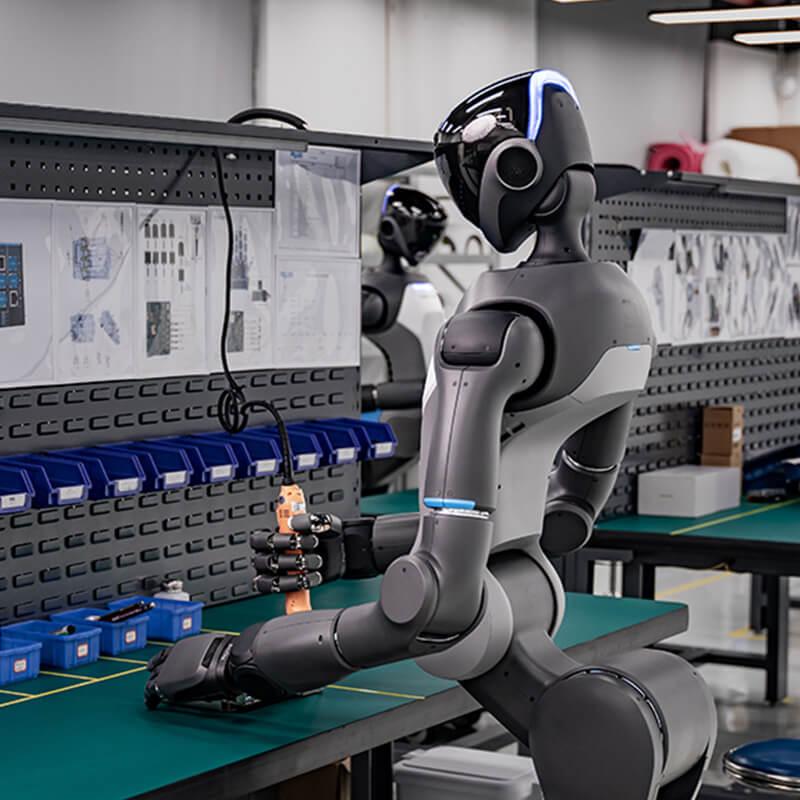
What does the robot actually learn from reinforcement learning?
Suppose we want a humanoid to place a vibration sensor against a bearing housing.
We could define a successful outcome:
- reach the correct machine,
- identify the measurement point,
- position the sensor correctly,
- establish adequate contact,
- collect the measurement,
- confirm logic measurement,
- and avoid damaging the equipment.
The learning system can assign positive feedback when these objectives are achieved and negative feedback when they are not.
The robot then searches for better ways of achieving the objective.
It might discover that approaching from one angle gives better stability.
It might learn that excessive force does not improve the measurement.
It might learn to reposition its body before extending its arm.
It might even learn that a particular approach becomes unreliable when another object obstructs the normal path.
This is where reinforcement learning becomes particularly powerful for humanoids.
The robot is not simply memorizing: Move joint 17 by this amount.
It is learning something closer to: Given this situation, these actions increase my probability of achieving the objective safely.
Recent research is pushing reinforcement learning beyond laboratory demonstrations. For example, Zhang et al. (2026) proposed HARC, a real-world online reinforcement-learning framework for robotic manipulation. The method was evaluated on physical robotic arms and on simulated humanoid-manipulation tasks, where it improved success rates over a strong baseline on several pick-and-place and object-relocation tasks.[5]
But there is an important warning here.
We Cannot Let the Robot Learn Everything the Hard Way
A robot learning to dance can fall.
A robot learning to sprint can crash into a barrier.
A robot learning to manipulate a training object can drop it.
A maintenance humanoid learning beside a running turbine, energized cabinet, or expensive production machine cannot be given the same freedom to experiment.
This is why reinforcement learning is unlikely to operate alone.
The more realistic architecture combines the four methods we have discussed:
Watch humans → learn from demonstrations → practice in simulation → refine through controlled interaction.
And the rewards themselves must reflect maintenance priorities.
Speed should not be the highest reward.
A maintenance humanoid should be rewarded for:
Safety + accuracy + repeatability + correct diagnosis + equipment protection + task completion.
Only then does the definition of “good performance” begin to resemble maintenance.
A humanoid that completes a lubrication task in two minutes but damages a seal is not better than one that takes four minutes and completes it correctly.
A humanoid/robot that identifies an abnormal vibration but cannot recognise when its measurement is unreliable is not autonomous enough.
And a robot that encounters an unexpected condition and continues blindly may be more dangerous than one that simply stops.
This leads to perhaps the most important lesson from the spectacular athletic demonstrations we are seeing today:
The objective is not to make the humanoid look human. The objective is to make its behavior reliable enough to be trusted.
From Learned Skills to Real Maintenance Tasks
We have now explored how a humanoid might acquire physical skills. But training methods alone do not tell us which tasks deserve our attention.
From a maintenance engineering perspective, the next question is more practical: where should we begin?
Not every maintenance activity requires a humanoid. Many inspections are already performed more efficiently with fixed sensors, drones, specialized mobile robots, or conventional automation.
A humanoid becomes interesting when a task requires a combination of human-like access, manipulation, mobility, and interaction with equipment designed around people.
The following are candidate applications, not claims of proven industrial autonomy.
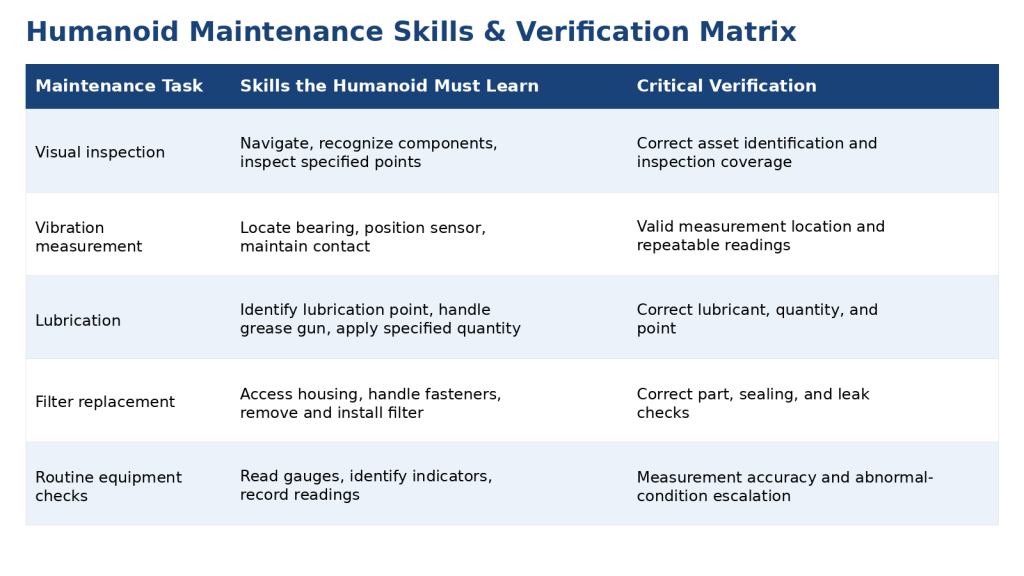
A sensible starting point would be non-invasive inspection and data collection in controlled areas. These activities can provide practical experience without immediately requiring a robot to manipulate critical components. The value is maximized if those areas carries some sort of risk to humans not to robots.
As capabilities and validation improve, tasks involving tools, component removal, and physical intervention could be considered individually.
However, any task involving hazardous energy, confined spaces, or safety-critical equipment would require a separate engineering assessment, appropriate safeguards, and validated procedures. A learned policy does not replace lockout/tagout, isolation verification, or an authorized work permit.
The training objective is therefore not to produce a humanoid that can perform every job in a maintenance department. It is to develop a dependable set of skills for specific tasks, under clearly defined operating conditions.
That is a much more useful engineering target than general human-like capability.
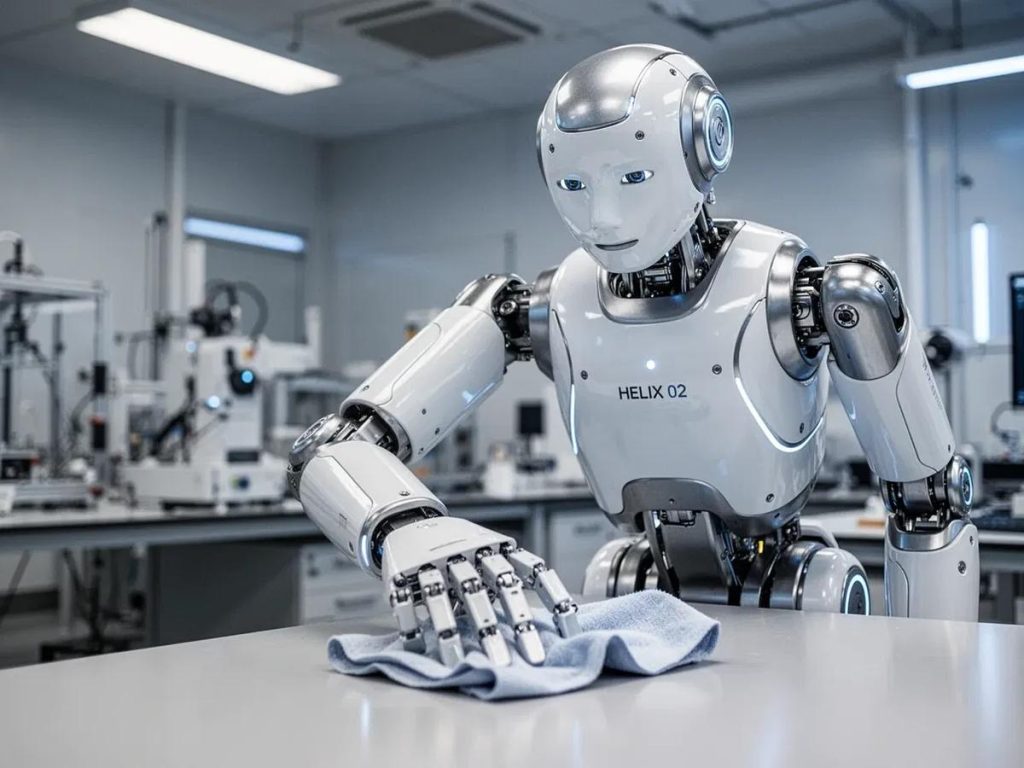
Thought Experiment: The Maintenance Technician We Actually Need
The progress in humanoid robotics is real, but the path from impressive demonstrations to industrial deployment remains demanding.
Simulation can accelerate learning. Demonstrations can transfer human experience. Reinforcement learning can help discover effective movements. Yet none of these methods, individually or together, automatically establishes safe, repeatable maintenance performance.
We will need to define tasks carefully, train against realistic variations, validate results on real equipment, and establish clear limits on autonomy.
Most importantly, we must judge these systems by the standards we already apply to maintenance: equipment reliability, personnel safety, measurement quality, and verified outcomes.
The next maintenance technician may have a humanoid body, but its value will not come from walking on two legs or holding a tool like a human.
It will come from knowing what to do, doing it correctly, recognizing when conditions have changed, and stopping when the situation exceeds its validated capabilities.
And that brings us to the practical challenge ahead: How do we select the first maintenance tasks for humanoids, and build a training and validation program that earns the trust of the people responsible for the plant?
That is where the conversation moves from robotics demonstrations to maintenance engineering.
That is how we begin building a maintenance colleague we can trust: one carefully selected task, one validated skill, and one controlled step at a time.
Must-Know Jargon
Sim-to-Real Gap: The difference between a robot’s performance in a simulated environment and its behaviour in the physical world. Variations in friction, lighting, sensor readings, component wear, and unexpected obstacles can cause a trained policy to perform differently on real equipment.
Sim-to-Real Transfer: The process of deploying skills or learned control policies developed in simulation onto a physical robot. The transferred behaviour must still be tested and validated because real equipment and operating conditions may differ from the simulated environment.
Loco-manipulation: It describes a robot that moves its body while interacting with an object, rather than performing these actions separately. This requires coordinating movement, balance, contact forces, and object handling at the same time.
Domain Randomization: A training technique that deliberately varies simulated conditions, such as lighting, textures, object dimensions, and sensor noise. This helps prevent the robot from becoming dependent on one specific simulation and improves its ability to handle variations in real environments.
Reinforcement Learning (RL): A machine learning method in which a robot learns through actions and feedback. The system receives rewards or penalties based on its performance and gradually discovers actions that help it achieve a defined objective.
Reward Function: A mathematical definition of the outcomes a learning system should pursue. In maintenance, it can incorporate task accuracy, measurement quality, equipment protection, and safe stopping, rather than simply rewarding speed or task completion.
Policy (in Reinforcement Learning): The learned decision-making rule that maps the robot’s observations or estimated state to its next action. For example, a policy might help a humanoid adjust its approach angle and arm movement when positioning a sensor against a bearing housing.
References
1- Proceedings of The 9th Conference on Robot Learning, PMLR 305:4926-4940, Toru Lin, Kartik Sachdev, Linxi Fan, Jitendra Malik, Yuke Zhu, “Sim-to-Real Reinforcement Learning for
Vision-Based Dexterous Manipulation on Humanoids”, 2025, https://proceedings.mlr.press/v305/lin25c.html
2- Proceedings of the IEEE/CVF Conference on Computer Vision and Pattern Recognition (CVPR), Tairan He et al, Visual Sim-to-Real at Scale for Humanoid Loco-Manipulation, 2026,
3- Proceedings of the IEEE/CVF Conference on Computer Vision and Pattern Recognition (CVPR), Haoru Xue et al, “Opening the Sim-to-Real Door for Humanoid Pixel-to-Action Policy Transfer.”, 2026:https://www.umiacs.umd.edu/news-events/news/umd-researchers-enable-robots-learn-human-experience
4- Silver, D., Hubert, T., Schrittwieser, J., et al, 2018. “A general reinforcement learning algorithm that masters chess, shogi, and Go through self-play.” Science, 362(6419), 1140–1144, https://doi.org/10.1126/science.aar6404
5- alphaXiv, Zhang, Y., Torielli, D., et al. “Efficient Real-World Online Reinforcement Learning for Robot Manipulation via Centralized Training and Critic Decomposition.” August 2026, https://www.alphaxiv.org/abs/2608.09762
6- MaintenanceWorld.com, Ahmed Rezika, Training the Next Maintenance Technician: Can Robots Learn Industrial Tasks, September 3rd , 2026, https://maintenanceworld.com/2026/09/03/training-the-next-maintenance-technician-can-robots-learn-industrial-tasks/

Related Articles

An Engineer's Guide to Robots