An Inspector Seeking Work: Closing the Gaps Nobody Has Time to Cover
A maintenance department does not always need another technician. Sometimes, it needs something different: more consistent inspection coverage, more detailed observations, and reliable records of what is happening across the plant. The maintenance team may know its equipment well and follow established maintenance plans, yet some inspection points receive less attention than others. Small abnormalities may go unnoticed between rounds. Routine checks may be completed without capturing enough detail to compare results over time. The issue is not necessarily a shortage of people. It is whether the maintenance system consistently captures the information needed to make sound decisions.
McKinsey’s 2023 survey of 100 senior leaders responsible for maintenance and asset productivity found that preventive maintenance accounted for an average of 51% of maintenance activity among respondents, compared with 70–85% of technician hours in organizations with mature reliability-centered maintenance capabilities. McKinsey also described persistent difficulties with maintenance costs, reactive work, and the effective use of maintenance personnel. These figures do not mean every plant has the same weakness, but they show why maintenance coverage and work practices deserve closer examination.[1]
The problem extends beyond the number of inspections performed. A maintenance observation is only useful if it is sufficiently accurate, recorded consistently, and available when someone needs to make a decision. Research published by the US National Institute of Standards and Technology examined how missing or inaccurate information in historical maintenance work orders can distort performance indicators and trend analysis. In other words, even when maintenance work has been performed, weaknesses in the records can limit what the organization learns from it. [2]
A maintenance manager facing these problems start asking five questions about the plant. Which equipment is inspected too infrequently? Which routine jobs are repeatedly postponed? Which locations are difficult or hazardous for people to access? Which observations are still collected manually, inconsistently, or not at all? And which repetitive tasks could be automated without introducing a new safety risk?
The answers will vary from one plant to another. Some gaps may turn out to be minor. Others may justify changes to inspection intervals, work procedures, instrumentation, or maintenance planning. The first task is to establish which gaps actually exist, why they matter, and what evidence would demonstrate that they have been closed.
Now imagine that the maintenance manager turns those findings into a job advertisement. The vacancy is not for an extra pair of hands to compensate for an understaffed department. It is for a maintenance practitioner who can deliver consistent observations, follow defined inspection routines, and provide dependable information from places or tasks where the existing approach falls short.
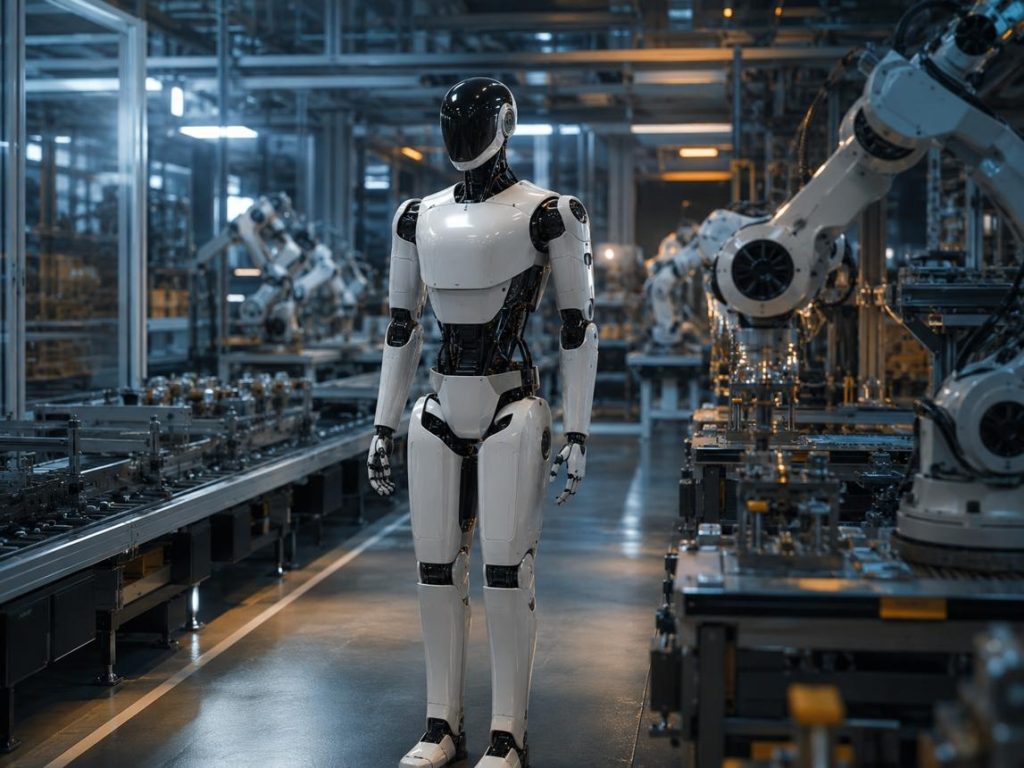
Job Vacancy: Industrial Maintenance Inspection Specialist
Location: Industrial manufacturing plant
Department: Maintenance and Reliability
Employment Type: Full-time
Job Purpose
We are seeking an experienced Industrial Maintenance Inspection Specialist to improve the consistency, detail, and traceability of routine equipment inspections across our plant.
The maintenance department has established maintenance plans and experienced personnel. However, maintaining consistent inspection coverage across a large industrial facility remains a challenge. We need a specialist who can follow defined inspection routines, collect reliable equipment-condition data, identify abnormalities, and ensure that observations are properly documented for maintenance follow-up.
This position focuses on improving the quality and consistency of maintenance information rather than increasing the number of maintenance personnel.
Key Responsibilities
- Conduct scheduled inspections of electrical, mechanical, and auxiliary equipment according to approved procedures.
- Check equipment indicators, operating parameters, visible condition, abnormal noise, leakage, overheating, and other signs of deterioration within the assigned scope.
- Ensure that inspection points are covered consistently and that findings are recorded in a clear, repeatable format.
- Identify deviations from established operating conditions and promptly report abnormalities requiring further investigation.
- Maintain accurate inspection records, including measurements, observations, timestamps, and supporting images where applicable.
- Follow up on routine inspection items and ensure that identified issues are communicated to the responsible maintenance personnel.
- Support the review and improvement of inspection routes, checklists, and data-collection practices.
- Comply with plant safety procedures and access restrictions, particularly in elevated, restricted, or hazardous areas.
Required Qualifications and Experience
- Diploma or degree in Electrical, Mechanical, Instrumentation, or a related engineering discipline.
- Practical experience in industrial maintenance, equipment inspection, or reliability activities.
- Familiarity with industrial equipment, inspection procedures, and condition-monitoring principles.
- Ability to recognize abnormal conditions and distinguish routine observations from findings requiring escalation.
- Good documentation skills and attention to detail.
- Familiarity with computerized maintenance management systems (CMMS) and digital inspection tools.
- Ability to work systematically, follow defined procedures, and maintain consistent inspection standards.
Performance Expectations
The successful candidate will be expected to demonstrate:
- Improved consistency and completeness of inspection records.
- Reliable execution of assigned inspection routes.
- Timely identification and reporting of abnormal conditions.
- Better traceability of inspection findings and follow-up actions.
- Compliance with site safety requirements and approved inspection procedures.
Application
Qualified candidates should submit their CV, outlining their industrial maintenance experience, inspection responsibilities, and familiarity with digital maintenance systems.
That is where our story begins.
Application for the Position of Industrial Maintenance Inspection Specialist
Dear Maintenance Manager,
I am applying for the Industrial Maintenance Inspection Specialist position advertised by your company. My capabilities align with your requirements for consistent inspection coverage, accurate data collection, systematic reporting, and the identification of abnormal equipment conditions.
My approach is based on following defined inspection procedures, recording observations in a consistent format, and providing the maintenance team with traceable information for further investigation. I can be configured to follow approved inspection routes, capture visual records, read selected instruments where recognition accuracy has been validated, and report deviations against established criteria.
I would welcome the opportunity to demonstrate these capabilities against your actual inspection requirements and discuss how a site-specific training program could prepare me for the role.
Yours sincerely,
Candidate: H-01
Industrial Maintenance Inspection Specialist
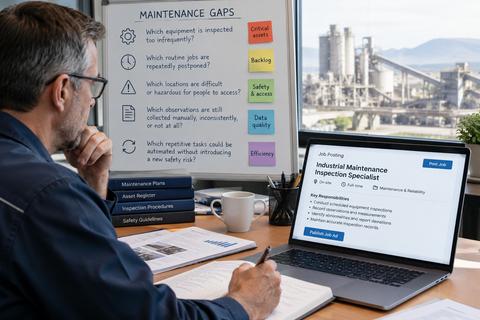
H-01 — Curriculum Vitae
Target position: Industrial Maintenance Inspection Specialist
Professional Profile
A maintenance practitioner with a broad foundation in industrial engineering knowledge, maintenance methods, equipment inspection, and reliability practices. Able to draw on extensive technical knowledge across industries, apply defined procedures consistently, and maintain detailed, structured records of observations. Focused on improving inspection coverage, identifying deviations from established conditions, and providing reliable information to support maintenance decisions. Particularly suited to repetitive, detail-oriented assignments where consistency, traceability, and adherence to approved procedures are essential.
Relevant Knowledge and Capabilities
Industrial maintenance knowledge
- Familiarity with preventive and condition-based maintenance principles, inspection procedures, equipment documentation, and common failure indicators.
- Knowledge of electrical equipment, rotating machinery, industrial instrumentation, and auxiliary systems, subject to the scope of the configured knowledge base.
- Ability to use defined criteria to flag observations for review by qualified maintenance personnel.
Inspection and data collection
- Camera-based observation and image capture.
- Recognition of selected equipment features, labels, gauges, and indicators, subject to validation under actual site conditions.
- Execution of predefined inspection routes and checklists.
- Structured recording of observations, timestamps, and supporting images.
Digital reporting
- Potential integration with inspection databases, reporting tools, and computerized maintenance management systems.
- Consistent use of approved reporting templates and escalation rules.
- Ability to compare observations with supplied baselines when suitable data and analytical tools are available.
Training and adaptation
- Site-specific task training using demonstrations, simulation, and supervised practice.
- Validation of assigned tasks against agreed accuracy, repeatability, and safety criteria.
- Adaptation of approved routes and procedures when the site environment or task requirements change, subject to retraining and authorization.
Relevant Experience
Knowledge foundation Broad exposure to human-generated technical material, including engineering concepts, equipment documentation, maintenance practices, and troubleshooting guidance. This provides a knowledge foundation but does not constitute personal industrial employment or proven hands-on experience.
Physical capability Mobility and manipulation capabilities depend on the selected hardware configuration. Actual performance in walking, reaching, handling objects, reading instruments, and operating controls must be demonstrated for each assigned task.
Site-specific training — To be completed The proposed deployment would include training on approved inspection routes, designated equipment, reporting requirements, and site safety procedures. Competence would be established through practical tests before independent execution of any approved task.
Proposed Performance Objectives
- Complete the assigned inspection route and record all required inspection points.
- Produce repeatable observations in the agreed reporting format.
- Identify and report specified abnormalities within validated detection limits.
- Transfer inspection records into the designated maintenance workflow.
- Operate within approved safety boundaries and request human assistance when required.
References and Demonstration
A general-purpose humanoid robotic platform combined with an AI-based perception, reasoning, and task-planning system. Designed to be adapted for structured inspection, visual data collection, and selected routine activities in environments built for people.
A demonstration can be arranged using selected plant inspection tasks. Acceptance should be based on measured performance in the intended environment rather than on general demonstrations or knowledge claims.
How Did This Candidate Arrive?
The advertisement enters the online world, where AI agents search websites, screen opportunities, and match requirements to products and services. One agent identifies the vacancy and flags it to a robotics company. The company already has a general-purpose humanoid model. Could that model, after site-specific training and qualification, become a suitable candidate? [3]
The company’s commercial agent reviews the job requirements, compares them with the capabilities of its available humanoid platform, and prepares a proposal. It does not recommend building a new robot from scratch. Instead, it proposes adapting an existing model through site-specific training, integration, and qualification. [4]
The proposal arrives in the maintenance manager’s inbox as a conventional CV. The candidate’s profile is impressive. It describes broad technical knowledge, familiarity with industrial maintenance practices, a systematic approach to inspections, and the ability to produce consistent, detailed records.
The maintenance manager’s response
The CV is promising, but the maintenance manager has not yet found the answer to the most important question: can this candidate do the job reliably in this plant?
The ability to walk through a factory, recognize objects, or manipulate tools in a demonstration is not enough. The plant needs repeatable observations, dependable readings, complete records, and safe operation under real working conditions.
The manager invites the candidate for an interview.
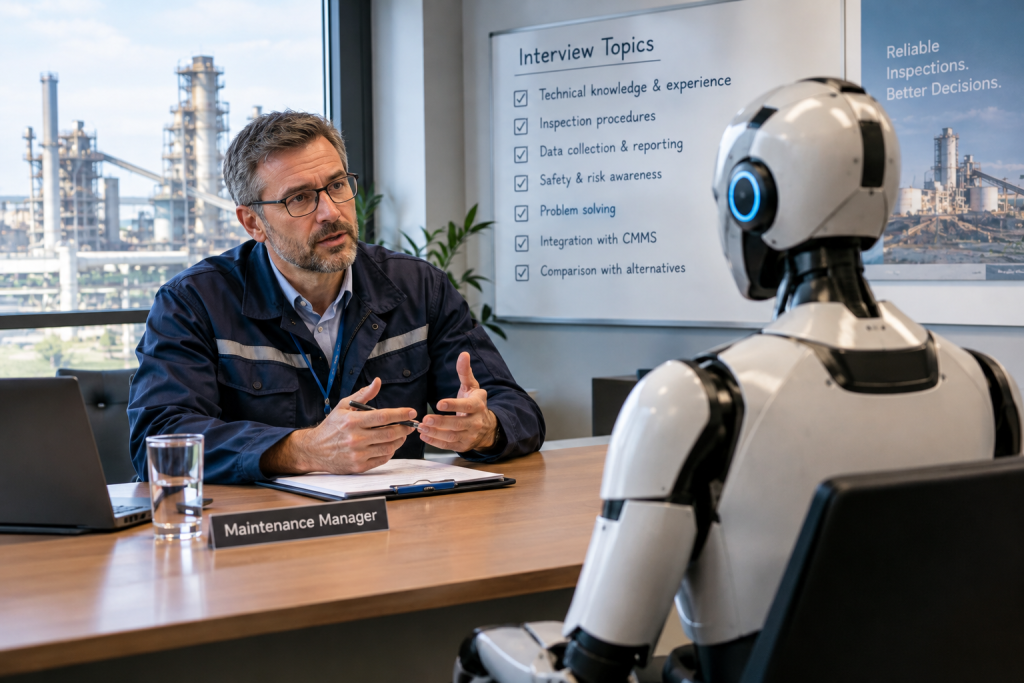
The interview
Maintenance Manager: Your CV says you have broad knowledge of industrial maintenance. Tell me how that knowledge would help us improve our inspection routines.
Candidate H-01: I can draw on technical information covering industrial equipment, preventive maintenance, common failure mechanisms, inspection practices, and reliability principles. Given the relevant equipment documentation and approved procedures, I can help structure inspection tasks, identify the observations that matter, and compare recorded findings with established criteria.
Maintenance Manager: That sounds good on paper. But we already have experienced technicians who understand our equipment. We are not looking for someone to teach them basic maintenance. Our problem is maintaining consistent inspection coverage and recording enough detail to identify changes over time. What would you bring that we do not already have?
Candidate H-01: My proposed contribution is consistency in executing defined tasks. I can be trained to follow an approved route, visit designated inspection points, capture images from specified positions, record selected readings, and complete a structured checklist. The same procedure can be repeated at agreed intervals, with records linked to the relevant equipment and inspection point. These tasks can be repeatedly done forever without any extra notice unless new tasks added or existing tasks modified.
Maintenance Manager: Can you read a pressure gauge, identify an overheating connection, or recognize an abnormal bearing condition?
Candidate H-01: Those tasks require separate validation. I may be able to recognize gauge values from images or detect visible changes, provided the camera, lighting, viewing angle, and recognition system are suitable. Thermal inspection would require appropriate thermal imaging hardware and validated measurement procedures. Bearing condition assessment may require vibration measurements or other suitable sensors. A photograph alone cannot reliably establish every fault.
Maintenance Manager: So you cannot simply look at a machine and tell me everything that is wrong with it?
Candidate H-01: Correct. I can collect observations and flag deviations within my validated capabilities. More complex diagnosis may require additional measurements, historical data, engineering analysis, or assessment by your maintenance specialists. I should not report a suspected fault as confirmed when the available evidence does not support that conclusion.
Maintenance Manager: Your CV also emphasizes detailed records. How would you make those records useful to our maintenance team rather than simply generate more data?
Candidate H-01: Each assigned inspection can have a defined equipment identifier, inspection point, timestamp, required observation, and reporting format. Images and measurements can be associated with those records. With suitable integration, the information can be transferred to your maintenance system, and specified deviations can be flagged for review. The objective is to produce information that supports a decision, not simply increase the volume of collected data.
Maintenance Manager: What happens when you encounter an obstruction, an unfamiliar machine, a changed layout, or a condition outside your training?
Candidate H-01: My response must be defined and tested before deployment. Depending on the situation, I may stop, record the exception, request human assistance, or return to a designated safe state. I should not improvise around an unassessed hazard or continue a task when the conditions fall outside my authorization.
Maintenance Manager: One final question. Why should I hire you instead of installing fixed sensors or purchasing a purpose-built inspection robot?
Candidate H-01: That decision depends on the inspection requirements. Fixed sensors may be more appropriate for continuous monitoring of known parameters. A purpose-built mobile robot may be better suited to repeated inspection routes. A humanoid could offer an advantage where several tasks require mobility and interaction with equipment or objects designed for people. I would need to demonstrate that this flexibility provides sufficient value to justify the additional cost and complexity.
The manager pauses. The answers are technically reasonable. The candidate has acknowledged limitations rather than claiming universal capability. But the interview has also revealed something important: extensive knowledge does not automatically establish practical competence.
Thought Experiment: What can this Maintenance Technician Actually Do
A general-purpose AI model can draw on a vast body of human-generated technical knowledge. A humanoid platform adds physical capabilities, such as movement and manipulation, depending on its hardware. Task planning connects the intended work with actions the platform may be able to perform.
Yet these are different capabilities, and they should not be confused with years of personal industrial experience. The system has not personally spent decades maintaining rolling mills, inspecting electrical installations, or responding to unexpected equipment failures. Its knowledge comes from training, while its ability to perform a specific physical task must be demonstrated.[5]
This distinction matters because maintenance work depends on more than knowing the correct procedure. Equipment condition varies, plant environments change, and measurements can be misleading. A useful maintenance practitioner must recognize the limits of the available evidence, follow safety requirements, and know when to escalate a problem.
The proposed humanoid therefore needs more than a technical knowledge base. It needs suitable sensors, validated task routines, site-specific training, integration with the maintenance workflow, and performance tests conducted under representative conditions. The maintenance team must establish which tasks it can perform reliably and which still require a human technician.
The verdict: shortlisted, not yet hired
The maintenance manager has found a candidate worth evaluating. The humanoid’s potential advantage is not that it knows more about maintenance than experienced engineers. It is that, for suitable tasks, it may repeatedly execute defined routines and collect structured observations without the same variation in task execution that can arise between people or across shifts.
Whether that potential becomes a practical advantage remains to be proven. The company must demonstrate inspection completeness, measurement accuracy, repeatability, safe operation, data quality, and an acceptable total cost. It must also compare the candidate with simpler solutions that may close the same gap more effectively.
The interview is over, but the recruitment process is not. The next step is a practical assessment using real inspection tasks at the plant.
The maintenance manager is not hiring a humanoid because it looks like a maintenance technician. The manager is considering it because a specific maintenance gap exists. The candidate will get the job only if it can demonstrate that it closes that gap reliably, safely, and economically.
Must-Know Jargon
General-Purpose AI Model: An AI model trained on broad data that can support different tasks rather than being developed for only one specific application. In robotics, it provides a starting point for interpreting instructions and planning tasks, but it does not automatically give the robot the physical skills needed for every industrial environment.
Site-Specific Training: The process of adapting a robot’s tasks, routes, recognition capabilities, and operating procedures to a particular plant. It may involve demonstrations, simulation, supervised practice, and testing against actual equipment and site conditions.
Task Validation: The process of demonstrating that a robot can perform a defined task to agreed requirements under representative operating conditions. For maintenance inspections, this may include checking measurement accuracy, inspection completeness, repeatability, and safe responses to unexpected conditions.
Human-in-the-Loop: An operating approach in which a human remains involved in reviewing findings, making decisions, supervising activities, or handling situations that exceed the robot’s authorized capabilities. In maintenance, this can allow a robot to collect routine inspection data while qualified personnel assess abnormalities and decide what action is required.
References
1- McKinsey, Hélène Cervo, Sergio Farioli et al, Maintenance and operations: Is asset productivity broken?, April 12, 2023, https://www.mckinsey.com/industries/electric-power-and-natural-gas/our-insights/maintenance-and-operations-is-asset-productivity-broken?
2- NIST, Hélène Cervo, Sergio Farioli et al, The Impact of Data Quality on Maintenance Work Order Analysis: A Case Study in Historical HVAC Maintenance Work Orders, July 2nd 2021, https://www.nist.gov/publications/impact-data-quality-maintenance-work-order-analysis-case-study-historical-hvac?
3- MaintenanceWorld.com, Ahmed Rezika, “Training Robots for Maintenance: From Digital Practice to Real-World Reliability”, 08 Oct 2026, https://maintenanceworld.com/2026/10/08/training-robots-for-maintenance-from-digital-practice-to-real-world-reliability/
4- CLARITY, AI Agents for Intelligent Revenue Operations, https://www.clarity.cx/ai/ai-agents/
5– MaintenanceWorld.com, Ahmed Rezika, Training the Next Maintenance Technician: Can Robots Learn Industrial Tasks, September 3rd , 2026, https://maintenanceworld.com/2026/09/03/training-the-next-maintenance-technician-can-robots-learn-industrial-tasks/

Related Articles

Training Robots for Maintenance: From Digital Practice to Real-World Reliability

Maximo Application Suite – Trick or Treat?

An Engineer's Guide to Robots