El Niño 2026–2027: Seven Business Risks and How Companies Should Respond
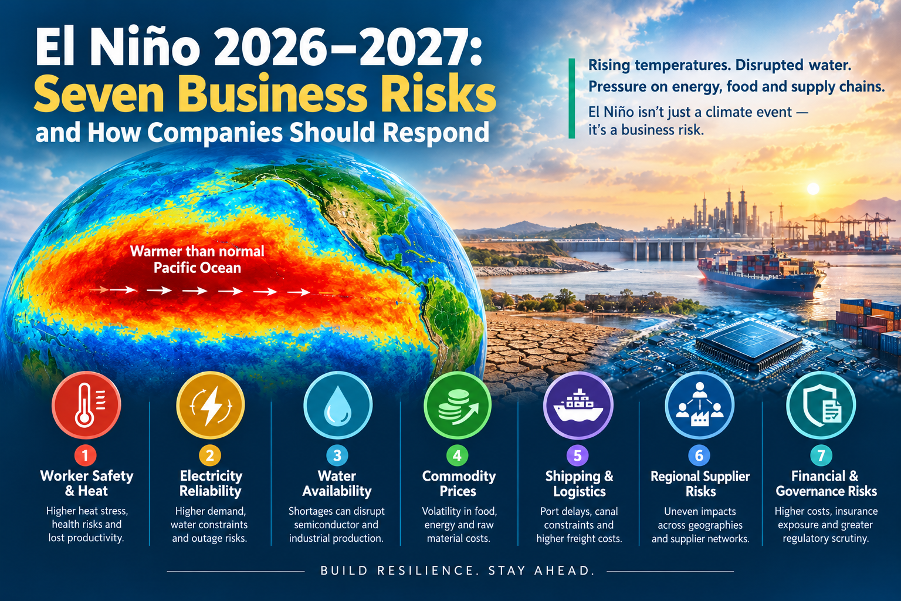
El Niño is more than a climate phenomenon. It is a potential business-disruption trigger that can affect worker safety, electricity reliability, water availability, commodity prices, global logistics and manufacturing quality. As the 2026–2027 event intensifies, companies face a critical question: Are their operations and supply chains prepared for climate-driven disruption?
El Niño is a naturally occurring climate pattern characterized by unusually warm sea-surface temperatures in the central and eastern equatorial Pacific Ocean. It forms part of the El Niño–Southern Oscillation (ENSO), which also includes La Niña, its cooler counterpart, and neutral conditions. During El Niño, changes in tropical Pacific winds and ocean circulation alter the distribution of ocean heat, influencing atmospheric circulation and shifting rainfall and temperature patterns around the world. Depending on the region, these changes can contribute to extreme heat, drought, heavy rainfall or flooding. The impacts vary by location, season and event intensity.
For businesses, the consequences can extend far beyond weather-related damage. Extreme heat can threaten worker health and increase cooling demand; drought can constrain water supplies, hydropower generation and shipping routes; and rainfall disruptions can affect agricultural output, commodity prices and supplier reliability. For electronics and semiconductor manufacturers, where production depends on stable utilities, controlled processes and geographically concentrated suppliers, climate stress can rapidly become a production-continuity, product-quality and supply-chain problem.
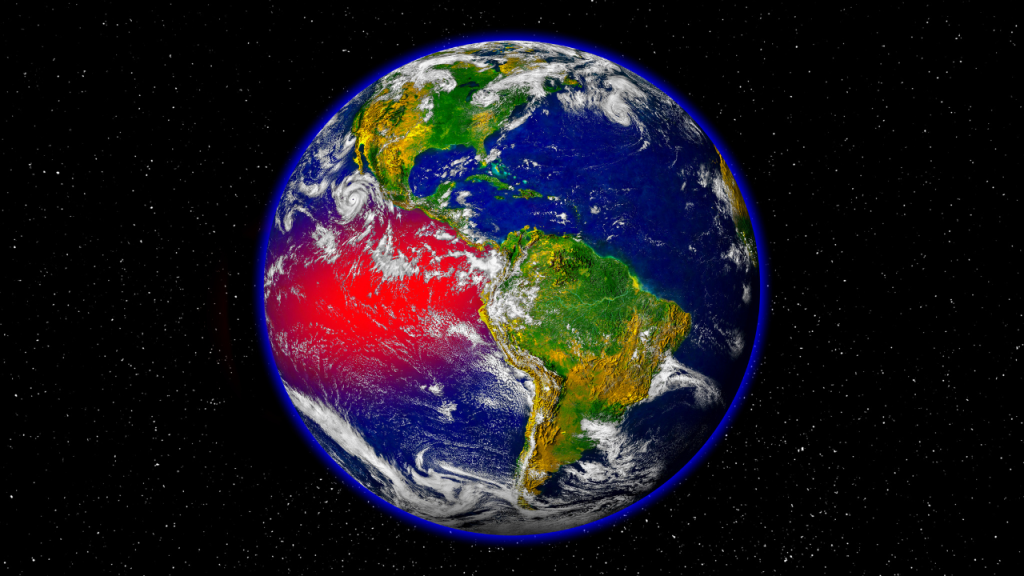
The latest outlook raises the stakes. On 8 October 2026, the World Meteorological Organization (WMO) forecast that sea-surface temperature anomalies in the central and eastern tropical Pacific could reach approximately +3.7°C above normal during October–December 2026. This would exceed the previous Niño 3.4 peak of +2.6°C, recorded from November 2015 to January 2016. WMO forecasts indicate a near-100% likelihood that the current event will persist through February 2027, potentially making it one of the strongest since at least 1950. [1]
These figures refer to Pacific Ocean sea-surface temperature anomalies, not a 3.7°C rise in global air temperature. NOAA also uses the Relative Oceanic Niño Index (RONI), a different measure of El Niño strength, so its thresholds should not be compared directly with Niño 3.4 values. NOAA’s 8 October outlook separately indicated an 83% chance of a historic-strength event during October–December and a greater-than-83% chance of strong-to-very-strong conditions continuing through January–March 2027. These probabilities describe different outcomes and periods. [2]
For business leaders, the priority is not to predict every weather event. It is to identify where climate stress could interrupt people, power, water, materials, production or deliveries, and strengthen resilience before disruption becomes a costly operational failure.
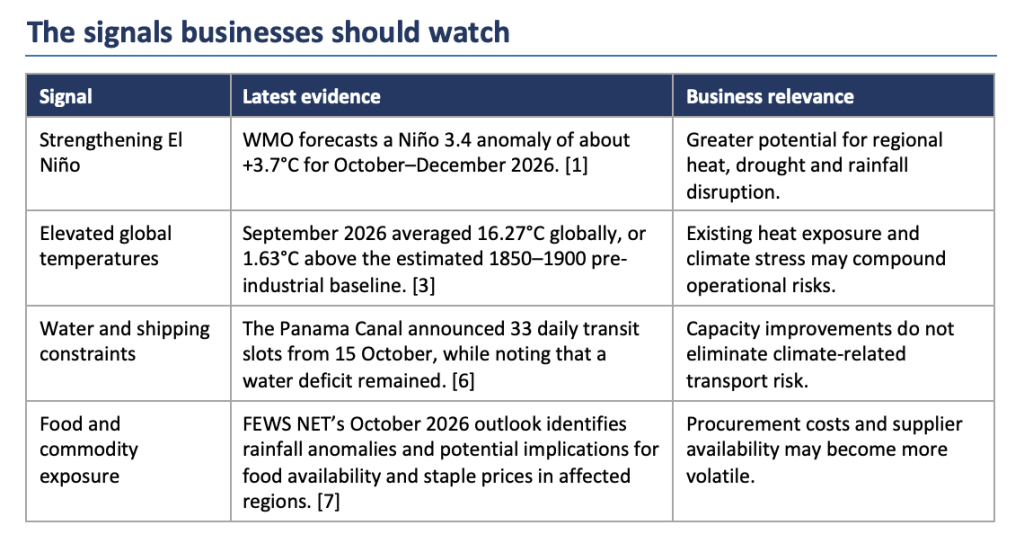
The 1.63°C figure is a monthly global temperature anomaly, not evidence that the world has permanently crossed the Paris Agreement’s long-term warming threshold. Copernicus reported September as the second-warmest September on record and the second consecutive month in 2026 above 1.5°C relative to pre-industrial levels. [3]
Seven business risks and how companies should respond
1. Extreme heat can threaten worker safety and productivity
Extreme heat can increase heat illness, fatigue, errors and absenteeism. The risks are particularly relevant to factories, warehouses, logistics operations, construction and facilities with physically demanding work or inadequate cooling.
Climate Impact Lab projects 451,000 excess heat-related deaths from June 2026 through February 2027, relative to a normal-year baseline. This is a model-based projection, not a count of deaths already recorded. Its analysis also indicates that heat-related impacts could continue beyond the forecast period. [4]
For manufacturers, heat can affect shift patterns, equipment cooling, maintenance schedules and production targets.
What companies should do
- Map heat exposure by facility, shift, task and supplier location.
- Implement practical heat-rest, hydration, ventilation and cooling measures.
- Establish heat alerts, escalation thresholds and emergency procedures.
- Check whether critical suppliers protect workers during extreme conditions.
2. Electricity reliability can become a production constraint
High temperatures can increase electricity demand for cooling, while drought can constrain hydropower generation. Where the power system is already under pressure, manufacturers may face outages, higher energy costs or production restrictions.
Northern Vietnam illustrates the economic consequences. A World Bank assessment of the 2023 power shortages reported a 5.4 GW supply deficit in May, estimated economic losses of approximately US$1.4 billion, or 0.3% of GDP, and revenue losses of up to 10% among some surveyed businesses. This is a historical example of infrastructure vulnerability, not a prediction that the same outcome will recur during the current El Niño. [5]
What companies should do
- Map electricity dependence at critical facilities and suppliers.
- Review backup generation, storage, cooling and emergency shutdown arrangements.
- Determine whether backup systems can support critical production processes.
- Test outage scenarios in business-continuity plans.
3. Water stress can threaten semiconductor and industrial production
Water is essential to semiconductor fabrication, electronics manufacturing, cleaning, cooling and chemicals processing. Shortages can restrict production, increase operating costs or force temporary shutdowns.
Taiwan’s 2021 drought demonstrated the vulnerability of water-intensive semiconductor manufacturing to prolonged dry conditions. Reuters reported that chipmakers were ordering water trucks as the drought put pressure on supplies. This historical example illustrates the importance of water resilience; it does not mean Taiwan will necessarily experience the same conditions again during the current El Niño. [16]
What companies should do
- Map water use and local water stress at critical facilities and suppliers.
- Identify processes that cannot operate without a reliable water supply.
- Assess water recycling, reuse, storage and alternative supply options.
- Ask critical suppliers about drought plans, restrictions and continuity thresholds.
4. Commodity volatility can affect procurement and production costs
El Niño can affect crop yields and rainfall patterns, but price movements also depend on inventories, trade restrictions, energy prices, fertiliser costs and transport conditions. Businesses should therefore treat climate forecasts as risk indicators, not precise commodity-price predictions.
FEWS NET’s October 2026 outlook identifies potential El Niño-related rainfall impacts across several regions and examines the implications for food availability and staple prices. It also highlights the interaction between weather conditions and other pressures, including fuel, fertiliser and transport costs. [7]
For manufacturers, these effects can reach procurement through packaging, agricultural feedstocks, energy and other climate-sensitive inputs.
What companies should do
- Identify climate-sensitive materials and single-source dependencies.
- Stress-test availability and costs under alternative scenarios.
- Review inventory coverage and qualified alternative suppliers.
- Monitor commodity prices, supplier lead times and regional weather indicators.
5. Shipping and logistics disruption can undermine delivery commitments
Drought can constrain inland waterways, while extreme weather can disrupt ports, roads, railways and air freight. These pressures can increase lead times, freight costs and working-capital requirements.
On 28 September 2026, the Panama Canal Authority announced that daily transit capacity would rise to 33 slots from 15 October, with a maximum authorised draft of 14.94 metres (49 feet) for vessels using the Neopanamax locks. The Authority also said a water deficit remained in the Canal watershed. The capacity increase therefore does not mean the underlying water risk has disappeared. [6]
For electronics manufacturers operating on tightly scheduled component deliveries, a route disruption can affect production even when the factory itself remains unaffected.
What companies should do
- Identify shipments dependent on climate-sensitive routes.
- Build realistic lead-time buffers into delivery commitments.
- Review alternative ports, routes, carriers and freight contracts.
- Monitor official operator notices and booking conditions.
6. Regional differences can create uneven supplier risks
El Niño does not produce the same conditions everywhere. Some areas may face heat and drought, while others experience heavy rainfall or flooding. National-level forecasts can obscure substantial differences between supplier locations.
FEWS NET’s October outlook illustrates this regional variation. It identifies below-average rainfall concerns in parts of East Africa, the Sahel, Latin America and the Caribbean, and Pakistan, while also highlighting flood risk in parts of the eastern Horn of Africa. These are regional outlooks, not guarantees of specific outcomes at individual sites. [7]
What companies should do
- Assess risk at facility and subregional level, not just by country.
- Map critical suppliers, logistics routes and lower-tier dependencies.
- Identify shared dependencies, including power grids, watersheds and transport corridors.
- Request evidence of supplier continuity planning and test recovery assumptions.
7. Financial, insurance and governance risks can compound disruption
Climate-related interruptions can affect revenue forecasts, insurance costs, working capital and customer commitments. They can also expose weaknesses in enterprise risk management and sustainability reporting.
For reporting entities, obligations depend on jurisdiction, company scope and the applicable reporting period. IFRS S2 provides a framework for climate-related financial disclosures. In India, SEBI’s BRSR-related requirements and its 28 March 2025 circular address sustainability disclosures and aspects of value-chain ESG reporting. In the EU, Directive (EU) 2026/470 amended corporate sustainability reporting and due-diligence requirements; Delegated Regulation (EU) 2026/1560 establishes voluntary sustainability reporting standards for certain value-chain undertakings, while Delegated Regulation (EU) 2026/1563 simplifies certain existing European Sustainability Reporting Standards. Companies should assess the specific provisions that apply to them rather than assume universal coverage. [8–12]
What companies should do
- Link climate scenarios to financial planning and enterprise risk registers.
- Review insurance exclusions, business-interruption limits and recovery assumptions.
- Document material risks, mitigation measures and the evidence supporting decisions.
- Confirm reporting obligations with qualified legal, finance and sustainability teams.
When climate disruption becomes a quality failure
Climate exposure can become a product-quality issue when heat, humidity, water shortages, power interruptions or supplier changes alter process conditions. Possible consequences include material variation, equipment instability, contamination, handling problems and inconsistent inspection results.
Five quality controls are especially important:
- Change control: Assess process, material, equipment or site changes triggered by disruption before implementation.
- Supplier quality: Reassess suppliers whose operating conditions, sources or production locations change.
- Traceability: Preserve records linking materials, lots, production conditions and affected customers.
- Risk-based inspection: Increase verification where evidence indicates a higher risk of nonconformity.
- Corrective action: Investigate root causes and verify effectiveness rather than treating repeated failures as isolated incidents.
In electronics manufacturing, an emergency switch to substitute components or an alternative supplier can introduce risks that extend beyond production continuity. Existing RoHS, REACH and POPs declarations may no longer cover the substitute materials or supplier, while traceability and change-control records may become incomplete. Companies should verify compliance evidence and approve substitutions before use rather than assume that an alternative component is equivalent.
ISO published ISO 9001:2026 on 16 September 2026. The new edition aims to help organisations strengthen resilience, respond to evolving customer expectations and manage increasingly interconnected supply chains. ISO 9001:2026 carries forward the requirement to consider whether climate change is a relevant issue for the quality management system, first introduced through the 2024 amendment to ISO 9001:2015. Organisations should assess relevance to their context rather than assume climate change automatically requires a specific initiative. [13, 14]
Published transition guidance has differed between 15 September 2029 and 30 September 2029. ISO/TC 176 guidance gives 30 September 2029, while TÜV SÜD’s detailed guidance has stated 15 September 2029. Organizations should confirm the applicable deadline with their certification body rather than assume the discrepancy has been resolved. [14, 15]
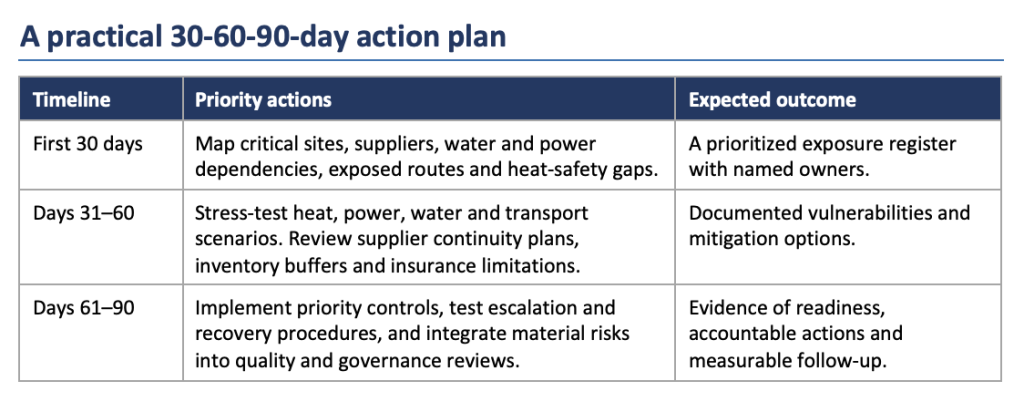
Track practical indicators such as heat-related incidents, outage hours, water availability, supplier recovery time, delivery performance, nonconformities and overdue mitigation actions. Review thresholds as forecasts and operating conditions change.
Conclusion – El Niño 2026–2027: Seven Business Risks and How Companies Should Respond
The 2026–2027 El Niño is a warning to test business resilience before disruption occurs. For electronics and semiconductor manufacturers, exposure may sit not only at their own facilities but also among suppliers, utilities, watersheds and transport routes on which production depends.
Companies do not need to predict every weather event. They need to identify where climate stress could interrupt people, materials, production or delivery, and establish controls before those vulnerabilities become costly failures.
The practical priority is clear: map exposure, protect workers, test continuity plans and connect climate risk to supplier quality and enterprise governance.
References El Niño Business Risk
1. World Meteorological Organization (8 October 2026). Sea-surface temperatures reflect strengthening El Niño.
https://public.wmo.int/media/news/sea-surface-temperatures-reflect-strengthening-el-nino
2. NOAA Climate Prediction Center (8 October 2026). ENSO Diagnostic Discussion.
https://www.cpc.ncep.noaa.gov/products/analysis_monitoring/enso_advisory/ensodisc.shtml
3. Copernicus Climate Change Service (12 October 2026). Copernicus: Second warmest September as global temperatures stay above 1.5°C.
https://climate.copernicus.eu/copernicus-second-warmest-september-global-temperatures-stay-above-15degc
4. Climate Impact Lab (September 2026). 451,000 at Risk: Where Action Can Save Lives During the Super El Niño.
https://impactlab.org/research/451000-at-risk/
5. World Bank. Vietnam power shortage assessment.
https://documents1.worldbank.org/curated/en/099408408092319382/pdf/IDU0301a3e760c732046e509d3106e81810de4b9.pdf
6. Panama Canal Authority (28 September 2026). Panama Canal announces increase in draft and daily transit.
https://pancanal.com/en/panama-canal-announces-increase-in-draft-and-daily-transit/
7. FEWS NET (6 October 2026). 2026–2027 El Niño food security impacts.
https://fews.net/global/special-report/october-2026
8. IFRS Foundation. IFRS S2 Climate-related Disclosures.
https://www.ifrs.org/issued-standards/ifrs-sustainability-standards-navigator/ifrs-s2-climate-related-disclosures/
9. SEBI (28 March 2025). Measures to facilitate ease of doing business with respect to framework for assurance or assessment, ESG disclosures for value chain, and introduction of voluntary disclosure on green credits. Circular SEBI/HO/CFD/CFD-PoD-1/P/CIR/2025/42
https://www.sebi.gov.in/legal/circulars/mar-2025/measures-to-facilitate-ease-of-doing-business-with-respect-to-framework-for-assurance-or-assessment-esg-disclosures-for-value-chain-and-introduction-of-voluntary-disclosure-on-green-credits_93102.html
10. European Union (24 February 2026). Directive (EU) 2026/470 on certain corporate sustainability reporting and due-diligence requirements.
https://eur-lex.europa.eu/legal-content/EN/TXT/?uri=CELEX:32026L0470
11. European Commission (3 July 2026). Delegated Regulation (EU) 2026/1560 establishing voluntary sustainability reporting standards for certain value-chain undertakings.
https://eur-lex.europa.eu/legal-content/EN/TXT/?uri=CELEX:32026R1560
12. European Commission (3 July 2026). Delegated Regulation (EU) 2026/1563 simplifying certain sustainability reporting standards.
https://eur-lex.europa.eu/legal-content/EN/TXT/?uri=CELEX:32026R1563
13. International Organization for Standardization. ISO 9001:2026: What businesses need to know
https://committee.iso.org/quality-management/iso-9001-2026
14. ISO/TC 176. ISO 9001:2026 revision and transition guidance.
https://committee.iso.org/sites/tc176sc2/home/news/content-left-area/news-and-updates/news-2.html
15. TÜV SÜD. ISO 9001:2026: Everything you need to know about the new revision.
https://www.tuvsud.com/en-ae/resource-centre/blogs/iso-9001-2026-everything-you-need-to-know-about-the-new-revision
16. Reuters (24 February 2021). Chipmakers in drought-hit Taiwan order water trucks to prepare for ‘the worst’.
https://www.investing.com/news/technology-news/chipmakers-in-droughthit-taiwan-order-water-trucks-to-prepare-for-the-worst-2427785

Related Articles

Improved Safety

How Green is Green When it Comes to Using Everyday Industrial Cleaning Products for Plant Maintenance?

What to do When you Receive an OSHA Citation

Making Sense of NIST & Cybersecurity Requirements for Maximo
Mining Maintainability
Non-Destructive Exposing of Buried Energized Lines