

Weatherproofing and Ingress Protection in Mobile Control Components
P3 America – Precision Sensors and Joysticks
Posted 2/17/2026

The world runs on the back of heavy machinery, from construction equipment to the mining and agricultural machines that keep us fed and provided for. The industrial vehicles that power this kind of work are in another league from consumer-grade equipment. Fieldwork is quite unpredictable. A crucial part of being prepared is having tools that can handle all kinds of inclement weather.
Weatherproofing
Heavy machinery, and its control components in particular, are extensively weatherproofed to help it endure harsh working conditions and continue to operate. These vehicles can expect to encounter challenging conditions, including severe temperature changes, humidity, dust, rain, snow, and other inclement weather of all kinds.
Ingress Protection (IP)
The extent to which an industrial component is “weatherproofed” is more accurately measured by its ingress protection. This is a standardized code that perfectly describes the degree to which items like mobile control components can resist liquids and solids like dust particles. IP and weatherproofing are terms often used interchangeably, but a key difference exists where IP depicts a precise set of details surrounding protection, unlike weatherproofing.
How Does it Work?
IP rating is often described as a two-digit code whose structure typically looks like this: “IP(digit one)(digit two)”. For example, IP65 is a common ingress protection rating for industrial joysticks.
Digit One – Ranging from 0 to 6, this is an indicator of protection against the ingress of solids, such as dust.
Digit Two – The degree of protection is against moisture and liquids ranging from 0 to 9.
This means that our example of a joystick with a rating of IP65 will have complete protection against solid dust and particles, as well as limited protection against water jets from any angle. By comparison, it has less resistance against liquids than one with a higher rating, like IP67; such a component would be protected from complete immersion in water for a limited time.
Ingress Protection of Common Mobile Control Components

External Components like Joysticks
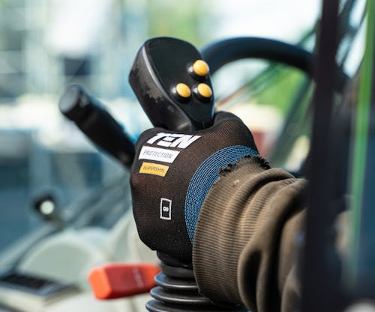
Selecting an industrial joystick with a specific IP rating depends heavily on the environment in which it will be used. Take the construction space, for instance, a high-stakes environment where machines are often subjected to harsh conditions.
Here, exposure to dust and, sometimes, moisture is common, which is why the IP65-rated joystick may come in handy. Such protection is key as it fosters the components’ longevity. Additionally, they offer unmatched safety and peace of mind through issue- and accident-free operations, as ingress-influenced malfunctions are kept at bay.
Internal Components Like Angle Sensors and Potentiometers
Ingress Protection is also critical here. Take, for example, an IP40-rated angle sensor. The digit 4 indicates strong resistance to solid particles 1.00 mm and larger. However, the “0” part of its rating shows that it has no protection against liquids and will need to be completely enclosed to effectively resist moisture.
The Weatherproofing and IP Space
Weatherproofing and ingress protection are vital for protecting mobile control components. Additionally, IP ratings make it easy to choose the right tools for the work environment of each piece of equipment. It provides an easy, at-a-glance reference to help determine whether a component will meet dust and moisture protection requirements.
Key Takeaways
- Components such as industrial joysticks for heavy machinery have an “Ingress Protection”, or “IP” rating that indicates how well they stand up to dust and water on the job.
- In a component with a rating like “IP65”, the first digit indicates the degree of protection against solid ingress like dust on a scale from 0 to 6. The second digit indicates protection against liquids on a scale from 0 to 9.
- It is advisable to use a component in the appropriate environment based on its IP rating.
Related Articles
Unbalanced Spinning Equipment

Ultrasonic Level Detectors

What Happens When the New Team Member is AI?