Unfired pressure vessel inspections – are they necessary? Absolutely. Pressure vessels must be regularly inspected and be maintained in a safe operating condition. The higher the risk, the more stringent the requirements for operating and inspecting the vessel.
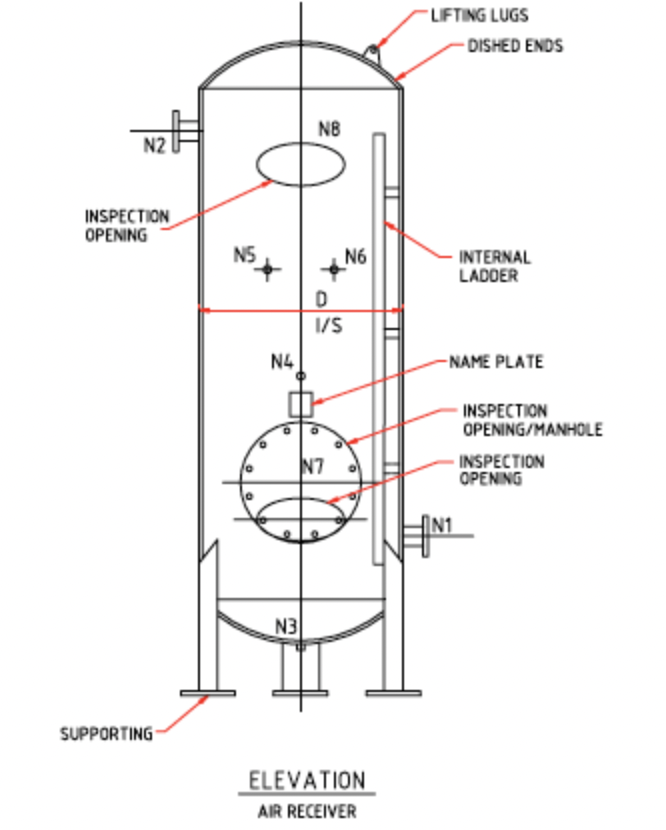
The definition of a pressure vessel in Australian Standard AS 3873 is “ a vessel subject to internal or external pressure. It includes interconnecting parts and components, valves, gauges and other fittings up to the first point of connection to connecting piping.” Pressure vessels are such things as compressed air receivers (see the drawing below), barbecue gas bottles, steam boilers, aerosol cans, vertical leaf filters, beer bottles, cigarette lighters, and fire extinguishers. This article discusses the general requirements for inspection of unfired pressure vessels such as compressed air and liquefied gas receivers and process reactors. The other types of vessels are inspected to different criteria.
It is vital to inspect the integrity of pressure vessels due to these safety concerns:
(a) Gases and liquids stored under pressure inside a container are in an energized and compressed state. Rupture of the vessel would result in catastrophic release of pressure.
(b) The chemicals within the pressure vessel may be toxic (e.g. chlorine and ammonia gases).
(c) The contents may attack, erode, corrode, induce stress, change the metal characteristics or weaken the containment vessel over a period of time.
(d) External impact or corrosion may weaken the pressure vessel. (A real problem with externally insulated vessels where the insulation gets wet from rain or from the process.)
Who Performs Unfired Pressure Vessel Inspections?
Inspections can be in-service inspections where the inspector does an external inspection, tests the pressure relief device operation, and does documentation review so they can certify the vessel for continued use for a short period of time. Or the inspection can be a full inspection requiring inspection of the vessel internal walls and attachments, the external surfaces and attachments, pressure gauges, pressure relief devices, the immediate surrounds of the vessel, and documentation. It may be necessary to remove sections of insulation to expose the outer shell wall.
If full visual inspections are impossible or costly it may be possible to substitute nondestructive testing (NDT) methods to confirm the vessel integrity. Such NDT methods as ultrasonic thickness testing, eddy current thickness testing, acoustic crack detection, magnetic particle crack detection and hydrostatic pressure tests are all viable means of proving vessel integrity.
Only persons experienced and trained in the techniques of pressure vessel inspections are allowed to conduct the inspection. Normally a competent, independent third party is used. The inspector may require improvements to ensure compliance with relevant codes of practice.
They provide a written report on their findings and certifies the vessel for continued use for a specific period of time. The inspector also advises the relevant government department of the condition of the vessel and the due date for the next inspection. When the certificate is received it is normally displayed in a prominent place near the vessel as proof the vessel complies with the law.
What is the Procedure for Unfired Pressure Vessel Inspections?
The inspector looks for the following evidence of performance and compliance depending on the Hazard Level of the vessel:
Shell wall thinning
Cracks at welds and connections to vessel walls caused by stress
Damage to the shell by impact
Leaking gaskets and seals; other evidence of poor maintenance practices
Condition of protective coatings and linings
Soundness of foundation and supports
Condition of pressure relief device; check to ensure it relieves pressure buildup
Pressure gauge calibration
Inspect the immediate vicinity of the vessel for potential risks
Inspect relief piping to ensure it safely vents to the proper area
Confirm vessel registration with the corresponding authority
Confirm display of vessel registration
Confirm registration number on vessel
Confirm that the design of the vessel is registered with the corresponding authority
Check verified design drawings, calculations, and specs
Review the manufacturer’s fabrication and materials report and as-built installation drawings
Review the vessel designer’s hazard identification and risk assessment
Confirm the hydrostatic test and other testing performed by the manufacturer
Confirm the installation, commissioning, and maintenance instructions from the manufacturer
Review the commissioning compliance statement – especially for new installations
Review records of inspections, service, and maintenance
Review the operating log showing records of operating conditions for plantReview records of any in-service inspections or special test such as proof of instrumentation calibration
Conclusion
Regular inspection of unfired pressure vessels is not just a regulatory requirement—it’s a critical safety practice. These vessels, if compromised, pose serious risks due to high internal pressures and potentially hazardous contents. By ensuring inspections are carried out by qualified professionals, using appropriate methods, and maintaining accurate documentation, businesses can protect their personnel, property, and the environment. Staying compliant with inspection procedures helps ensure that pressure vessels remain safe, efficient, and legally certified for continued operation.
Mike Sondalini
Mike Sondalini is a Senior Consultant at PWWEAM System-of-Reliability. BEng(Hons), MBA, CPEng. As a consultant and trainer, Mike was able to present his insights to his clients, suggesting innovative approaches to plant and equipment reliability. Their feedback was resoundingly positive. Efforts which earned him an international reputation for articulate, out-of-the-box articles on plant and equipment reliability, life-cycle EAM, maintenance management, work quality assurance, and team building. After decades of dedicated research, Mike authored “Industrial Manufacturing Wellness: The Complete Guide to Successful Enterprise Asset Management” a revolutionary approach on how maintenance and physical asset management systems should be run, the book detailed who, what, where, when, why, and how outstanding reliability could be achieved. Each step based in scientific and mathematical understanding to ensure repeatability of results and optimal outcomes.
Work-related deaths at U.S. manufacturing plants declined 14.0 percent in 2007, marking a rebound from the 16.0 percent increase that occurred in 2006. This was among the findings of the new Census of Fatal Occupational Injuries report released recently by the U.S. Department of Labor's Bureau of Labor Statistics.
Work-related deaths at U.S. manufacturing plants declined 14.0 percent in 2007, marking a rebound from the 16.0 percent increase that occurred in 2006. This was among the findings of the new Census of Fatal Occupational Injuries report released recently by the U.S. Department of Labor's Bureau of Labor Statistics.
Have safety efforts gravitated into the back seat driver technique being applied in your workplace? When an employee’s actions are observed as not in accordance with the safety rules and procedures, their error is brought to their attention. The workplace reality is that this error often goes unaddressed, or even unobserved, until a safety incident occurs. The safety incident becomes the trigger for an investigation. The investigation determines what actions led up to the safety incident and often stop at the point of identifying the human error. The resulting corrective measures attempt to contain the human error by revising policies, enhancing procedures, retraining employees, punishing offenders, or some combination thereof. Such corrective measures lag behind the worker’s thought process.
Have safety efforts gravitated into the back seat driver technique being applied in your workplace? When an employee’s actions are observed as not in accordance with the safety rules and procedures, their error is brought to their attention. The workplace reality is that this error often goes unaddressed, or even unobserved, until a safety incident occurs. The safety incident becomes the trigger for an investigation. The investigation determines what actions led up to the safety incident and often stop at the point of identifying the human error. The resulting corrective measures attempt to contain the human error by revising policies, enhancing procedures, retraining employees, punishing offenders, or some combination thereof. Such corrective measures lag behind the worker’s thought process.
Many of today’s manufacturing plants have removed asbestos from their facilities, but some still manufacture products that contain legal amounts of asbestos. Although exposure at these plants is well monitored and minimal, there is no safe level of asbestos exposure according to the Environmental Protection Agency.
Many of today’s manufacturing plants have removed asbestos from their facilities, but some still manufacture products that contain legal amounts of asbestos. Although exposure at these plants is well monitored and minimal, there is no safe level of asbestos exposure according to the Environmental Protection Agency.
Republic Windows & Doors transformed their plant safety for the sake of their workers. By implementing 3 "outs" they were able to make significant safety gains in just a few short years, even with high turnover rates and unskilled labor. If they can improve safety and job quality at the same time, so can you!
Republic Windows & Doors transformed their plant safety for the sake of their workers. By implementing 3 "outs" they were able to make significant safety gains in just a few short years, even with high turnover rates and unskilled labor. If they can improve safety and job quality at the same time, so can you!
A chaotic or traumatic event can happen to anyone at any time or place. Would you be ready if it happened to you? Anything that threatens your sense of safety and security either physically or mentally can be considered a traumatic event. How well you respond to and recover from such events primarily depends on your overall state of well-being. Let's look at ways to develop the Internal Resources and External Resources you need to put yourself in the best possible position to deal with chaotic events.
A chaotic or traumatic event can happen to anyone at any time or place. Would you be ready if it happened to you? Anything that threatens your sense of safety and security either physically or mentally can be considered a traumatic event. How well you respond to and recover from such events primarily depends on your overall state of well-being. Let's look at ways to develop the Internal Resources and External Resources you need to put yourself in the best possible position to deal with chaotic events.
The answer is, it depends. For example, a traditional cleaner/degreaser, of which there are literally hundreds on the market, generally does an adequate job of cleaning. However – and this is an ongoing problem – the majority of them basically move the contamination from one location to another. The result? This cost of hydrocarbon removal is added to the clean-up process, plus your employees could be at risk of additional from toxins in the cleaner. So, how do you clean, provide a safe product for your employees and contribute to an active pollution prevention program?
The answer is, it depends. For example, a traditional cleaner/degreaser, of which there are literally hundreds on the market, generally does an adequate job of cleaning. However – and this is an ongoing problem – the majority of them basically move the contamination from one location to another. The result? This cost of hydrocarbon removal is added to the clean-up process, plus your employees could be at risk of additional from toxins in the cleaner. So, how do you clean, provide a safe product for your employees and contribute to an active pollution prevention program?