

Hazardous Areas for Dust and Flammables
Mike Sondalini, PWW EAM System Consultant
with permission of BIN95 Business Industrial Network
Posted 2/24/2026
Hazardous areas for dusts and flammables. Many explosions in the processing, manufacturing and bulk materials handling industries involve flammable gases or vapors and explosive dusts or fibers. Such chemicals are known as hazardous materials. The article provides a basic overview of the design requirements and maintenance practices for electrical equipment in hazardous areas.
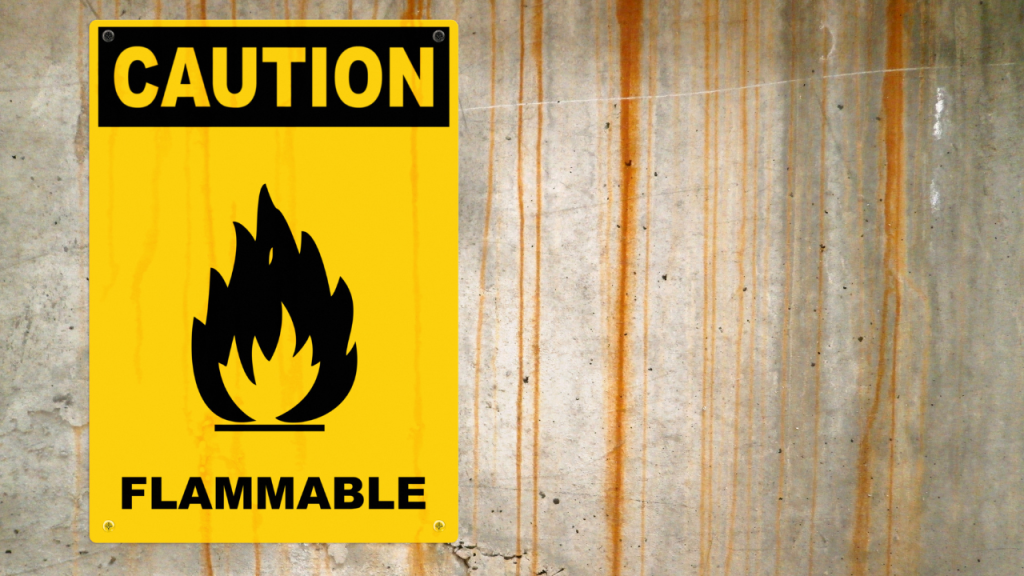
WHAT IS A HAZARDOUS AREA?
One definition of a hazardous area is “an area in which an explosive atmosphere is present, or may be expected to be present, in quantities such as to require special precautions for the construction, installation and use of potential ignition sources.” Flammables and combustible dusts are dangerous if present at explosive concentrations; in an atmosphere that will support combustion; when exposed to a sufficiently energetic ignition source. An explosion is impossible unless all three requirements are present together.
EXPLOSIVE RANGE
As with the engine of a motor car not firing if the fuel mixture is too lean or too rich, so must the concentration of a flammable gas or vapor be within a certain range for it to explode. For flammable materials like gasoline, methane or hydrogen to be in explosive concentrations, the atmosphere must be laced, or loaded, with appropriate quantities of the material to support combustion. The bottom of the flammability range is called the lower explosive limit (LEL) and the top of the range the upper explosive limit (UEL).
For explosive dusts, the criteria for an explosive condition is the amount of dust suspended in the atmosphere. Combustible dust clouds will only explode once a minimum threshold concentration in air is passed and a minimum amount of ignition energy is available. Should an ignition occur when sufficient the dust is suspended then an explosion would result. A combustible dust layer siting on equipment will ignite if the layer ignition temperature is reached for a sufficient length of time.
ASSESSING THE HAZARDS
It is the responsibility of the User to assess the nature of the hazards present. The persons involved in assessing hazardous areas need to have a strong background in the industry concerned as well as a good appreciation of the nature of the hazards caused by the chemicals present. The chemical properties and explosive nature of a flammable gas or vapor are major factors that influence the extent of the hazard. Other properties for consideration include the flash point temperature, vapor pressure, boiling point, extent of the explosive range, density of the gas or vapor and the ignition temperature to set off an explosion.
If the hazardous area involves dusts and fibers a good appreciation of the physical, chemical and bulk material properties is required. The critical factors are the dust layer temperature at which a heated surface can ignite a layer of the dust. And the dust cloud ignition temperature at which a cloud of the dust ignites. Additional factors like fineness of particle size, dilution by inert materials and moisture content also affect the extent of the hazard.
The size of the hazardous zone may increase during maintenance and cleaning if dust is lifted off equipment.
WHAT IF AN EXPLOSION OCCURS?
An important factor to consider is what occurs if a flammable or combustible material is ignited and explodes? Explosions generate a pressure front or shock wave that travel ahead of the flame front. Properties of the shock wave, maximum generated pressure, the speed of pressure rises, and the amount of energy liberated by the explosion need to be considered when addressing the hazards.
DOCUMENTATION IS CRITICAL
The result of a hazard assessment is the classification of an area of plant and equipment into hazard zones. The area classification documents, zone indication drawings, and justifications must be compiled in a verification dossier and made available to all persons who work on the plant.
An example of a completed hazardous area zone classification drawing is shown in Figure No. 1. The drawing specifies the volume of space in which a risk is likely to be present and the nature of the risk. With this information the necessary design decisions can be made.
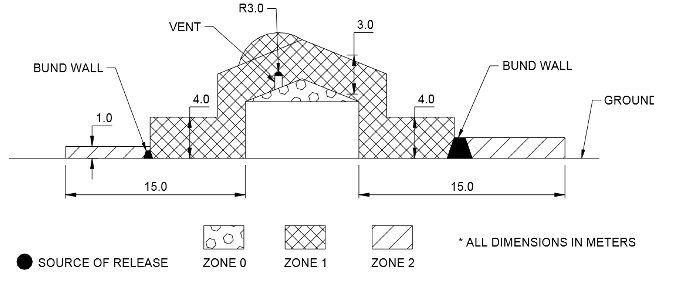
Figure No. 1 Zone classification for a flammables tank.
HAZARDOUS ZONES
The designation (naming) of the zones reflects whether the hazard is a flammable gas or an explosive dust and the likelihood that a hazard will be present. For a gas/vapor the zones and their definition are listed below.
- Zone 0 – a volume of space an explosive gas atmosphere is continuously present. An example is the vapor space in a fuel storage tank.
- Zone 1 – a volume of space an explosive gas atmosphere occurs periodically in normal operation. An example is while filling the fuel tank of a car.
- Zone 2 – a volume of space an explosive gas atmosphere is not normally expected and if it does occur, it will only be present for a short period of time. An example is a spill from overfilling a car fuel tank.
For dusts the zone designations are noted below and reflect the probability of the occurrence of an explosive mixture.
- Zone 20 – a volume of space where a combustible dust cloud is present for lengthy periods during normal operation or layers of combustible dust will form. An example is inside a dust collector.
- Zone 21 – a volume of space where a combustible dust cloud is likely to occur during normal operation or layers of combustible dust will gather during operation. An example is beside a 25-kg bag filling-head.
- Zone 22 – a volume of space where due to abnormal conditions a combustible dust cloud may occur infrequently and for short periods of time or layers of combustible will gather over an extended period of time. An example is inside a grain milling room that gradually accumulates dust over years of operation.
Once the zone is designated the appropriate hazard protection measures suited to the zone must be applied.
MINIMIZING SURFACE TEMPERATURES
To prevent hot surfaces from causing gases and dusts to ignite, their temperatures must be kept below the ignition temperature. Electrical apparatus, like motors, build up heat in operation. Their surface temperature rises and unless they are properly selected for the hazardous area, they may introduce an explosion risk.
Electrical equipment can be designed and built to a specific temperature class that limits the maximum surface temperature. There are two designations within the surface temperature classification system. Group I apparatus are used in the mining industry and Group II equipment are used everywhere else. Within Group II there is a second rating system known as the maximum surface temperature designation and is shown in Table No. 1.

EXPLOSION PROTECTION TECHNIQUES
As already noted, the three requirements that must coincide for an explosion to occur are – the presence of a fuel, at the right concentration to burn, when ignition is present.
One explosion control principle is to purposely introduce a non-flammable atmosphere into the process. An example is the use of inert nitrogen or carbon dioxide gas to replace air inside reactors mixing flammable chemicals or inside mills grinding explosive powders.
The other explosion principle used in hazardous areas is to select electrical equipment and designs that remove the ignition source. Table No. 2 lists the explosion techniques available. They must be selectively used as they can only be applied in the appropriate hazard zone.

An alternative that should be considered to using hazardous area equipment is whether the electrical equipment can be located outside of the hazardous area. Hazardous area equipment is more costly and deliveries are longer because of the precision and quality requirements. By using standard off-the-shelf equipment located outside the hazardous area the cost and time for the work can be greatly reduced.
EQUIPMENT APPROVAL AND CERTIFICATION
Electrical equipment for hazardous areas is marked with symbols that indicate their certification and classification. They can only be used if the correct markings are in place to verify they are suited to the particular hazardous area concerned. An example is –

The markings Ex II 1 G EEx show it is approved and certified to the specifications of relevant international bodies, while ia indicates the type of protection rating, IIC indicates the explosion group and T6 the temperature class. The markings are permanently on the equipment and recorded on the documentation accompanying the apparatus.
INSTALLATION AND MAINTENANCE
To ensure hazardous area equipment retains its effectiveness it must be installed and maintained so that the protection it provides is continuously available. Only competent and qualified persons can design, install and work with hazardous area apparatus. Cables, glands, sockets, plugs, enclosures, etc. must all meet the hazardous area designation. Special cable and gland installation methods and sealing techniques are required to prevent combustible atmospheres and flames from being transferred to connected, neighboring equipment. Unless the exact requirements are followed the explosion protection is voided.
Always replace equipment in hazardous areas with a certified, exact duplicate. If it is necessary to use an alternative because the exact duplicate is not available, a qualified and competent person must check the rating and approve the alternative. The change approval process must be documented.
Once hazardous area equipment is installed there are ongoing inspection and upkeep requirements. The integrity of the apparatus must be examined periodically. There have been numerous occasions where bolts have been left out of rated enclosures resulting in the loss of explosion protection capabilities. Inspection frequencies need to be determined and set to suit the operating requirements and risks in the plant. The use and keeping of documented maintenance records is necessary on hazardous area plant and equipment.

Related Articles
Machine Safety: Machinery Friend or Foe?

Leveraging Inspection Forms for Job Hazard Analysis (JHA)
CSA Launches First Confined Spaces Standard in Canada
How to Use Mechanical Integrity Inspections
Safety Incidents: Is Safety a Backseat Driver?

Innovations in Maintenance Safety: Tools and Techniques for Safer Work Environments