
An Introduction to the Maintenance Scorecard
Daryl Mather
Click here to download the full pdf.
Related Articles
Leading Change: Why Transformation Efforts Fail
Over the past decade, I have watched more than 100 companies try to remake themselves into significantly better competitors. They have included large organizations and small ones, companies based in the United States and elsewhere, corporations that were on their knees, and companies that were earning good money. These efforts have gone under many banners: total quality management, reengineering, right sizing, restructuring, cultural change, and turnaround. But, in almost every case, the basic goal has been the same: to make fundamental changes in how business is conducted in order to help cope with a new, more challenging market environment.

Is Your Plant Organization Ship Shape?
Over the years, I probably asked this of several hundred employees, and many of the answers related to the interaction of management within the plant. They wanted the magic fix to be management that worked together, shift changes that were transparent, maintenance to work with operations, supervisors to be knowledgeable about expectations, and to feel part of the team. In essence, they wanted to perform like the USS Lincoln.
The Missing Link Between OEE and TPM
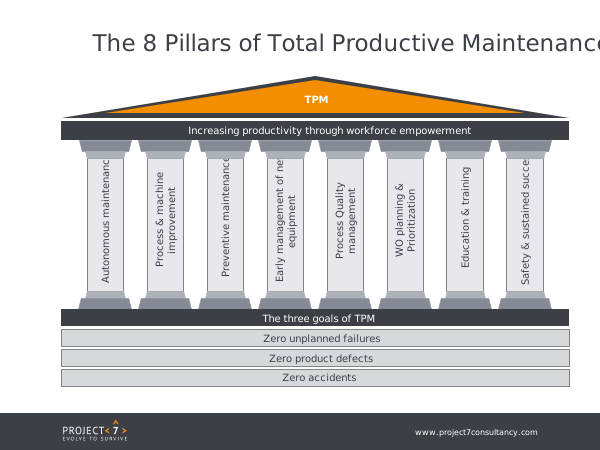
So, let’s start with my hypothesis that TPM drives all three elements of OEE, namely: machine availability, speed and quality. Traditionally as a Maintenance Leader and then Operational Excellence (OpEx) leader in paper mills and packaging manufacturing plants, my focus was all about machine availability. If the machine was running, it belonged to operations and I could focus on writing PMs, improving RCM and building Gantt charts for my next planned outage. However, experience has taught me that just focusing on availability is missing 2/3 of the opportunity to improve business by not embracing the entire OEE metric through maintenance action.

The New Productivity Challenge
The single greatest challenge facing managers in the developed countries of the world is to raise the productivity of knowledge and service workers. This challenge, which will dominate the management agenda for the next several decades, will ultimately determine the competitive performance of companies. Even more important, it will determine the very fabric of society and the quality of life in every industrialized nation.

Creating a Spare Parts Holding List with Confidence
As anyone with a hand in running a household knows, it’s important to keep a stockpile of key items. You certainly don’t want to find out the hard way that you’re on your last square of toilet paper! But in the case of a facility like a power plant, a missing spare part could be more than just a nuisance, it could be downright expensive.

Releasing Asset Value Sustainably - An Analysis of ISO55000x
Although safety and risk mitigation is a fundamental part of creating value and boosting profits, it is not the end of the story when it comes to asset management. To realize the true value of an asset across its entire lifecycle, a business must ensure it has a set of key building blocks in place. These consist of forward-looking management structures and processes that adopt a broader perspective than just identifying and addressing threats and vulnerabilities.