
[webinar] Embracing Digital Transformation in Maintenance & Plant Operations | March 13 at 10AM EST – Register Now
Failure Codes in Maintenance Systems – CMMS
Bryan Weir, Perspective CMMS
What are Failure Codes?
Quite simply, a failure code is a code that illustrates why an asset failed or the reason that the asset failed. Failure codes can be a number which is cross referenced to a list of actual code descriptions or more conveniently a series of alphanumeric characters that are a logical abbreviation of their descriptions. However, with modern database technology and available disk space, the full descriptions are increasingly being used instead of alphanumeric codes.
Where are they used?
They are generally used in maintenance systems or more commonly computerized maintenance management systems, CMMS. They can be used on a work order for an asset or equipment failure. The failure codes are normally input by the person reporting the problem at the time of failure or by the technician when closing the work order.
Why are Failure Codes used?
Failure codes provide a convenient method of getting statistics about equipment failures or breakdowns. CMMS systems will generally have a reporting function that allows reports to be run on specific failure codes for your equipment. Let’s say that you have a machine, which has problems with alignment. You could run a report for a period of time and, by selecting a failure code, determine how many times your machine has had misalignment problems. These statistics are invaluable in any continuous improvement program.
The complexity of the codes will be dependent on the know-how of the system users. For example, if unskilled operators are using the codes to report equipment problems they will have to be of a general nature. Conversely, if trained technical people are the users then the codes can be more complex. For this reason some companies prefer to use both failure codes and problem codes. Problem codes are more a list of symptoms than causes. These would typically be used by operators with the technicians entering the additional failure code after the work was completed.
How are they formed?
Whatever method you chose, your operators and maintenance personnel will soon become familiar with your own codes providing that the list is limited to a manageable number. I firmly believe that there is no need to have more than perhaps 20 or 30 codes and that these need only be of a general nature. For example, if you use your CMMS to report on occurrences of “Misalignment” on a particular piece of equipment those who are familiar with the equipment will know where the misalignment was likely to have occurred, making more specific information unnecessary. Problems will occur when users selecting a code are presented with a drop down list with 50 or 100 codes on it and choosing one becomes difficult. In this case you will find the catch-all “other” being selected too regularly.
If your CMMS supports a hierarchical failure code structure or where codes can be associated to areas or equipment so much the better. In this case you will require more of them simply because they are equipment specific but there may be only 5 or 10 codes for each type of equipment. Functionally this is not a problem because after selecting an asset in the CMMS, users will still only have to choose from the limited number of failure codes associated with that asset.
I have deliberately limited the codes in the illustration below to four characters in an attempt to show that this can provide a good indication of the full description. To prove the effectiveness of this have a look at all the codes and descriptions just once then cover up the descriptions and you will find that you are able to remember most of them. After they have been in use for a week or two you will memorise them all effortlessly.
Alphabetic List of Typical Four: Character Codes and Suggested Abbreviations
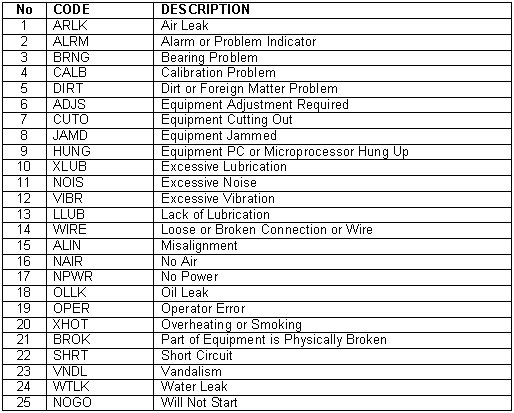
The above codes are of a very general nature and some of them may be considered to be more like problem codes than failure codes but you will find that almost all your failures can be linked to one of them. It is also recognised that you will have local requirements that may mean adding a few more of your own. If this is the case you may also find that you can drop some of those provided if they are inapplicable.
Additional functionality can be added to the codes to suit your own site. For example a number 1, 2 or 3 could be added to indicate priority or seriousness of the failure. A problem with excessive vibration could then become 1VIBR, 2VIBR or 3VIBR dependent on the reporter’s perception of the seriousness of the problem. Alternatively (or additionally), you could add a letter A, B or C to represent the shift when the problem occurred.
In conclusion, the methods outlined in this document are those recommended by the writer. We do recognise that here are other ways of doing things and we are always interested to here about these. Please feel free to share your own opinions and experiences of failure codes or any other aspect of computerised maintenance management.
The effectiveness of maintenance can make the difference between success and insolvency, between limping by financially and organizational excellence. Many companies and organizations consider their computerized maintenance management system (CMMS) and processes as catalysts for achieving a competitive advantage. Yet, good intentions are only part of the recipe for success.
The key to shifting perception of maintenance lies in harnessing data to showcase the benefits of a proactive, data-driven maintenance strategy. By leveraging data, maintenance teams can effectively demonstrate their value and position themselves as indispensable contributors to organizational success.
Inspite of the automation, work orders were created manually and assigned manually to maintenance engineers. The automation provided by software tools relied on humans inputting asset, maintenance and people related information in the software. Over the 5 to 7 years, the basic concept of entering information is becoming redundant. Most modern machines can now monitor their own condition and send out information to maintenance teams if their operating parameters have breached. Industrial Internet of Things is changing how maintenance work orders are created, executed and completed.
Despite current economic hardships, investing in CMMS software presents an opportunity for businesses aiming to optimize operations and reduce costs. By implementing CMMS systems, businesses can manage maintenance schedules, minimize unexpected breakdowns, and extend the lifespan of their assets.
Asset performance data fuels predictive, condition-based and reliability-centered maintenance strategies. Capturing run-time readings, energy consumption, condition and qualitative data in the EAM (Enterprise Asset Management)system on a real-time basis can save time, reduce maintenance costs and improve asset reliability. Obtaining quick and efficient access to asset performance data should be mission critical for every asset management operation.
Much has been written in the past about the implementation of maintenance software (CMMS systems). This article takes a slightly different approach in that it attempts to explain some of the pitfalls associated with first time implementation in SME's. It suggests a "try before you buy" approach, which stages the maintenance software implementation to reduce both risk and cost. Tales of failed implementations abound and failure rates of 40% to 80% are commonly quoted. Real statistics are hard to come by but the following data is both relevant and current.
The job of a maintenance worker is dependent on variables such as supplying spare parts or managing the spare parts inventory. Other challenges involve procuring the right supplier for spare parts. This boils down to challenges related to settling the entire supply chain internally because if you have several facilities, you also need to consider internal spare parts transfers between different warehouses.