
Physical AI on the Shop Floor: Translating Emerging Tech into Maintenance Tasks
Ahmed Rezika, SimpleWays OU
Posted 7/9/2026
You can no longer dismiss physical AI as a distant concept. What used to be lab demos is now shown in public, repeatedly, by companies like Tesla, Boston Dynamics, and Figure AI. These systems walk, handle objects, and execute multi-step tasks in semi-structured environments.
This is not yet full autonomy—but it is no longer theory.
A similar pattern already played out with self-driving technology. What once sounded unrealistic is now operating at scale through systems like Waymo [1], running real rides without human drivers in defined areas. Ten years ago, that level of deployment would have been dismissed.
The lesson is not that timelines are exact. The lesson is that capability compounds faster than expectations.
Physical AI today is where autonomous driving once was:
Not fully mature, but already functional in controlled conditions.
So the real question is no longer if these systems will reach the shop floor.
The real one is which maintenance tasks are structured enough to get there first—and how we prepare for them.

Not a Toy, Not a Technician: What Physical AI Can Actually Do Today
What is demonstrated today is measurable, not speculative. Boston Dynamics’ latest Atlas spec sheet [2] lists 56 degrees of freedom, 50 kg instant weight capacity, 30 kg sustained capacity, and operation from -20°C to 40°C. These are not lab-only numbers—they reflect systems designed for real industrial scenarios. In addition, Atlas can operate autonomously or via teleoperation, with integrated sensing including 360° vision and tactile feedback . The conclusion here is clear: strength, reach, and environmental tolerance already meet many maintenance conditions.
What does this mean in reality?
While much of the public attention focuses on humanoid appearance, the more relevant question for maintenance professionals is capability. The latest Atlas platform from Boston Dynamics demonstrates industrial-level performance with a peak lifting capacity of 50 kg and sustained handling of approximately 30 kg. These figures place it within the range of many routine material-handling tasks performed by technicians, although still below what teams can safely manage using mechanical lifting aids.
Strength alone, however, is not what differentiates Physical AI from traditional industrial robots. Fixed robotic systems have exceeded human lifting capability for decades. The difference lies in mobility and adaptability. Conventional industrial robots are typically bolted to the floor and operate inside carefully defined work envelopes. They deliver exceptional precision and speed but depend on the work coming to them. Atlas and similar systems reverse that relationship by bringing the robot to the work.
The platform’s 56 degrees of freedom illustrate this distinction. A traditional six-axis industrial robot can position a tool with remarkable accuracy but has limited flexibility outside its programmed workspace. By comparison, a humanoid platform must coordinate dozens of joints simultaneously to walk, maintain balance, reach around obstacles, climb steps, crouch, manipulate tools, and interact with equipment designed for human operators. The objective is not to outperform fixed automation in precision. It is to access environments that were originally built for people.
Sensing capability further extends this advantage. Atlas integrates 360-degree perception and tactile feedback this means it can sense its surroundings in all directions and feel contact or pressure through its hands or body. This allows Atlas to continuously update its understanding of the surrounding environment. A human technician still possesses superior contextual awareness and judgment, but the robot can simultaneously monitor multiple sensor streams, access digital procedures, retrieve historical records, and compare live conditions against expected parameters without cognitive fatigue.
What are the limitations?
Viewed through a maintenance lens, the significance becomes clearer. Physical AI does not compete directly with either humans or conventional robots. Fixed robots remain superior for repetitive production tasks within a defined workspace. Humans remain superior when diagnosis, improvisation, and judgment are required. Physical AI occupies a growing middle ground: tasks that require mobility, repeatability, data access, and operation within environments originally designed for human workers.
Mobility and control are equally grounded in research. Peer-reviewed work on Atlas locomotion shows the use of optimization-based control and state estimation to achieve stable walking and task execution over uneven terrain . These systems fuse kinematics, inertial sensors, and LIDAR to continuously estimate position and adapt movement in real time. Simply, these systems combine body-motion data, motion sensors, and laser-based distance sensing to track where they are and adjust their movements instantly as conditions change.
This is not scripted motion—it is closed-loop control operating continuously, enabling robots to adjust step placement, balance, and trajectory dynamically. In simple terms: they don’t just move—they correct themselves while moving.
Manipulation capability is progressing, but with visible limits. Demonstrations show Atlas handling real industrial objects such as ~13.6 kg (30 lb) automotive components, performing lift, carry, and placement tasks . However, even these examples highlight constraints: grasping complex shapes requires careful positioning, and slight variation can still disrupt execution. This aligns with broader research showing that manipulation in unstructured environments remains a primary technical bottleneck, especially when objects vary in shape, weight distribution, or compliance.
Precision and repeatability are already strong—but only under control. Studies on systems like Boston Dynamics’ Spot show ongoing research into accuracy and repeatability performance, confirming that robotic systems can achieve consistent motion execution when conditions are defined . This is consistent with decades of industrial robotics: machines outperform humans in repeatability, but only when variability is minimized.
The Reality (no hype, just boundary conditions)
Physical AI already exceeds humans in:
Strength consistency (no fatigue, stable output)
Repeatability (same motion, minimal deviation)
Sensor fusion awareness (multiple inputs simultaneously)
It still falls short in:
Dexterity under variation
Context understanding
Adaptation to small, unplanned changes
This is not a toy. But it is also not a technician. It is a high-performance system that works well only when the task is engineered to fit its strengths.
From Possibility to Proof
The BMW-Figure [3] [4] deployment moved Physical AI from demonstration to measurable industrial work. During the pilot, Figure humanoids accumulated approximately 1,250 operating hours, handled more than 90,000 components, and supported production of over 30,000 vehicles. Those numbers matter because they demonstrate sustained operation in a real factory rather than a controlled technology showcase. The achievement was not assembly itself. It was proving that a humanoid system could navigate industrial spaces, locate workstations, manipulate objects, and perform repeatable tasks safely around existing operations.
Maintenance professionals should look beyond the specific production task and focus on the capabilities demonstrated. A system that can identify an object, determine where it belongs, transport it, position it accurately, and repeat the process thousands of times has already crossed several barriers shared by maintenance activities such as inspections, material handling, tool transport, and routine servicing.
Researchers are now targeting the next major challenge: dexterity [5]. Moving from handling known objects to handling the wide variety of tools, components, fasteners, and equipment encountered in maintenance work remains one of the industry’s biggest hurdles. Recent developments show how quickly that gap is narrowing. New robotic hand designs can already reproduce the complete set of 33 standard human grasp types while maintaining human-scale dimensions and low cost. Other research teams have demonstrated robotic hands capable of handling objects ranging from paper clips and toothpicks to large containers with grasp success rates approaching 98 percent.
Research is also expanding the operating envelope of robotic manipulation. In early 2026, researchers demonstrated a detachable robotic hand capable of grasping objects from multiple directions, handling several objects simultaneously, and operating within confined spaces inaccessible to conventional robotic arms. The researchers specifically identified inspection and object retrieval inside machinery and industrial equipment as potential applications.
Yet the industry remains realistic about its limitations. In its 2025 analysis [6], McKinsey & Company argued that humanoid deployment would first succeed in structured, repeatable tasks where environments are predictable and success criteria are clear. Inspection routes, material transport, monitoring rounds, and basic handling activities were identified as likely early applications, while judgment-intensive work remained a challenge. By early 2026, BMW was already demonstrating measurable industrial results. The discussion is no longer whether Physical AI can contribute useful work. The more relevant question is which tasks are mature enough to benefit from it today.
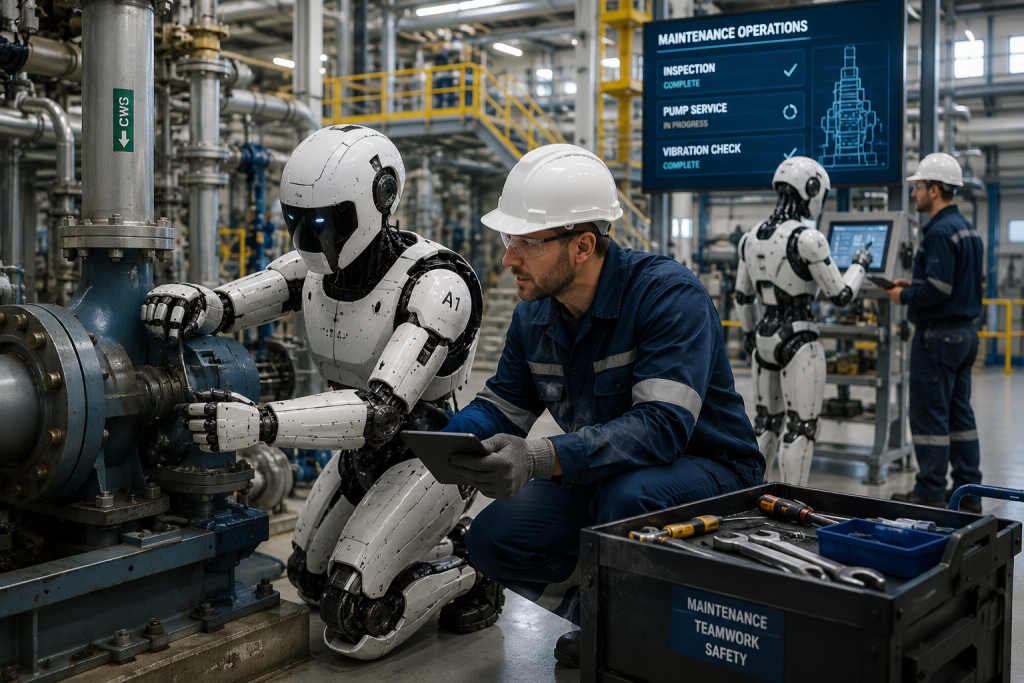
The thought experiment: Where Physical AI Fits in Industrial Maintenance Today
Routine Inspection and Condition Monitoring
This is perhaps the strongest application for today’s physical AI systems. Inspection routes are repetitive, structured, and governed by standard operating procedures. A humanoid equipped with thermal cameras, acoustic sensors, vibration instruments, and vision systems could follow predefined routes, compare live readings against historical baselines, retrieve equipment documentation instantly, and generate inspection reports without fatigue. Unlike human inspectors, it would perform every inspection with the same sequence and attention to detail. The main limitation is contextual judgment. While the system may detect an abnormal temperature or unusual vibration, deciding whether it is an acceptable operating variation or the beginning of a failure still requires engineering experience and operational context.
Lubrication and Preventive Maintenance
Preventive maintenance tasks such as lubrication, filter replacement, visual cleaning, and routine adjustments are excellent candidates because they are highly standardized. Once the location of lubrication points, lubricant type, quantity, and intervals are defined, a physical AI system can execute these activities consistently while automatically recording completion. The challenge appears when conditions deviate from expectations. A seized grease nipple, contamination, incorrect lubricant, or damaged fitting requires diagnosis and adaptive decision-making that current systems still struggle to perform reliably.
Material Handling, Spare Parts, and Tool Logistics
Maintenance technicians often spend significant time walking between workshops, warehouses, and equipment locations. Delivering spare parts, collecting tools, transporting instruments, or removing replaced components demands little technical judgment but considerable physical effort. Physical AI could assume many of these logistics activities, reducing technician travel and allowing skilled personnel to focus on diagnosis and repair. The remaining challenge lies in navigating busy industrial environments where people, vehicles, temporary obstacles, and changing layouts require robust perception and safe interaction.
Standardized Component Replacement
Replacing components that follow a well-defined procedure—such as sensors, transmitters, pressure gauges, electric motors of identical models, or modular control devices—is becoming increasingly feasible. These tasks benefit from repeatability, digital work instructions, torque specifications, and verification steps that can all be integrated into the execution sequence. However, industrial assets rarely age uniformly. Corrosion, seized fasteners, damaged threads, poor accessibility, and undocumented field modifications often force technicians to improvise safely. This type of adaptive problem-solving remains one of the largest gaps between human technicians and today’s physical AI.
A Practical Observation
The pattern is remarkably consistent.
Physical AI performs best where the task is repetitive, measurable, well-documented, and follows a defined workflow. Its value decreases as uncertainty, variability, and engineering judgment increase.
This suggests that the first successful maintenance deployments will not replace technicians. Instead, they will remove repetitive physical work, automate structured execution, and provide intelligent assistance, allowing maintenance professionals to concentrate on diagnosis, decision-making, and continuous improvement. At the end, it is just a thought experiment ahead of time.
Must-Know Jargon
Dexterity: The ability of a humanoid or robotic system to manipulate objects accurately and skillfully using its hands, fingers, wrists, and arms. High dexterity enables tasks such as grasping tools, turning fasteners, inserting connectors, handling fragile components, and adapting to slight variations in object position or shape.
Degrees of Freedom (DoF): The number of independent movements a robot or humanoid can perform through its joints. More degrees of freedom generally allow greater flexibility, dexterity, and human-like motion.
Sensor Fusion: The process of combining information from multiple sensors—such as cameras, force sensors, LiDAR, thermal cameras, microphones, or inertial sensors—to create a more accurate understanding of the surrounding environment than any single sensor could provide
Embodied AI: Artificial intelligence integrated into a physical machine that can perceive its environment, make decisions, and perform actions in the real world rather than operating only in software.
Locomotion: The way the robot moves its whole body from place to place, especially walking on two legs. In humanoids, good locomotion means stable, balanced movement across different surfaces and obstacles.
References
1- Wayomo
2- Boston Dynamics, Atlas spec sheet, 25 December 2025.
3- BMW Group, First humanoid robot introduced in Plant Leipzig, 09 March 2026.
4- Figure AI, F.02 Contributed to the Production of 30,000 Cars at BMW,19 November 2025.
5- Yale University, Yinkai Dong et al. Model Q-II: An Underactuated Hand with Enhanced Grasping Modes and Primitives for Dexterous Manipulation, proceedings of the 2025 IEEE International Conference on Robotics and Automation (ICRA), 2025.
6. McKinsey & Co., Ani Kelkar et al., Humanoid robots: Crossing the chasm from concept to commercial reality, 15 October 2025.

Related Articles

Direction is Not Supervision: Tips for Supervisors

Can Maintenance and Operations Coexist? A Radical Process Change Story

Is Your Plant Organization Ship Shape?

Problem Analysis to Manage and Enhance Customer-Supplier Relationships

Continuous Improvement Leadership – Accelerating Your Success Part III