
Everyday Digital Solutions that Transform Modern Workflows
Ahmed Rezika, SimpleWays OU
Posted 2/3/2026
Everyday Digital Solutions that Transform Modern Workflows. In today’s maintenance landscape, digital transformation is no longer a futuristic aspiration — it is an operational imperative. Maintenance teams are increasingly expected to act as both technical experts and digital natives, capable of navigating tools, data streams, and analytical insights with the same confidence they bring to mechanical diagnostics. Yet, despite decades of investment in large enterprise systems, the everyday digital experience for many technicians still feels like a series of compromises: paper forms that get lost, whiteboards that disappear at shift change, and spreadsheets that grow tangled with time. This growing gap between expectation and reality has led to seek simpler, more accessible digital solutions — tools that support maintenance thinking in the moment, rather than only serving as repositories for paperwork and compliance reports.
Deloitte’s survey of 600 executives shows that as factories and operations get smarter, manufacturers work to overcome obstacles in talent acquisition. Deloitte is famous for being one of the Big professional service firms for Management Consultancy and Audit & Assurance. In their report [1]: “more than a third (35%) of respondents cited adapting workers to the “Factory of the Future” as a top concern, including by equipping them with the skills and tools they need to harness the full potential of smart manufacturing and operations. The challenge of addressing the skills gap comes alongside a gap in applications for open positions”. That’s why the interest in practical digital support remains strong.
Frontline teams recognize the value of digital aids when they genuinely reduce friction and support real work practices rather than add layered bureaucracy. Moreover, broader surveys indicate that a large proportion of maintenance teams are still early in their digital journeys: a substantial number continue to depend on manual processes even as they express confidence in the long-term value of connected, digital maintenance workflows.
This predicts a growing appetite for digital tools that are intuitive, lightweight, and purpose-built for maintenance work. These are not heavy, enterprise-wide systems that require months of configuration and consultancy. They are simple companions for everyday activities — tools that help a technician ask why a failure occurred, visualize cause and effect, and assess a process with structure and clarity. In this emerging ecosystem, digital tools act not only as execution aids but as cognitive supports that improve analysis, documentation, and decision-making without overwhelming the user.
This article explores that space. It looks at everyday digital solutions — including Analysis, and structured Assessment tools — and shows how they help maintenance teams work better in the daily grind of inspection, troubleshooting, and continuous improvement. Rather than promising radical transformation overnight, we focus on how small, practical digital helpers can make the day-to-day work clearer, more consistent, and better aligned with the overall goals of reliability, predictability, and organizational resilience.

Maintenance Work Might Become Digital in Behavior, but Analog in Capture
Maintenance professionals spend much of their day interacting with digital screens. From work orders in enterprise systems to mobile inspection photos, messaging platforms, diagnostic dashboards, and online manuals, the everyday rhythm of work runs through digital interfaces. Yet the very moment that defines expert practice — the space between noticing something is wrong and formulating a structured explanation — is often lived outside of the systems that will eventually record it. This gap creates a kind of cognitive friction: people think on screens, but they capture on forms that were never designed to support thinking itself.
The systems we rely on — CMMS, EAM, and formal reporting tools — excel at recording decisions after the fact. They are structured for compliance, planning, history, and auditability. -mostly- they are not designed for is the early exploratory stage of problem solving, where uncertainty is high and structured answers are still forming. In this early phase, a blank input field or an empty form often feels more like a barrier than a canvas. In psychology, similar “blank page” situations have been studied for how they influence creative problem solving, suggesting that too little constraint or too little structure can paradoxically impede progress and increase cognitive load rather than help it. Researchers refer to this as the blank page effect, where an open space can overwhelm rather than invite productive thought.
At the same time, human cognitive capacity is limited. Psychological theories such as cognitive load explain that the brain has a finite capacity for processing and holding information during complex tasks. High cognitive load — the mental effort required to manage multiple pieces of information simultaneously — can reduce performance in reasoning and problem solving – specially when tools add extraneous effort rather than remove it [2]. In practical maintenance work, having to translate a nascent line of inquiry into the rigid structure of a work order or root cause template before the analysis has properly formed drains attention. It forces technicians and engineers to decide what they will write before what they think. And all of this, before they have fully thought it through. In effect, the tools meant to capture work often get in the way of thinking about work.
As a result, many professionals revert to informal digital behaviors: sketching hypotheses in notepads, taking screenshots and photos, jotting ideas in personal notes, or discussing theories in chat threads. These behaviors reflect a real need: people want low-friction, flexible digital spaces — personal thinking arenas where ideas can take shape without the immediate pressure of formal categorization. It is in these spaces that maintenance teams form the mental models that drive real decisions. The persistence of analog capture in this phase is not about resistance to technology; it is about the mismatch between how we think and how our official tools make us capture that thinking.
Before Looking for a New Tool, Let’s Understand Where Digital Support Is Missing
Before investing time or effort in new digital tools, it is worth pausing to understand where digital support is actually missing in maintenance work. The previous discussion highlighted a cognitive gap: the space between uncertainty and formal documentation. To move from psychology to practice, this section translates that insight into a simple diagnostic approach — one that helps organizations and individuals identify gaps without bias toward any specific tool or system.
Digital adoption [3] is often assessed at the system level: whether a CMMS exists, whether data is collected, or whether reports are generated. Yet real adoption begins elsewhere. It begins with people — how they think, explore, question, and structure problems before those problems ever enter a system. Moving from observation to action requires examining both personal behavior and process design, and more importantly, the friction between them. Let’s go through some checklists for Digital Adoption that might spark your curiosity to use or create your own:
Personal Digital Adoption Checklist (People First)
This checklist focuses on individual behavior during everyday maintenance work:
- Where do I first try to understand a problem — inside the official system or outside it?
- Do I need a private space to explore causes before committing to formal entries?
- Do I sketch logic, causes, or task steps informally before documentation?
- Can I easily retrieve my own past reasoning?
- Do I rely on memory when completing structured fields?
- Do I feel pressure to “fill the form correctly” before clarity exists?
Frequent off-system behavior is not a failure of discipline. It is a signal. It indicates that the current digital environment supports recording outcomes better than forming understanding.
System and Process Adoption Checklist (Systems Second)
To move from systems to people, the same questions must be asked in reverse — this time of the tools and processes themselves:
- Does the system support early, incomplete, or evolving analysis?
- Can thinking be captured progressively rather than only at closure?
- Are cause–effect relationships explicit or hidden in free text?
- Can previous analyses be searched, reused, or adapted?
- Is there space for individual reasoning before formal sharing?
- Does the system reduce or increase cognitive load during problem definition?
When systems do not support these needs, users adapt. They create spreadsheets, notes, screenshots, or parallel documents. These workarounds are not resistance to digitalization. They are attempts to regain cognitive control.
Metrics That Reveal the Gaps
Several neutral metrics can help quantify where digital support is missing:
- Time between failure occurrence and first system entry
- Frequency of work order rewrites or clarifications
- Repeated RCA efforts on similar assets
- High reliance on free-text fields
- References to external files during analysis
- Variability in problem descriptions for similar events
These metrics do not evaluate performance. They highlight where thinking happens outside formal structures.
Probing Down: Spreadsheet or Asset Management System
Whether an organization relies on spreadsheets or a full-scale asset management platform, the probing logic remains the same. Start by asking: Where does thinking actually occur? Then trace how that thinking is translated into the official system. Each manual transfer, simplification, or reformatting step is a loss point. Those loss points reveal precisely where simpler, more supportive digital guides are needed — not to replace systems, but to connect human reasoning with formal structure.

Everyday Digital Tools as Thinking Guides
Once the gaps in digital support become visible, the question is no longer whether new tools are needed, but what kind. The answer is not more complexity. It is not another layer of enterprise software. What maintenance work increasingly needs are everyday digital tools that act as thinking guides — simple, accessible aids that help structure reasoning before it is formalized in official systems.
Thinking guides are fundamentally different from systems of record. They do not aim to replace CMMS or asset management platforms. Instead, they sit upstream. They support the early, uncertain phase of work, when symptoms are unclear, causes are debated, and confidence has not yet formed. In this phase, the value of a tool lies in how well it reduces cognitive load, prompts the right questions, and preserves reasoning — not in how many features it offers.
Digital versions of familiar methods provide a natural entry point. Take the 5 Why technique. On paper, it is often rushed or oversimplified, constrained by space or time. In a digital thinking guide, each “why” can remain visible, editable, and traceable. Assumptions can be revisited. Alternative paths can be explored without erasing previous thinking. The method remains the same, but the experience changes. The tool guides the thinker instead of forcing premature closure.
The same applies to fishbone (Ishikawa) analysis. Traditionally drawn on whiteboards, these diagrams work well in the moment but disappear quickly. A digital fishbone used as a thinking guide preserves the logic behind category choices, allows causes to evolve, and makes relationships explicit. More importantly, it enables edit and reuse. Past analyses become references rather than memories, supporting consistency across shifts, teams, and similar assets.
Structured process or system assessments benefit in similar ways. When assessments are treated as formal checklists only, they become compliance exercises. When used as guided thinking tools, they help users explore weaknesses, trade-offs, and inter-dependencies. Simple digital prompts can surface questions that are often skipped under time pressure, without overwhelming the user with rigid frameworks.
There are many of such tools available within larger EAM and CMMS systems and others work individually to help enriching personal understanding and experience [4]. What makes these tools effective is not sophistication, but intentional guidance. Good thinking guides do not attempt to capture everything. They focus on:
- clarity over completeness,
- guidance over enforcement,
- progression over perfection.
They allow uncertainty. They support iteration. They respect the way maintenance professionals actually think.
Another important characteristic is personal ownership. Thinking often starts individually, even when decisions are collective. Digital guides that allow private exploration before formal sharing reduce the pressure to “get it right” too early. They create space for reflection, hypothesis testing, and learning — all of which improve the quality of what eventually enters the official system.
From an organizational perspective, the impact of such tools is subtle but significant. Better thinking upstream leads to:
- clearer problem statements,
- more consistent root cause identification,
- higher-quality work orders,
- reduced rework and duplication,
- stronger knowledge retention.
These gains do not come from automation alone. They come from supporting human reasoning where it is most fragile.
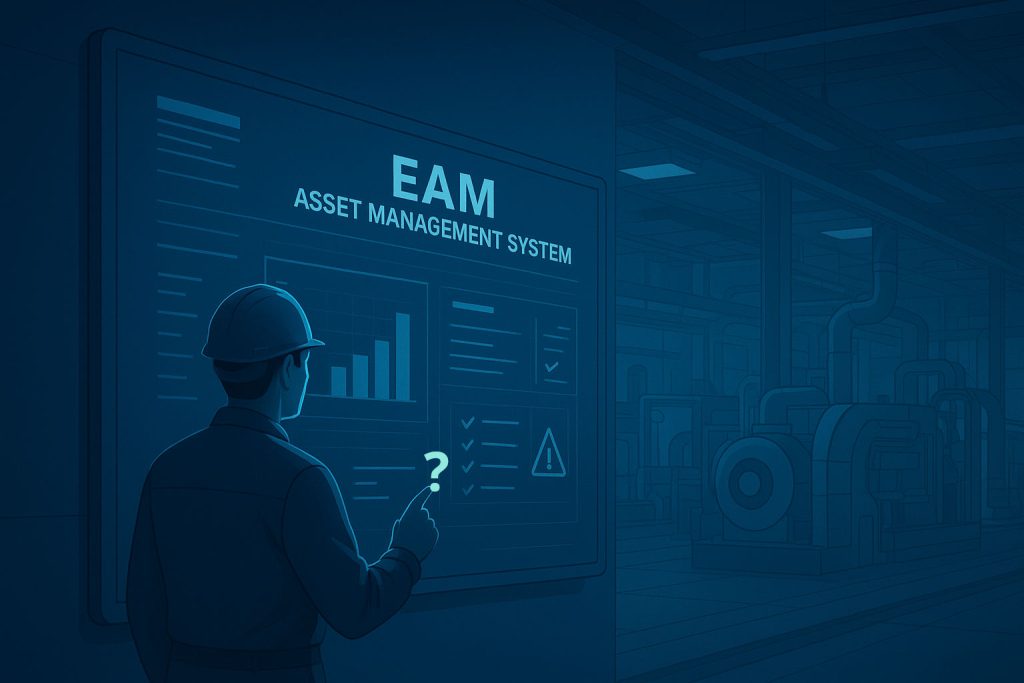
Focus Point: Digital Thinking Guides
Importantly, everyday digital thinking guides scale naturally. They can be used in environments dominated by spreadsheets as well as in organizations running advanced asset management platforms. The logic does not change. Wherever thinking currently happens outside the system, a simple digital guide can act as a bridge — capturing intent, preserving context, and smoothing the transition into formal workflows. This also in a way elevates the practitioners digital experience smoothly so they retain their position as a valuable asset in the digital transformation as it is in the shop floor activities. We explored this insight in the previous article: The New Toolkit: Why Maintenance Digital Skills Can’t Be Outsourced [5].
In the end, digital maturity in maintenance is not defined by the number of tools deployed, but by how well those tools align with human behavior. When digital solutions respect the realities of uncertainty, cognitive load, and everyday work pressure, they stop feeling like obligations and start feeling like support. That is where real transformation begins — not in the skies of grand promises, but in the clarity gained when the stars of everyday work become easier to see and understand.
Must-Know Jargon
Digital Thinking Guides: Lightweight digital tools designed to support reasoning, not just documentation. They help maintenance professionals structure thought, reduce cognitive load, and preserve context before formal system entry.
Cognitive Load: The amount of mental effort required to process information while performing a task. In maintenance work, poorly designed tools increase cognitive load and hinder clear problem definition and decision-making.
System of Record: An official platform, such as a CMMS or EAM, used to store validated and approved information. These systems excel at traceability and compliance but are not optimized for early-stage thinking.
Early-Stage Problem Definition: The phase where symptoms are observed, hypotheses are formed, and uncertainty is highest. Supporting this phase digitally improves the quality of root cause analysis and downstream decisions.
Thinking–Capture Gap: The disconnect between where maintenance reasoning happens and where it is formally recorded. This gap explains why informal notes, spreadsheets, and side tools persist even in digital organizations.
Structured Analysis: The use of logical frameworks, such as 5 Why or fishbone diagrams, to guide reasoning. Structure does not eliminate thinking; it focuses it and makes it repeatable.
Digital Adoption: The degree to which digital tools align with actual work behavior, not just system availability. True adoption occurs when tools support how people think, not only how processes are audited.
References
1- Deloitte Insights, Tim Gaus and Michael Schlotterbeck, May 1, 2025 | 2025 Smart Manufacturing and Operations Survey: Navigating challenges to implementation
2- Educational Administration: Theory and Practice, Ravi Mishra , Dec 1, 2023| Research Article, Cognitive Load and Worker Performance in Digitally Augmented Manufacturing Environments, https://kuey.net/index.php/kuey/article/view/11174/8718
3- TRACTIAN, Billy Cassano, November 25, 2025, What Is System Adoption Rate? Key Metrics For Maintenance Teams, https://tractian.com/en/blog/system-adoption-rate
4- MaintIQ, Ahmed Rezika, January 2026, https://maintiq.simpleways.life/five-whys
5- Maintenance World Magazine, Ahmed Rezika, January 6, 2026, The New Toolkit: Why Maintenance Digital Skills Can’t Be Outsourced, https://maintenanceworld.com/2026/01/06/the-new-toolkit-why-maintenance-digital-skills-cant-be-outsourced/

Related Articles

Cost of Unreliability

Power Plant Maintenance: Which Strategy Is Best?
How to Develop Inclusive Lean Leadership Training

Leaders in Maintenance: Parts 1 - 4

10 Things Your Management Needs to Know Now

The Face of Effective Reliability Management