
Is Agentic AI Just a Fancy CMMS? – The Agentic Framework and Collective Intelligence
Ahmed Rezika, SimpleWays OU
Posted 10/2/2025
Exploring the new frontiers of the AI era gives us plenty of reasons to be excited — but it also requires us to stay grounded, critical, and practical. New ideas must prove their worth not only in theory but in the day-to-day reality of maintenance and operations.

AI agents, as powerful as they are, remain bound by design. They are optimized to execute specific tasks, provide recommendations, and solve well-defined problems—but they rarely transcend their trained/programmed context. Unless they do. In maintenance, this means they can flag anomalies or optimize inspections, but they still depend on how human operators trained them to interpret, decide, and act. They assist, but they do not truly collaborate. They are faster and more precise, but only within the boundaries set for them. The 360-degree perspective—the ability to connect the dots and envision where these trends may ultimately lead—is still reserved for a handful of human leaders who can see beyond immediate efficiencies toward the broader horizon.
This is where the Agentic Framework signals the next evolution. Unlike static AI agents or pre-trained/pre-programmed automation, agentic systems are designed for coordinating all other AI Agents through adaptability, autonomy, and contextual awareness. They don’t just process instructions; they interpret global environments, pursue broader goals, and continuously adjust their actions as conditions change. By learning from interactions and situating decisions within a wider operational context, agentic systems can anticipate needs, negotiate trade-offs, and coordinate seamlessly with both humans and other machines.
In essence, the Agentic Framework redefines intelligence—not as the sum of data or the efficiency of execution, but as the ability to act purposefully within complex, changing environments – overseeing the whole scenario.
Let’s remind ourselves with the classical definition of AI: “At its core, AI refers to intelligent systems and algorithms capable of performing tasks that traditionally require human-like cognitive abilities. These include problem-solving, decision-making, perception, reasoning, and even creative creation in more advanced systems.” [1]
For maintenance, the implications can be profound. Imagine systems that don’t just predict failures but autonomously arrange repair schedules, negotiate resource allocation, or reroute workflows to minimize disruption—without waiting for human intervention. This moves beyond efficiency into a realm of true autonomy, where maintenance becomes an orchestrated, intelligent process embedded seamlessly within operations. The question is no longer whether AI can support maintenance, but whether maintenance teams are ready and willing to embrace this next rise of collective intelligence.
Bottom line, Early adoption may come from top-tier firms with deep digital capabilities, but the benefits extend well beyond them—bringing tangible value to maintenance teams of any size and within organizations at every scale.
The Critic’s Lens: Is Agentic AI Just CMMS With Lipstick?
It’s a fair question, and one that many in maintenance will raise: isn’t all this “Agentic AI” talk just another way of describing what a well-configured CMMS or ERP system already do? After all, most systems today can flag an abnormal reading, generate a work order, and even schedule a task based on available technicians and spare parts. With a bit of programming, thresholds can trigger escalations, and calendars can be aligned with production schedules. For many practitioners, that looks like more than enough — and in truth, it covers much of the day-to-day work.
But this is also where traditional automation shows its limits. These systems operate deterministically: if X happens, then do Y. They rely on the data tables and workflows you’ve already defined, and they don’t get better on their own unless someone goes in to rewrite the rules. Their scope is also narrow. Maintenance logic stays within maintenance; it doesn’t usually stretch into supply chain uncertainty, regulatory changes, or cross-functional goals that may conflict with each other.
Agentic AI [2] aims to push beyond those limits. Instead of running only on pre-training / pre-programmed rules, it is designed to adapt and even propose new decision paths when the situation doesn’t fit the script. It can bring together multiple sources — vibration sensors and CMMS logs, yes, but also supplier APIs, OEM bulletins, or even external data streams like energy price forecasts or weather patterns. Different agents — one specialized in diagnostics, another in planning, another in logistics — can coordinate under a shared framework, each contributing a piece of the puzzle. The result is not a fixed reaction to a trigger, but a system that reasons across domains, weighs competing priorities, and pursues higher-level dynamic goals such as uptime, cost efficiency, or compliance.
So no, it isn’t a scam — but it also isn’t magic. For routine alarms and straightforward cases, traditional systems remain entirely sufficient. Where the agentic approach starts to show its real value is when maintenance must interact with the bigger picture: production pressures, resource constraints, safety standards, and business strategy all at once. That’s a space where a simple rule or workflow quickly runs out of steam — and where agentic thinking, if applied carefully, can become a true partner rather than just another programmed response.
What Is Agentic AI?
Agentic AI represents the next evolution beyond standalone AI agents. Where traditional agents excel at performing specific tasks — anomaly detection, scheduling, reporting — Agentic AI ensures these specialized personas work together toward broader organizational goals.
Think of it this way: each process in a workplace can be represented by an AI persona — a maintenance agent, a procurement agent, a scheduling agent, even an HR agent. On their own, these personas are highly capable but limited to the context they were trained for. They execute efficiently within their boundaries, but they do not naturally collaborate across domains.
This is where Agentic AI comes in. It acts as the orchestration layer, coordinating the work of multiple agents, reconciling priorities, and making decisions that balance efficiency, safety, cost, and strategy. In other words, Agentic AI is the “conductor” ensuring harmony among specialized AI “musicians,” creating not just isolated outputs but a cohesive performance aligned with organizational goals.
Unlike static agents, Agentic AI is:
- Global Context-aware: It interprets signals from across the system, not just within a single process.
- Goal-oriented: It pursues overarching objectives, not just local tasks.
- Adaptive: It learns from interactions and adjusts coordination strategies over time.
- Collaborative: It enables human workers and AI agents to operate as a blended workforce.
In short, Agentic AI doesn’t replace individual agents — it elevates them, enabling a workplace where autonomous processes don’t just coexist but actively collaborate.
Are Agentic AI and Agentic Framework the Same?
- Agentic AI usually refers to the paradigm or capability of AI systems that act autonomously, contextually, and with goal-directed behavior[3].
- Agentic Framework is the infrastructure or methodology that enables Agentic AI to operate strategically— the orchestration layer, protocols, memory, planning, and guardrails.
So, Agentic AI is the outcome, the “intelligence,” while the Agentic Framework is the structure that makes it possible. Think of AI agents as “workers,” Agentic AI as the “collaborative intelligence,” and the Agentic Framework as the “workplace infrastructure.”
Analogy: From Chat Agents to Organizational Orchestration
Traditional AI agents (whether chatbots, anomaly detectors, or schedulers) are like single-instrument players:
- Chat Agents: Optimized for one task — parsing queries, responding conversationally.
- Maintenance Agents: Focused on vibration anomalies, spare parts forecasts, or work order creation.
- They are efficient but narrow, operating within a closed loop (input → output).
Agentic AI, by contrast, plays the role of the conductor:
- It doesn’t just answer a query or flag an alert.
- It interprets signals across CMMS (Computerized Maintenance Management Systems), EAM (Enterprise Asset Management), IoT telemetry, ERP systems, and even strategic KPIs.
- It aligns local decisions (e.g., fixing Pump A) with organizational objectives (minimizing Mean Time Between Failures [MTBF], reducing Total Cost of Ownership [TCO], or ensuring Safety Integrity Level [SIL] compliance).

Agentic AI Applied Ideally to Maintenance at the organizational level
At the organizational level, Agentic AI transforms maintenance from isolated tasks into strategic orchestration:
- Anomaly Detection → Strategic Impact Analysis
- A vibration anomaly on a turbine (detected by an AI agent) is no longer just an alert.
- The agentic system evaluates:
- OEE (Overall Equipment Effectiveness) impact if downtime occurs.
- MTTR (Mean Time to Repair) given technician availability.
- SLA (Service Level Agreement) penalties if production halts.
- Decision: delay intervention until a scheduled production lull, or trigger immediate shutdown if thresholds are breached.
- Work Order Prioritization → Holistic Scheduling
- Instead of creating a simple work order, the system balances:
- Resource leveling (technicians with specific certifications).
- Spares lead time from ERP procurement data.
- Criticality index of the asset (e.g., Tier 1 process-critical vs Tier 3 utility).
- It dynamically re-prioritizes the maintenance backlog using risk-based maintenance (RBM)principles.
- Instead of creating a simple work order, the system balances:
- Maintenance Policy Alignment → Strategy Awareness
- Traditional AI follows programmed rules; Agentic AI can be trained on the Asset Management Strategy (ISO 55000).
- It “senses” organizational strategy (e.g., maximize uptime vs minimize cost) and weighs decisions accordingly.
- Example: For a plant shifting to a Reliability-Centered Maintenance (RCM) approach, the framework biases decisions toward long-term reliability vs short-term fixes.
Why This Matters
Without the Agentic Framework, maintenance AI is like multiple chat agents in silos [4]— answering, flagging, and optimizing locally. With Agentic AI, those silos dissolve into a cohesive decision-making fabric that integrates:
- IoT/SCADA feeds (real-time sensor data)
- EAM/CMMS workflows (asset lifecycle management)
- ERP systems (parts, procurement, labor costs)
- Organizational strategy (safety, cost, sustainability, uptime)
The outcome is maintenance that is no longer just predictive but truly prescriptive and strategic, where every action is weighted against the business objectives.
Agentic AI for Small Businesses
Most workplaces aren’t sitting on a shiny, fully integrated digital twin, and “AI enforcing safety/compliance” can sound more like corporate hype than shop-floor reality. In fact:
- Digital Twins → Still expensive, data-heavy, and mostly deployed in high-capital industries (aviation, oil & gas, advanced manufacturing). Most plants rely on ERP/CMMS, SCADA, and spreadsheets.
- AI Enforcement → In most places, maintenance teams (and unions) would push back if AI tried to enforcerules. Adoption works better when AI recommends, contextualizes, and explains instead of commanding.
So, for non-top-tier firms, the real draw isn’t futuristic digital replicas or hard AI enforcement — it’s practical value in the here and now.
- Resource Constraints
- Mid-size plants don’t have endless technicians or spares.
- Agentic AI helps them stretch thin resources by prioritizing work that truly matters, avoiding wasted time on low-impact tasks.
- Example: instead of chasing every SCADA alarm, teams get a ranked list tied to production impact.
- Knowledge Gaps
- Smaller firms often rely on a handful of “tribal knowledge” experts. When they retire or leave, the know-how goes with them.
- Agentic AI can embed historical CMMS data, past failure modes, and manufacturer notes to augment less-experienced technicians.
- Incremental Digitalization
- Not every company needs a digital twin. A simple IoT sensor feed + ERP/CMMS integration can still unlock agentic orchestration.
- For these firms, Agentic AI becomes a bridge between existing systems rather than a full replacement.
- Competitive Advantage Without Heavy Investment
- It’s like moving from flip phone → smartphone without building a telecom tower yourself.
- Human Buy-in at the Team Level
- Instead of promising “AI will enforce safety,” firms can frame it as:
- AI helps reduce overtime stress.
- AI ensures techs aren’t blamed for missing hidden anomalies.
- AI explains why a task matters in business terms (OEE, downtime costs).
- Top-tier firms may have massive budgets, but mid-tier players can adopt lighter agentic layers to leapfrog without building a full-scale digital twin.
- That way, individuals feel supported, not policed.
- Instead of promising “AI will enforce safety,” firms can frame it as:
Bottom Line for Small Businesses & Their Teams
Agentic AI doesn’t have to be futuristic — it can start small:
- Prioritizing maintenance tickets.
- Mapping production schedules against downtime.
- Giving technicians better context before they pick up a wrench.
For management, it’s a chance to extract more value from existing assets without massive CapEx. For teams, it’s less stress, less firefighting, and more meaningful decision support.
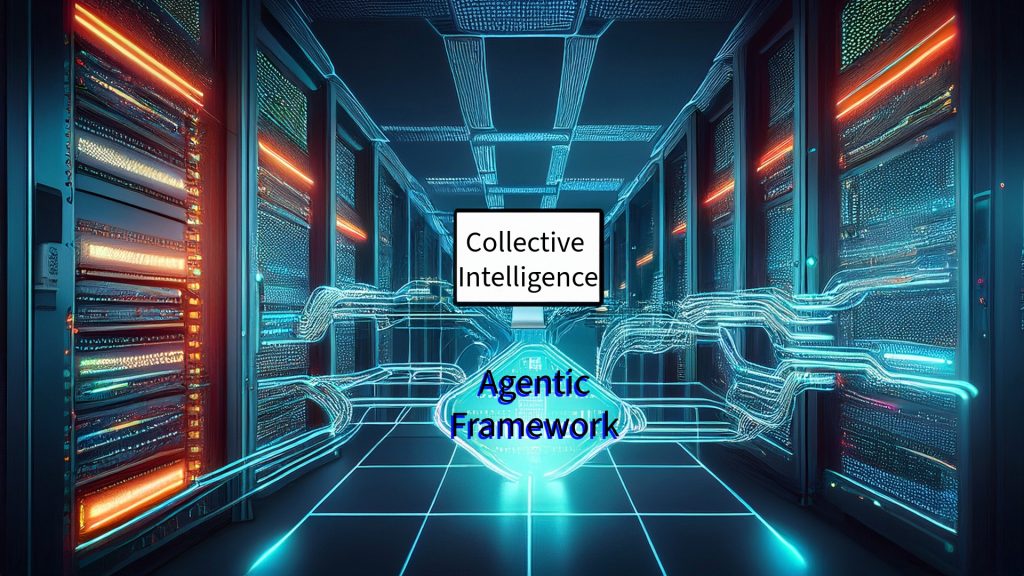
Conclusion: The Agentic AI Framework and the promise of collective intelligence
The rise of AI agents in maintenance has brought real possibilities — from anomaly detection to predictive scheduling — but these systems are still bound by learning/design. They work well within their trained context, yet they remain task-specific, like chat agents built for conversation or CMMS workflows scripted to fire when a threshold is crossed.
The difference lies in scope and behavior. A CMMS or ERP workflow is deterministic — if X, then Y — and tied to the tables and rules you define. An agentic framework, by contrast, coordinates multiple specialized agents, draws from heterogeneous sources, and adapts dynamically toward higher-level changing goals such as uptime, cost efficiency, or compliance. It’s less about reacting to a trigger and more about orchestrating decisions across domains — like a conductor leading an orchestra rather than a technician flipping a switch. That’s way a common language or protocols are currently needed as we can see in the rise of MCP -Model Context Protocol-[5] which we are going to explore in our coming lecture.
This doesn’t make traditional automation obsolete; it remains perfectly suited for routine alerts and straightforward cases. Where Agentic AI starts to show its value is in the gray areas: when maintenance decisions are entangled with supply chain delays, regulatory changes, energy costs, or production pressures. In those moments, rule-based logic runs out of steam, and a goal-seeking, context-aware framework can turn maintenance from firefighting into foresight.
Must-Know Jargon
Agentic AI Framework: A software framework that enables building autonomous AI agents capable of planning, reasoning, and independently executing multi-step tasks. These frameworks typically provide architecture, toolkits, and workflows to transform large language models into goal-driven agents.
Autonomous AI Agent: A software entity powered by AI that can perform specific tasks independently by making decisions and adapting without continual human input. They use machine learning and natural language processing to interact, plan actions, or solve problems within a domain.
AI Agent:An AI-driven program designed to perform goal-directed actions autonomously, often within a limited scope or specific task. AI agents are typically components of agentic AI systems and may leverage generative AI models for decision-making.
Agentic Workflow:A structured sequence of processes guided by AI agents to accomplish goals autonomously. These workflows integrate perception, reasoning, planning, and action phases, allowing agents to break down complex problems and adapt dynamically.
Context Awareness:The capability of an AI agent to understand and utilize contextual information such as past interactions, environmental factors, or user state to provide more relevant and personalized responses or actions.
Agent-to-Human Handoff:The process of transferring an ongoing task or interaction from an AI agent to a human, ensuring all relevant context and information are preserved so the human can seamlessly continue the interaction.
Human in the Loop (HITL): is an AI design approach where humans actively participate in the AI system’s training, decision-making, and operational processes.
References
1- MaintenanceWorld.com, Ahmed Rezika, Oct 2024, AI-Powered Maintenance: AI Models and Possible Use Cases, https://maintenanceworld.com/2024/09/04/ai-powered-maintenance-ai-models-and-possible-use-cases/
2-mendex- A Siemens Business, Agentic AI: https://www.mendix.com/glossary/agentic-ai/
3-Toloka AI by Bezos Expeditions, What Are Autonomous AI Agents?
, https://toloka.ai/blog/autonomous-ai-agents-paving-the-way-for-agi/
4- Google Cloud .Multi-agent systems versus single-agent systems: https://cloud.google.com/discover/what-is-a-multi-agent-system
5- Langchain Documents: Model Context Protocol (MCP) : https://modelcontextprotocol.io/introduction

Related Articles

Sources of data for AI Empowered Maintenance – Manufacturing Execution System

Mobile CMMS: The Future Maintenance Team's BFF
Parts Inventory Management: What do You Need in Your Storeroom?

The Key to Unlocking the Full Potential of Your CMMS
Mobile vs. Desktop: Differences in CMMS Features
Why Might your Business Need a CMMS?