In many organizations, maintenance departments struggle to secure the resources they need to keep facilities and equipment operational. Business leaders may view maintenance as a cost driver, only investing in it when absolutely necessary, rather than as a strategic business asset capable of providing significant value. This perception leads to underinvestment in maintenance teams, equipment, and processes, resulting in an unfortunate cycle of reactive maintenance work and costly breakdowns.
The key to shifting this perception lies in harnessing data to showcase the benefits of a proactive, data-driven maintenance strategy. By leveraging data, maintenance teams can effectively demonstrate their value and position themselves as indispensable contributors to organizational success.
Harnessing the Power of Data
Maintenance teams often lack accessible, accurate data. Without the proper tools to gather insights into asset health, process efficacy, team productivity, and the department’s broader impact, organizations can find themselves trapped in reactive maintenance patterns. This approach, where investments are made only when something fails, is far costlier than proactive and preventive maintenance strategies and creates a cycle of underinvestment and underperformance.
Maintenance teams should focus on collecting and analyzing data that resonates with decision-makers and aligns with overall business objectives. Instead of focusing solely on maintenance-specific metrics, maintenance teams must translate the data into broader business impacts – potential cost savings from reduced downtime, improved product quality and customer satisfaction, enhanced safety and regulatory compliance, increased equipment lifespan and reduced capital expenditures, and energy efficiency and sustainability improvements. By connecting maintenance activities and needs to key performance indicators that matter to executives, the department can more effectively demonstrate its overall strategic value.
Making the Case for a CMMS
To truly transform maintenance from a cost center to a value driver, maintenance organizations first need the right tools and skills. Implementing a Computerized Maintenance Management System (CMMS) is an important early step. A CMMS can provide real-time insights into asset health and maintenance activities, optimize resource allocation, improve overall compliance, and enhance decision-making capabilities across the entire organization. When making the case for a CMMS, it is important to emphasize the new level of visibility it will provide into maintenance operations and how these insights will support overall strategy.
Once approval for implementing a CMMS is secured, it’s crucial that maintenance teams deliver on their promises. Maintenance leaders must do research into user-friendly solutions that will support the team throughout implementation and promote end-user adoption. Low user adoption is one of the top reasons CMMS implementations fail and maintenance teams who are used to being regarded as low-value can’t afford a false start. Teams may consider starting with a preliminary implementation with a small number of critical assets to help smooth the transition. It is essential that the initial implementation and adoption goes smoothly to quickly demonstrate improvements in key metrics and ROI to executives.
With a CMMS successfully in place, maintenance teams will be better positioned to advocate for further initiatives such as new equipment or additional staffing. Teams can use asset histories to make data-driven arguments for equipment replacement or repair and leverage performance data to justify additional hires by showing workload trends, maintenance backlogs, and overtime costs.
Continuous Communication is Key to Shifting Maintenance Perspectives
As business leaders begin to implement these changes, it is vital that maintenance teams continue communicating their successes, rather than waiting for business executives to ask about the department’s performance. By regularly sharing success stories and positive outcomes resulting from proactive maintenance initiatives, maintenance teams are able to showcase their value and how these strategies contribute to overall business growth and success. For example, maintenance teams can provide case studies of prevented failures and the associated cost savings, before-and-after comparisons of equipment reliability and its effect on performance, or general trend analyses showing improvements in key metrics over time. It may even be beneficial to implement a regular Maintenance Impact Report to keep executives constantly informed of the department’s contributions to overall business goals so business leaders understand the impact their investments are making.
In order to truly shift business leaders’ perspective on maintenance, teams must emphasize the need for data-driven insights. By leveraging data and consistently demonstrating their impact on organizational success, maintenance teams can transform their image from cost center to indispensable value driver that contributes to long-term business growth and customer satisfaction.
Bryan Christiansen
Bryan Christiansen is a self-taught, full-stack developer turned marketer turned entrepreneur. Bryan is the founder and CEO of Limble CMMS, the leader in CMMS software which empowers the unsung heroes that support the world. Limble has grown to having thousands of users in just a few short years.
Standard job plans. Be sure your CMMS systems have a way to put in a standard job. That true? yeah? Okay, so Tor mentioned yesterday critical and repetitive work...great place to start and even on a repetitive job it may be something that's really simple but if there's a bill of materials that comes with that job, then you create a standard job plan that just has the bill of material, has the work order coding on it, and another CMMS system that we had at my last job you could actually link the standard job to an equipment number in the background so when you went in to create a work order you just put in the equipment number there's a standard job pull down every standard job that was linked to that equipment select it and create your work order.
Standard job plans. Be sure your CMMS systems have a way to put in a standard job. That true? yeah? Okay, so Tor mentioned yesterday critical and repetitive work...great place to start and even on a repetitive job it may be something that's really simple but if there's a bill of materials that comes with that job, then you create a standard job plan that just has the bill of material, has the work order coding on it, and another CMMS system that we had at my last job you could actually link the standard job to an equipment number in the background so when you went in to create a work order you just put in the equipment number there's a standard job pull down every standard job that was linked to that equipment select it and create your work order.
Why automate, why improve? They're all about the same question, so after covering the more general area, we'll zoom in on the specifics of PLCs. "Why improve?" Because your competitors are, and you will not be in competition with them very long, if you don't. "More and better" are today's bottom line. With the customers being better educated, and having better availability of the product they seek, you have no choice.
Why automate, why improve? They're all about the same question, so after covering the more general area, we'll zoom in on the specifics of PLCs. "Why improve?" Because your competitors are, and you will not be in competition with them very long, if you don't. "More and better" are today's bottom line. With the customers being better educated, and having better availability of the product they seek, you have no choice.
For most companies, gone are the days when users were forced to conform to a rigid framework dictated by the CMMS vendor and strictly controlled by the Information Systems department. Users today enjoy freedom to customise the content, look and feel of their CMMS environment on a variety of devices, from handhelds to desktops. With modern computers and software, users are overwhelmed with choices.
For most companies, gone are the days when users were forced to conform to a rigid framework dictated by the CMMS vendor and strictly controlled by the Information Systems department. Users today enjoy freedom to customise the content, look and feel of their CMMS environment on a variety of devices, from handhelds to desktops. With modern computers and software, users are overwhelmed with choices.
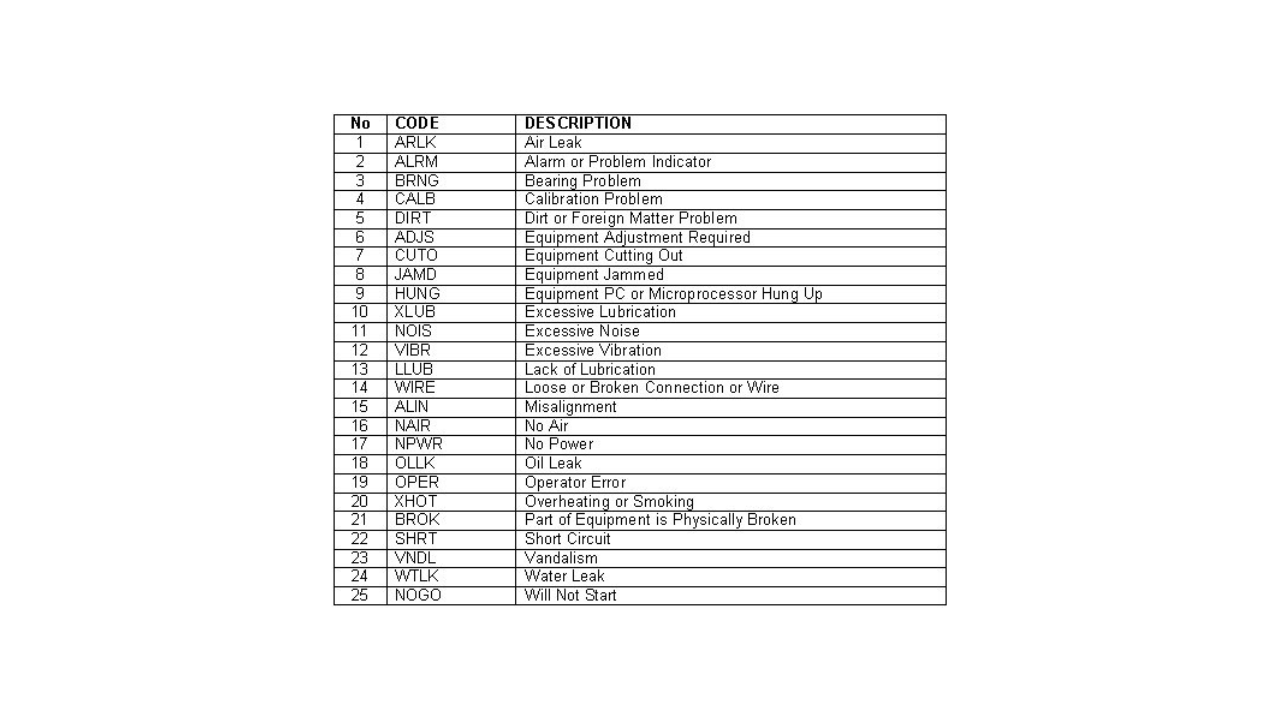
What is a failure code? Quite simply, it is a code that illustrates why an asset failed or the reason that the asset failed. Codes can be a number which is cross referenced to a list of actual code descriptions or more conveniently a series of alphanumeric characters that are a logical abbreviation of their descriptions. However, with modern database technology and available disk space, the full descriptions are increasingly being used instead of alphanumeric codes.
What is a failure code? Quite simply, it is a code that illustrates why an asset failed or the reason that the asset failed. Codes can be a number which is cross referenced to a list of actual code descriptions or more conveniently a series of alphanumeric characters that are a logical abbreviation of their descriptions. However, with modern database technology and available disk space, the full descriptions are increasingly being used instead of alphanumeric codes.
The job of a maintenance worker is dependent on variables such as supplying spare parts or managing the spare parts inventory. Other challenges involve procuring the right supplier for spare parts. This boils down to challenges related to settling the entire supply chain internally because if you have several facilities, you also need to consider internal spare parts transfers between different warehouses.
The job of a maintenance worker is dependent on variables such as supplying spare parts or managing the spare parts inventory. Other challenges involve procuring the right supplier for spare parts. This boils down to challenges related to settling the entire supply chain internally because if you have several facilities, you also need to consider internal spare parts transfers between different warehouses.
Many smaller companies feel maintenance management software is overkill for their organizations. Nothing could be further from the truth. In reality, even a one-person maintenance department can reap the benefits of maintenance management software. The same benefits realized by the maintenance crew in larger companies are there for smaller maintenance departments also.
Many smaller companies feel maintenance management software is overkill for their organizations. Nothing could be further from the truth. In reality, even a one-person maintenance department can reap the benefits of maintenance management software. The same benefits realized by the maintenance crew in larger companies are there for smaller maintenance departments also.
Now that the best EAM/ CMMS application for your business has been selected, the deployment phase begins. But an EAM system is not a plug-and-play application. Will you miss out on some real operational savings? Will the data be clean enough to provide value in a production environment? Will processes be tailored to match the new system, or will they be optimized to improve business? Is the vendor knowledgeable about your specific industry or regulatory requirements?
Now that the best EAM/ CMMS application for your business has been selected, the deployment phase begins. But an EAM system is not a plug-and-play application. Will you miss out on some real operational savings? Will the data be clean enough to provide value in a production environment? Will processes be tailored to match the new system, or will they be optimized to improve business? Is the vendor knowledgeable about your specific industry or regulatory requirements?