[webinar] Embracing Digital Transformation in Maintenance & Plant Operations | March 13 at 10AM EST – Register Now
How many Planners and Supervisors do we need?
How many Planners and Supervisors do we need?
Torbjörn Idhammar, CEO and President IDCON INC.
Planners and Supervisors
My personal free time has radically increased over the past six months. Our three sons, all played ice hockey until very recently, which meant year-round weekend travel up and down the East Coast, sometimes even driving to Detroit. It felt like a road trip that never ended, and sometimes it was just plain impossible to stitch the schedule together around three junior teams. Even though I champion the idea of my children doing what they love, I will admit that more than once I sat rink-side on my frozen behind wondering if I was nuts. Driving around half a country—for children’s ice hockey? I often thought (and sometimes wished) that they would probably lose interest and be on to the next thing with a split-second’s notice, any day.
Suddenly those secret wishes came true. All three kids decided to replace the hockey with long distance running. I think they, too, felt that it was too much travel, and they missed being home, hanging with other friends, on some weekends. The running pursuit only requires one real trip per year, to the Nationals, if they qualify, and the rest of the time there’s plenty of good races, much closer than Detroit, Chicago, New York, and Washington DC. And now that the 16-year-old has his driver’s license, the logistics have enormously changed for the better. So the time I once used for coaching and planning travel for games and tournaments, is now all mine – a true luxury.
During the hockey years, I spent about 15-20 hours in cars, locker rooms and hockey rinks—per week—trying to squeeze work in whenever I could find a few minutes. Often times I drew the parallel between supervisors and planners in our factories with the thankless job of being a parent, shivering to the echo of pucks hitting the ice. One question I get a lot from executives in the maintenance industry is: “How many planners and supervisors do we need?” Unfortunately, there are many consultants who go with a standardized answer: “One planner per every 16 worker, or one supervisor per every 20.” It’s not that simple. Many more factors play in to the numbers, just as they do in the hockey-parent logistics.
The easiest way to determine how many supervisors or planners one needs is to take a look at the workload. This differs from factory to factory and plant to plant, but it’s rooted in the organization, work processes and the expertise of the repair staff.
How do Planners and Supervisors fit into the organization?
Some plants have planners, schedulers and supervisors, while others have stop planners and daily planners separated. A few keep electricity and instruments from mechanical planners, while some plants are more bare bones. It makes a big difference if the planner can 100% dedicate his or her time to planning, instead of having to take care of purchasing orders, train workers in the CMMS, attend improvement meetings, and so on. It’s the same thing with the supervisor role. Can he or she focus on their team or he/she expected to run a few improvement projects and renovations? The more we tack on to these roles, the less time will be left for leading their workers.
Good work processes and background data are pieces to the puzzle
Quick access to spare parts, specialty tools, technical data, security standards and permits can make a big difference. If a plant is well organized, the planner can plan a number of jobs, but if the materials needed for actual planning cannot be found, the workload per work order increases, resulting in fewer jobs planned.
Knowledgeable and independent personnel
Just as a parent’s time demands are more significant for a 15-year-old hockey player than a 16-year-old long distance runner with a car, a supervisor’s time is better spent with inexperienced versus knowledgeable personnel. If every employee knows his or her job well enough to work independently, fewer supervisors are needed.
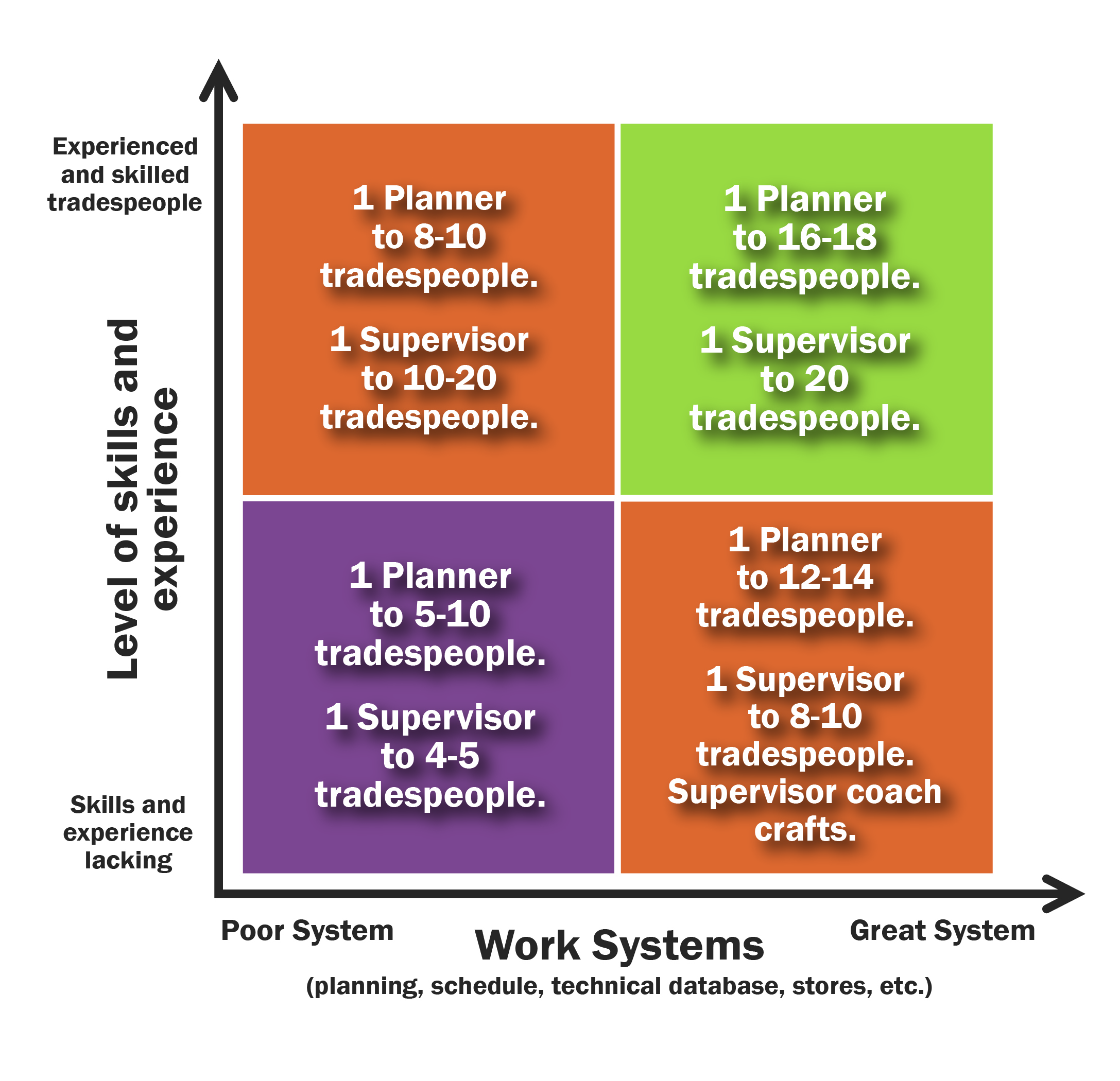
The workload can be changed, depending on the plant’s work process, organization, and expertise of the repair crew. Here’s a graph:
Figure 1. The number of planners and foremen needed primarily depends on the level of expertise among the repair personnel, and how well the data and spare parts are organized.
I think supervisors, planners, and repair personnel mainly build reliability. Therefore, it’s important to consider the workload of your supervisors and planners. How much interaction do their workers need? Are jobs being planned? Is data accessible? How many different responsibilities are placed on the planner or foremen, outside of their regular duties?
When it comes to the workload for hockey parents, I think we need extra sets of parents, more hours in the day, and an organizational method resembling NASA’s command center in Houston in order to survive more than a few seasons.
I invite you to send me your comments and questions to info@idcon.com and for more information about best practices in reliability and maintenance please click here for more articles.
Torbjörn Idhammar
Torbjörn Idhammar is the president and CEO of IDCON INC., a Reliability and Maintenance Management Consulting Firm. Tor’s responsibilities include training IDCON consultants, product development, sales, and marketing. He gives advice to IDCON’s multi-site and international clients to ensure outcomes and deliverables are met.
While off-line filtering and particle analysis were key to Smoky Canyon Mine’s reliability improvements, the mine’s reliability team found that these techniques did not do enough to warn about catastrophic failures in the mine’s fleet of 785 Caterpillar haul trucks. Therefore, the team decided to include magnetic plug inspections in the 500-hour interval inspections. Smoky Canyon Mine’s magnetic plug inspections have raised its reliability maintenance program beyond contamination control to the next level.
While off-line filtering and particle analysis were key to Smoky Canyon Mine’s reliability improvements, the mine’s reliability team found that these techniques did not do enough to warn about catastrophic failures in the mine’s fleet of 785 Caterpillar haul trucks. Therefore, the team decided to include magnetic plug inspections in the 500-hour interval inspections. Smoky Canyon Mine’s magnetic plug inspections have raised its reliability maintenance program beyond contamination control to the next level.
Daily and weekly meetings between operations and maintenance are crucial in taking the efficiency of your daily maintenance to a higher level. Coordinating meetings where various departments prioritize work orders (WO) and maintenance is the foundation for a partnership between operations and maintenance. Such meetings create efficiency. Well-organized meetings with clear goals and agendas can completely change the culture for the better in an organization.
Daily and weekly meetings between operations and maintenance are crucial in taking the efficiency of your daily maintenance to a higher level. Coordinating meetings where various departments prioritize work orders (WO) and maintenance is the foundation for a partnership between operations and maintenance. Such meetings create efficiency. Well-organized meetings with clear goals and agendas can completely change the culture for the better in an organization.
This paper outlines the key factors that you should consider when establishing a Maintenance Change program in your organization. In doing so, it provides a framework which you can apply to increase the chances of success in your change efforts. The paper draws heavily on Price Waterhouse experience in implementing Maintenance change at many major organizations throughout WA, as well as our international experience in implementing change as articulated in our book "Better Change."
This paper outlines the key factors that you should consider when establishing a Maintenance Change program in your organization. In doing so, it provides a framework which you can apply to increase the chances of success in your change efforts. The paper draws heavily on Price Waterhouse experience in implementing Maintenance change at many major organizations throughout WA, as well as our international experience in implementing change as articulated in our book "Better Change."
There are three significant trends that are causes of concern for the real estate industry and large enterprises globally in 2023. While most of these are common problems real estate owners and operators encounter, they threaten the very existence of such businesses during economic downturns. How do they keep themselves afloat and profitable? Real estate owners and operators are turning to technology solutions to find ways to curb spend and improve bottomline in 2023 and beyond.
There are three significant trends that are causes of concern for the real estate industry and large enterprises globally in 2023. While most of these are common problems real estate owners and operators encounter, they threaten the very existence of such businesses during economic downturns. How do they keep themselves afloat and profitable? Real estate owners and operators are turning to technology solutions to find ways to curb spend and improve bottomline in 2023 and beyond.
So you have a plan, now what? It is now time to execute. Hopefully, you are using some great CI methodologies founded in Six Sigma and the Toyota Production System. Each of the items on your plan may need some additional analysis to see exactly what is involved in the improvement of those items.
So you have a plan, now what? It is now time to execute. Hopefully, you are using some great CI methodologies founded in Six Sigma and the Toyota Production System. Each of the items on your plan may need some additional analysis to see exactly what is involved in the improvement of those items.
Choosing a model for maintenance and engineering projects, problem solving, process improvement or business change scenarios can become confusing with many models on offer. So, how do you get the best out of what is available, and why use just one?
Choosing a model for maintenance and engineering projects, problem solving, process improvement or business change scenarios can become confusing with many models on offer. So, how do you get the best out of what is available, and why use just one?
Management today is never the same what was yesterday. And India, undoubtedly, has been one place that has witnessed radical changes in Management - be it Man Management, Money or Material Management. And it goes without saying that concept of "Lean" in all fields is the name of the game. Lean Organization, Reduced Vendor base, Shorter Production Cycle, Market Micro-segmentation and Skinned Distribution Points are all globally accepted jargons of the present day cost conscious world.
Management today is never the same what was yesterday. And India, undoubtedly, has been one place that has witnessed radical changes in Management - be it Man Management, Money or Material Management. And it goes without saying that concept of "Lean" in all fields is the name of the game. Lean Organization, Reduced Vendor base, Shorter Production Cycle, Market Micro-segmentation and Skinned Distribution Points are all globally accepted jargons of the present day cost conscious world.