The component importance measure is an index of how much or how little an individual component contributes to the overall system reliability. It is useful to obtain the reliability importance measure or value of each component in the system prior to investing resources toward improving specific components. This is done to determine where to focus resources in order to achieve the most benefit from the improvement effort. The reliability importance measure of a component can be determined based on the failure characteristics of the component and its corresponding position in the system.
Once the reliability of a system has been determined, engineers are often faced with the task of identifying the least reliable components in the system in order to improve the design. For example, in a series system, the least reliable component has the biggest effect on the system reliability. If the reliability of the system needs to be improved, then efforts should first be concentrated on improving the reliability of the component that has the largest effect on reliability. (The cost of improving reliability is not considered in this article. However, this can be done using more complex algorithms available in ReliaSoft’s BlockSim software.) In simple systems such as a series system, it is easy to identify the weak components. However, this becomes more difficult in more complex systems. Therefore, a mathematical approach is needed to provide the means of identifying and quantifying the importance of each component in the system.
Calculating Reliability Importance
The reliability importance, I, of component i in a system of n components is given by:
Equation 1
where,
Rs(t) is the system reliability, and
Ri(t) is the component reliability.
The value of the reliability importance given by this equation depends both on the reliability of a component and its corresponding position in the system.
Static Reliability Importance
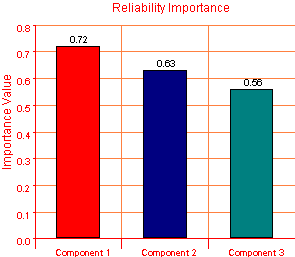
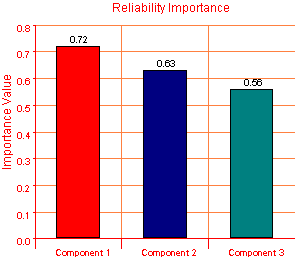
Consider a series system of three components, with reliabilities of 0.7, 0.8, and 0.9 at a given time, t. Using Eqn. (1), the reliability importance in terms of a value for each component can be obtained. The reliability importance values for these components can be calculated using ReliaSoft’s BlockSim. By using the BlockSim plot option and selecting a Static Reliability Importance plot, the graph in Figure 1 can be obtained.
Figure 1: Static Reliability Importance Plot
The values shown for each component were obtained using Eqn. (1). The reliability equation for this series system is given by:
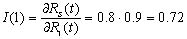
Taking the partial derivative of Eqn. (2) with respect to R1 yields:
Thus the reliability importance of Component 1 is 0.72. The reliability importance values for Components 2 and 3 are obtained in a similar manner.
Time-Dependent Reliability Importance
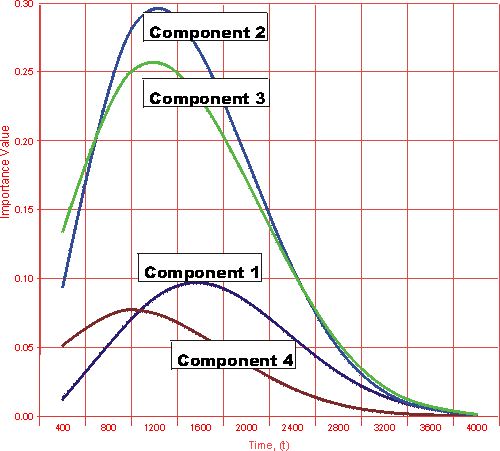
The reliability importance of a component can be calculated at a specific point in time or over a range of time. In the previous example, time-dependency was not considered. However, as demonstrated in Eqn. (1), the reliability importance of a component is a function of time. Another way to look at it is to generate a plot of Reliability Importance vs. Time. With this plot, the reliability importance of the component as a result of the behavior of its entire failure distribution can be observed rather than the importance relating to just one point on the distribution. For example, Figure 2 illustrates the reliability importance vs. time for a four-component system. In this figure, it can be seen that at 400 hours, Component 4 has a higher reliability importance than Component 1 and at 1200 hours this is reversed. Therefore, the measure will vary depending on the time of interest to the analyst.
Figure 2: Reliability Importance vs. Time
Application to a Complex System
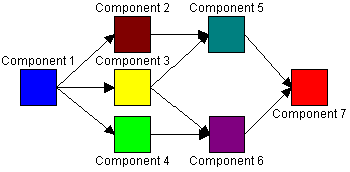
Consider the system shown in Figure 3. All components have the same reliability of 90% at a given time. The equation for system reliability obtained from BlockSim is given by Eqn. (3).
Figure 3: System Reliability Block Diagram and Reliability Importance Plot
Using Eqn. (1), the reliability importance was calculated and the results were plotted in Figure 3. Although the components are identical, their reliability importance is different. This is due to their unique positions within the system. When calculating the reliability importance of a component, its failure properties as well as its system properties are considered.
In any organization there are many departments that must work closely with other departments. One vital partnership is maintenance and the maintenance storeroom – nothing is more important than getting the right parts at the right time to achieve a high level of maintenance effectiveness. While this partnership is vital, it is difficult to develop and maintain because it requires a high level of discipline and determination by both parties. This article covers the dual responsibilities required to achieve success.
In any organization there are many departments that must work closely with other departments. One vital partnership is maintenance and the maintenance storeroom – nothing is more important than getting the right parts at the right time to achieve a high level of maintenance effectiveness. While this partnership is vital, it is difficult to develop and maintain because it requires a high level of discipline and determination by both parties. This article covers the dual responsibilities required to achieve success.
In a race to differentiate, FMs are turning to technology to optimize asset management, workflow automation, auditing and reporting, energy management, and many other O&M functions. However, there are several roadblocks that hinder the optimal use of technology and the smooth expansion of FM operations across client portfolios. Let's closely examine these common tech roadblocks and explore effective strategies to navigate them.
In a race to differentiate, FMs are turning to technology to optimize asset management, workflow automation, auditing and reporting, energy management, and many other O&M functions. However, there are several roadblocks that hinder the optimal use of technology and the smooth expansion of FM operations across client portfolios. Let's closely examine these common tech roadblocks and explore effective strategies to navigate them.
The cost of maintaining the status quo is enormous. The status quo affects each and every one of us every hour of every day, at work and at home. We have come to accept doing nothing as a safe and acceptable alternative. We even make it the default solution. Doing nothing is the management equivalent of a baby’s soother. It makes us feel safe and comfortable. But there is a cost to doing nothing.
The cost of maintaining the status quo is enormous. The status quo affects each and every one of us every hour of every day, at work and at home. We have come to accept doing nothing as a safe and acceptable alternative. We even make it the default solution. Doing nothing is the management equivalent of a baby’s soother. It makes us feel safe and comfortable. But there is a cost to doing nothing.
The new general manager at Doe Run’s South-east Missouri Mining and Milling Division determined that inaccurate and incomplete maintenance data was a major contributing factor preventing effective management of maintenance costs. Management then decided to obtain the necessary knowledge and tools which would allow implementation and operation of an effective maintenance management program. The company chose to pilot a program at one of the mines, and depending on its success, the program would be expanded to other areas within the division.
The new general manager at Doe Run’s South-east Missouri Mining and Milling Division determined that inaccurate and incomplete maintenance data was a major contributing factor preventing effective management of maintenance costs. Management then decided to obtain the necessary knowledge and tools which would allow implementation and operation of an effective maintenance management program. The company chose to pilot a program at one of the mines, and depending on its success, the program would be expanded to other areas within the division.
It is often said that "what gets measured gets done". And getting things done, through people, is what management is all about. Measuring things that get done and the results of this effort is an essential part of successful management, but too much emphasis on measurements, or the wrong measurements may not be in your company's best interests.
It is often said that "what gets measured gets done". And getting things done, through people, is what management is all about. Measuring things that get done and the results of this effort is an essential part of successful management, but too much emphasis on measurements, or the wrong measurements may not be in your company's best interests.
Facility managers need to ask themselves – What are the new energy paradigms that we must acknowledge, and what past practices are no longer smart or relevant? How can volatility be mitigated, and what strategies can be used to ensure it is not a major driver in rising operating costs?
Facility managers need to ask themselves – What are the new energy paradigms that we must acknowledge, and what past practices are no longer smart or relevant? How can volatility be mitigated, and what strategies can be used to ensure it is not a major driver in rising operating costs?
So, if you’ve had this discussion, which you will have at some point in your career, and if you haven’t heard it a hundred times already, you need to reduce maintenance costs. Have this discussion – how do we do this? What happens in most places is that maintenance cost X this year, last year it was X minus 5%. Why do we do that? Well, this year we have this big rebuilding of boilers…
So, if you’ve had this discussion, which you will have at some point in your career, and if you haven’t heard it a hundred times already, you need to reduce maintenance costs. Have this discussion – how do we do this? What happens in most places is that maintenance cost X this year, last year it was X minus 5%. Why do we do that? Well, this year we have this big rebuilding of boilers…