
Chaos is Inevitable — Panic is Optional
Ahmed Rezika, SimpleWays OU
Posted 4/2/2026
Maintenance is not a controlled environment, no matter how structured we try to make it. Systems are designed, procedures are written, and risks are assessed, yet reality always finds a way to introduce the unexpected. Equipment fails without warning, conditions change faster than anticipated, and sometimes multiple issues collide at the worst possible moment. Over time, you realize that chaos is not a rare event in maintenance; it is part of the landscape we operate in.
In those moments, what makes the real difference is not the failure itself, but the reaction that follows in the first few minutes. Before any tool is opened or any data is analyzed, people look for direction, tone, and control. A single reaction can either stabilize the situation or amplify the disruption, and that reaction often spreads across the team faster than any technical instruction.
This is where the role of the maintenance practitioner quietly shifts. Beyond technical expertise, there is an unspoken responsibility to become the center of the situation—to absorb pressure, organize thinking, and guide others through uncertainty. It is not about hiding the seriousness of the problem, but about presenting it in a way that allows safe and effective action.
At the core of every critical situation lies a simple but non-negotiable priority: protect people first. Business continuity, production targets, and recovery plans all depend on this foundation. When safety is preserved and decisions are made with clarity, even the most complex situations can be contained without lasting damage.
In recent years, digital tools have become an essential part of maintenance work, evolving from simple execution systems to intelligent assistants. However, these tools do not replace human judgment; they reflect it. The way we interact with them—our clarity, our urgency, even our tone—shapes the quality of the outcomes they produce. They amplify what we introduce to them. Their target is to serve our direction. So, we need to be wise about the direction we choose. [1]
All of this leads to a final realization: calm is not a personality trait that some people have and others do not. It is a skill, developed through experience, awareness, and deliberate practice. In maintenance, where pressure is unavoidable, the ability to remain composed becomes one of the most valuable capabilities a professional can build.
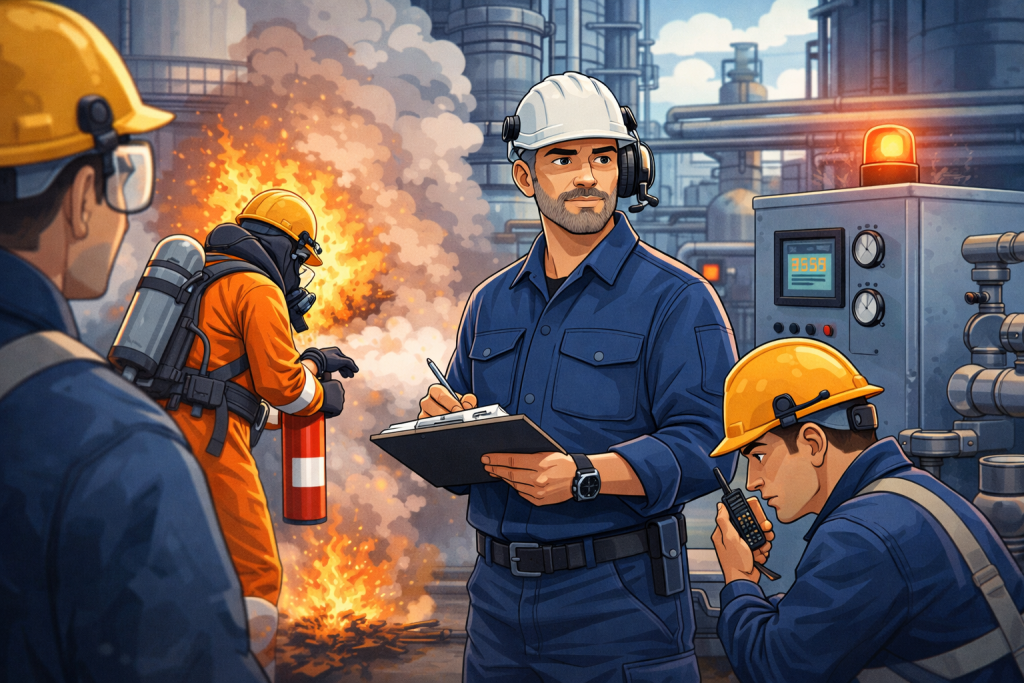
Chaos is Part of the System, Not a Failure of It
The idea that a well-maintained system should not fail is comforting, but it is not realistic. Even the most robust equipment operates under stress, variation, and hidden conditions that cannot always be predicted. Materials behave differently from one batch to another, environments shift, and human interaction introduces variables that no procedure can fully eliminate. What we often call “unexpected failure” is, in many cases, simply a risk that was present but not taken into account.
This becomes even more evident in complex operations, where systems are interconnected and dependencies are layered. A minor deviation in one area can trigger a chain of effects elsewhere, often in ways that are not immediately obvious. A cable overheats in one section, a transformer reacts abnormally in another, or a process behaves differently because of a subtle change in input. None of these events exist in isolation, and their combination is what creates the feeling of chaos.
Failure is not the exception. It is part of the design. Maintenance in its core is all about managing failure symptoms. Then, managing failures if they occur.[2]
Real-world experience reinforces this understanding. Fires in cable trays, unexpected grounding of major transformers, or the introduction of contaminated material into a process are not theoretical scenarios. They happen -and I faced them personally during my career years – , sometimes despite strong controls and experienced teams. What matters is not the fact that they occur, but how quickly they are recognized and how effectively they are contained.
Turning Chaos Into Controlled Response: A Practical Mindset for Industrial Failures
- Accept disruptions as manageable situations, not unexpected failures — this removes emotional shock and enables clearer thinking.
- Shift focus from prevention-only thinking to active, composed crisis management.
- Build team habits around flexibility and pressure performance, not just stable-condition procedures.
- Train teams to expect variation and anticipate system interactions.
- Acknowledge that not every failure scenario will match a manual — adaptability is a core skill.
- Measure resilience by the quality of response, not the absence of failure.
In the end, maintenance is not about creating a world where nothing goes wrong. It is about decreasing Failure probability then operating effectively in a world where things sometimes do fail. Accepting this reality is the first step toward mastering it, because it allows you to focus on what truly matters when the moment comes.
The First Five Minutes: Where Outcomes Are Decided
In those moments, what makes the real difference is not the failure itself, but the reaction that follows in the first few minutes. Before any tool is opened or any data is analyzed, people look for direction, tone, and control. A single reaction can either stabilize the situation or amplify the disruption, and that reaction often spreads across the team faster than any technical instruction.
The first five minutes of any critical event are rarely about solving the problem in full. They are about defining how the problem will be approached. In that short window, priorities are set, roles begin to take shape, and the overall direction is established. If confusion dominates those early moments, it tends to persist. If you ever heard about the The 5-second window Coined by Mel Robbins — the brief moment between the instinct to act and the brain’s suppression of that action. In crisis response, acting deliberately within this window prevents reactive, emotionally driven decisions from taking hold [3]. If clarity is introduced early, it creates a structure that supports everything that follows.
What makes this phase particularly sensitive is the way people respond under pressure. In uncertain situations, individuals do not only rely on procedures; they look for signals from those around them. Tone of voice, body language, and the speed of reactions all become indicators of how serious the situation is and how it should be handled. This is where emotional response becomes operational reality.
Panic, in this context, is not just an internal feeling. It is a multiplier. When one person reacts with urgency and lack of structure, others tend to mirror that behavior. Instructions become fragmented, communication overlaps, and important details are either missed or misunderstood. The situation itself may be manageable, but the way it is handled begins to introduce additional risk.
The first reaction defines the next outcome.
On the other hand, a controlled response has an equally powerful effect. When someone takes a moment to assess, speaks clearly, and sets immediate priorities, the environment begins to settle. People align more easily, actions become more deliberate, and the flow of information improves. Even if the problem remains complex, it is no longer chaotic in the same way.
This is why experienced maintenance professionals often appear slower in the first seconds of a crisis – I practiced this for years and it makes a huge difference in guiding the team to a safe shore- . In reality, they are not slower; they are more intentional. They understand that reacting instantly without structure can create more problems than it solves. A brief pause to observe, confirm, and prioritize often saves significant time and prevents escalation later.
The first decisions do not need to be perfect, but they must be clear. Typically, they revolve around a few critical questions: Is anyone at risk? What needs to be isolated? Who is responsible for what action? These questions create a simple framework that allows the team to move forward without unnecessary confusion.
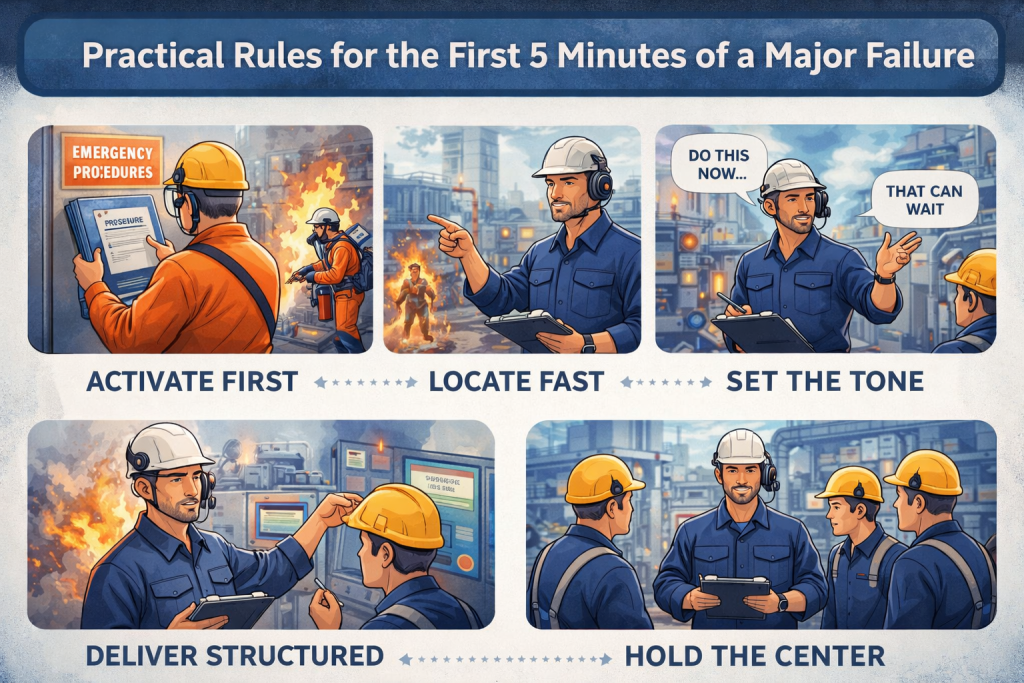
Practical Rules for the First 5 Minutes of a Major Failure
- Activate first, assess second — immediately identify and apply the relevant emergency or contingency procedure before anything else.
- Locate the right procedure fast — scan what is available, pick the closest match to the situation, and start there.
- Set the tone deliberately — your first visible reaction signals direction to the team; stay controlled, stay focused.
- Deliver structured communication — say what is needed now, defer what can wait; avoid both information overload and silence.
- Hold the center — a calm, coordinated start reduces the recovery cost later; a chaotic start requires extra effort just to regain ground before the technical work can even begin.
In the end, these first moments are not about fixing the failure. They are about shaping the conditions under which the failure will be addressed. When handled well, they transform a potentially overwhelming situation into one that can be managed step by step.

Digital Tools Don’t Replace You — They Reflect You
In recent years, digital tools have become an essential part of maintenance work, evolving from simple execution systems to connected platforms and intelligent assistants. They help us access information faster, structure workflows, and even suggest actions based on data. In stable conditions, their value is clear and measurable. However, their role becomes even more interesting when operations move into moments of stress and uncertainty.
In those first critical minutes, when pressure rises and decisions must be made quickly, digital tools do not operate in isolation. They respond to the way they are used. The clarity of the input, the structure of the request, and even the tone behind the interaction begin to influence the quality of what comes back. Unlike traditional tools that simply execute commands, modern systems—especially those enhanced with AI—interact in ways that mirror the user.
This creates a subtle but important shift. The tool is no longer just supporting the task; it is amplifying the state of the person using it.
When urgency turns into agitation, inputs become fragmented. Questions are rushed, context is incomplete, and the output reflects that lack of structure. The result is often more noise than clarity, which adds to the pressure rather than reducing it. On the other hand, when the same tool is approached with a composed and structured mindset, the interaction becomes more effective. Questions are clearer, information is better framed, and the responses tend to be more relevant and actionable.
Traditional Tools execute. Modern tools reflect.
This does not mean that digital systems are unreliable. On the contrary, they are highly capable when used well. But their effectiveness is closely tied to the quality of human engagement. In high-pressure situations, they can either reinforce confusion or strengthen clarity, depending on how they are approached.
This is where the connection to our earlier discussions becomes evident [1]. Digital skills are not only about knowing where to click or how to configure a system. They also involve knowing how to think, frame, and communicate under pressure. The interaction between human and tool becomes a feedback loop, where each influences the other.
There is also a psychological dimension to this interaction. Under stress, the human brain tends to narrow its focus, prioritize speed over structure, and react based on immediate perception rather than deliberate reasoning. When this state drives the use of digital tools, the outcome often reflects those same limitations. The tool is not causing the problem, but it is not correcting it either.[4]
In contrast, a composed mindset allows for broader awareness and better organization of information. This leads to more effective use of any supporting system, digital or otherwise. The tool becomes an extension of structured thinking rather than a channel for reactive behavior.
This is why digital transformation in maintenance cannot be separated from human behavior. Technology can enhance capability, but it does not replace judgment. It can accelerate decisions, but it does not ensure they are the right ones. In moments of pressure, it becomes clear that the tool is only as effective as the state of the person using it.
The real question, then, is not whether digital tools are powerful enough. It is whether we are centered enough to use them effectively when it matters most.

The Maintenance Practitioner as the Stabilizer
In critical moments, teams do not only look for technical answers; they look for signals of control. This is a natural human response. Under stress, attention narrows and uncertainty increases, so people instinctively align around the individual who appears most composed. Psychology describes this as emotional contagion, where the state of one person spreads across the group and begins to define collective behavior.
When a maintenance practitioner remains calm, structured, and deliberate, that state becomes the reference point for others. It slows down reactions, reduces unnecessary noise, and creates space for clearer thinking. This is not about personality or authority, but about presence. The ability to regulate one’s response in the moment directly influences how the entire situation unfolds.
“Control is not loud. It is structured.”
A trusted practitioner does not ignore the seriousness of the situation, nor do they hide uncomfortable truths. Instead, they sequence reality in a way that people can act on safely. Safety & Urgent risks are addressed first, responsibilities are clarified, and communication is kept focused. This approach aligns with how the brain performs best under pressure, when information is limited, ordered, and actionable.
In the end, the stabilizer is not the one who solves everything immediately, but the one who makes it possible for the right actions to happen. By managing their own response, they manage the environment itself—and that is often the difference between escalation and control.
Must-Know Jargon
Functional failure – RCM: The inability of an asset to meet a required performance standard. RCM distinguishes between the function (what the asset must do) and the failure (when it can no longer do it).
Reliability-Centered Maintenance (RCM): A structured methodology that treats failure as an expected system variable rather than an anomaly. It focuses on managing the consequences of failure, not eliminating failure itself.
Contingency procedure: A pre-defined, documented response plan activated when a specific failure or emergency condition occurs. It is the first tool to reach for in the initial minutes of a major disruption.ows, uncovering friction points, and validating organizational readiness before enterprise expansion.
Cognitive tunneling: A stress-induced narrowing of attention where the brain locks onto one element of a situation while neglecting others. Under industrial failure conditions, it causes operators to miss critical signals outside their immediate focus.
Emotional contagion: The automatic, unconscious process by which one person’s emotional state spreads to others through facial expressions, posture, voice, and behavior. In a failure scenario, a leader’s first visible reaction sets the emotional tone for the entire team. training, stakeholder alignment, and leadership reinforcement to ensure the tool becomes embedded in practice—not just deployed technically.
The 5-second window- An entry to the first 5 minutes after major failures: Coined by Mel Robbins — the brief moment between the instinct to act and the brain’s suppression of that action. In crisis response, acting deliberately within this window prevents reactive, emotionally driven decisions from taking hold.
References
1- Ahmed Rezika, “Navigating the AI Frontier: Balancing Innovation and Caution in Maintenance” MaintenanceWorld.com, October 1, 2024, https://maintenanceworld.com/2024/10/01/navigating-the-ai-frontier-balancing-innovation-and-caution-in-maintenance/
2-F. Stanley Nowlan & Howard F. Heap, “Reliability-Centered Maintenance” — U.S. Department of Defense, 1978 Report No. AD-A066579, https://apps.dtic.mil/sti/html/tr/ADA066579/index.html
3- Robbins, M. The 5 Second Rule: Transform Your Life, Work, and Confidence with Everyday Courage, 2017. https://www.melrobbins.com/book/the-5-second-rule/
4- Shiva Pooladvand et al. “Impacts of Stress on Workers’ Risk-Taking Behaviors: Cognitive Tunneling and Impaired Selective Attention.” Journal of Construction Engineering and Management, 2023, https://www.researchgate.net/publication/372812823_Impacts_of_Stress_on_Workers’_Risk-Taking_Behaviors_Cognitive_Tunneling_and_Impaired_Selective_Attention/
Related Articles

RCM or not? Are you shooting mosquitos with a big cannon?

Continuous Improvement Leadership: Accelerating Your Success Part II

No Part Left Behind: 4 Simple Rules for Efficient Inventory Management
The Godfather of Reliability: Christer Idhammar
Durability Meets Innovation: Exploring BRUTE’s Toughest Solutions for Manufacturing & Industrial Settings

30-60-90 Day Plan for New Maintenance Managers